September 10, 2015

My Continuing Crisis ENDS: Writing on CRISIS ON INFINITE EARTHS 12


IT COMES TO AN END...

As some sort of "self-flagellation psychological experiment", I agreed to take part in Comics Bulletin's celebration of the 30th anniversary of DC Comics' FIRST MAJOR CROSSOVER EVENT, Crisis on Infinite Earths.


Say what you will about superhero comics, the truth we’ve all learned from this experience is that they are all always the same. You can dress them up however you want, but in the end it’s all about solving problems by punching them and imposing one type of moral structure upon another. It’s as predictable and as hollow as the Cena/Orton rivalry became after a while, and the awe-like entertainment it once provided either switches into feeding a habit or drugging you from having to make interesting choices.
Superheroes are the heroin of comics. Crisis just showed that your dealer has more stamina than you.

September 8, 2015

Battle Cries and Champagne Just in Time for Sunrise -- A Review of CASANOVA: ACEDIA #4

SEE REVIEWS OF PREVIOUS ISSUES OF CASANOVA: ACEDIA:

Of the many things we ‘are’ at any given moment -- the man who hates what he has become -- is -- no kind of man at all.” -- Akim Athabadze’s father


Who’ll love Aladdin Sane?” -- David Bowie


Daniel Elkin: Casanova: Acedia #4 is out and, my god, it’s a thing of beauty. Fabio Moon has taken control of this issue, fully and fundamentally, in such a manner that Matt Fraction’s words end up in service of these pages. It’s as if they were going old school Marvel style and Moon took that guiding principle and set off a radiant and angelic art bomb.


I could wallpaper a fetid Appalachian outhouse with these pages and turn it into Trump Tower.


It’s that beautiful.


But fawn and drool as I will over what Moon has put forth, I must remain critical of the package. There are indeed sounds to go along with these visions, and therein I can be objective.


Casanova: Acedia #4 is the flashback issue you didn’t realize you were demanding! Here it is the story to tell of a young Akim Athabadze who became the man he was because of the childhood he endured.


Slam! So it wasn’t a game, cracking all the mirrors in shame.


This is a brutal tale of retribution and unleashing. Young Athabadze sees the horror of the world only to become the horror himself. But it is a crown that sits uneasily upon his head. Millions weep a fountain, just in case of sunrise. He is the man who hates who he has become, the man his father warned him about. He’s the cracked actor, spouting the lines he wished he never memorized, written by the revulsion that is the will to power.


He’s waiting in the wings. He speaks of senseless things. His script is you and me, boys.


This is visceral stuff that would turn the stomach of even a Lady Grinning Soul were it not for Moon’s triumphant art. It redeems the repulsion in an almost sensual manner with Cris Peters’ coloring laying belief on you, wrapping it all up in a skin sweet with musky odor.


Casanova: Arcadia #4 sits like a man but it smiles like a reptile. It bites on the neon and sleeps in a capsule. This issue raises the bar even further. It loves to be loved … and I love it.


Jason Sacks: And I love it too, Elkin.

There’s an intensely painful quality in Acedia #4, the quality of a life lived full of compromise, with violence as a constant companion and betrayal a constant threat. There are betrayals of different sorts in this issue, but the most painful betrayal we read about is the one that’s most corrosive of the soul: the betrayal of self.


What we witness in Acedia #4 is the continual, despairing letting go of self. It’s the fulfillment of the prophetic words of Akim’s father: “Of the many things that we ‘are’ at any given moment -- the man who hates what he has become is no kind of man at all. Do you understand? No other rules in this life. Of all the things we control, who we are remains sacrosanct.” Those words of wisdom are shared one brilliantly composed panel before the father is shot (in a gorgeously staged off-panel deal, I should add, a panel all the more poignant for its brutal simplicity).


At the end of the issue, after all time Akim spends running around with girls, and all the rules he learns about guns, the time he spends in kennel cages and the time spent he spends torturing enemies, we’re greeted with a scene in which Akim has to confront his true self and determine who he really, truly is inside. And in doing so, Akim provokes all of us to wonder what we would do in that circumstance. We have to wonder how we would react if we were him.


Of course all of this is gorgeously rendered by the luminous Moon, with perfectly composed scenes that threaten tear your guts from your body in wrenching sobs at the same time that they illuminate the majesty of comic art at its apotheosis. You’re right, Daniel. This art is triumphant. I want to luxuriate in it, even when the scenes repel me..

This issue is a bar raiser indeed.

September 7, 2015

Finding the Sound of The Self: A Review of 101 ARTISTS TO LISTEN TO BEFORE YOU DIE by Ricardo Cavolo


While it has been said that there is a soundtrack to everyone’s life, I think this statement is misleading. Music is not the backbeat to our daily lives, it is sound of the self. I insist that the music we love defines us completely, while also, of course, allowing for community. As much as our “taste” is a product of our environment, music somehow is a personal testament to the person we are, even more so than the person we want others to think us to be.

I bring this up as a result of reading Ricardo Cavolo’s new book 101 Artists To Listen To Before You Die, recently published by NoBrow Press. I also bring this up because while both Jason Sacks at Comics Bulletin and David Fairbanks at Loser City have both written tremendous reviews of this book, neither of them seemed to point out the role music plays in our development of self.

Fairbanks and Sacks have examined this book from an outsider’s perspective, spending most of their reviews scrutinizing the personal nature of Cavolo’s almost poetic mini-essays about his choices, how they are revelatory of Cavolo’s subjective taste. They also examine his beautiful outsider art portraits that hallucinatory punctuate this book, adding even more of a singular personality to 101 Artists To Listen To Before You Die. What is missing from these reviews, though, is what the totality of the book adds up to, and what deriving meaning from that exploration means universally.

Music is the litmus towards how we conceive ourselves. I mean this absolutely. Would I be the man I am today if I had not, at a pivotal moment in my life, listened to Black Angel’s Death Song and the rest of that first Velvet Underground album? I had been trying other music on for definition up until that moment, but up until then they had all fit me like a cheap suit or the skin of another man. The moment I discovered the sounds Lou Reed, John Cale, Sterling Morrison, and Mo Tucker were making, I discovered myself. Not who I wanted to be or how I wanted to be seen by others, mind you, but my essential self.

And this is why music plays such a powerful role in all of our lives. We inhabit songs because they are us. The diary aspect of Cavolo’s book emphasizes this in subtle ways. We understand Cavolo because of his musical choices. His connection to the songs and bands that he examines in 101 Artists To Listen To Before You Die tells us directly who he is. By looking at the music that he loves, he lays himself naked before us.

Yeah, sure, music builds community as well. We hear about new bands from our peers and gravitate to music that people we like, like. But I posit that we gravitate to that music in the same way we have gravitated to the people recommending it. We see so much of ourselves in our friends. We should see as much of ourselves in our songs as well.

Ricardo Cavolo’s 101 Artists To Listen To Before You Die is a beautiful book, not just for its honesty and not just for its transcendent art. It is a beautiful book because it is a pure expression of self, celebratory and excited. It is the direction that autobiographical books can easily go towards in order to strip away the self-deprecation and the self-doubt and the self- loathing that we all swaddle ourselves in so often.

It reveals the light inside us, the large heart we contain, the song that we are.

Many years ago, Victor Hugo wrote, “Music expresses that which cannot be said and on which it is impossible to be silent.” What he was talking about, and what Cavolo perfectly captures, is that music is access to our souls. If the universe began with a word, humanity began with a song. And, oh, what a beautiful song it is that we sing.

You can pick up a copy of 101 Artists To Listen To Before You Die from NoBrow Press here.

September 4, 2015

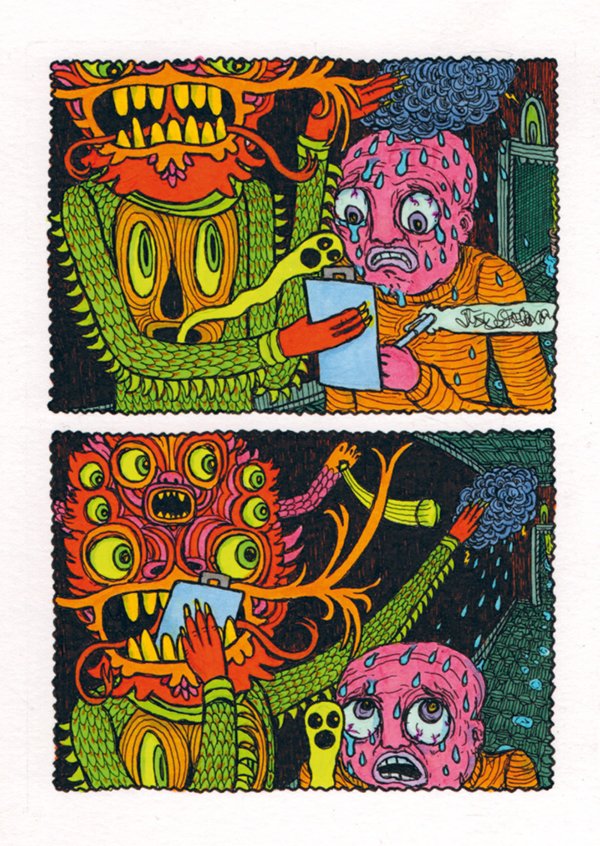
Derek Van Gieson is Selling some Original Art from EEL MANSIONS


If you know me, you know how much I love Derek Van Gieson's Eel Mansions.

A matter of fact, if things go as planned, I should have a new e-book out soon collecting all of the previous reviews of the first 6 issues I contributed to, as well as some sweet new stuff from Keith Silva, myself, and Van Gieson.

Anyway, I just found out yesterday that Van Gieson has put some 
ORIGINAL ART FROM THE SERIES up for sale.

Check out some samples below and then head on over to the whole collection


BTW, my birthday is in 18 days. Just saying....


August 31, 2015

Books In Bites 3: Three Comics Worth Your Attention

Quick Reviews of three books you may be interested in.
SUPERCAKES
by Kat Leyh
Published by Yeti Press
Available Here


On the back of Kat Leyh’s wonderful new comic SuperCakes, it says this book “touches on topics most ‘capes and tights’ comics wouldn’t even fly near.” I assume this has to do with the central relationship Leyh explores in this book. While operating within the “punch em in the face while quipping” superhero overlay, SuperCakes is really a book about May and Molly and their budding relationship.


May and Molly are in the early stages of falling in love and, in a way, their superheroic team-up reflects the bond they are building as they become vulnerable to each other. May is the character more comfortable in herself and her sexuality, and, as Tank, her powers are “super-strength and a degree of invulnerability.” She solves her problems head-on, not shying away from conflict or judgement, caring so little about what others think of her that at one point she even wears a knit hat shaped like a cupcake on her head as she fights an invasion of ice-monsters wrecking her city.


Molly, on the other hand, is seemingly younger, not yet fully accepting of who she is, slightly ill at ease with her role in the world and in her relationship with May. Her shape-shifting powers metaphorically reflect the nuances and subtle actions of a young woman unsure of herself coming out to the world and committing to love. But she can absorb energy, subsume blows and explosions, and use that which is directed against her to become stronger and turn it back on her enemies.


And that, in and of itself, is a dynamic statement.


Both of these women are empowered. Leyh makes that clear by not only casting them in the trope, but also by carefully choosing how they operate within it. Their relationship with each other is easy, gentle, and loving. These characters serve as role models certainly in terms of their heroics, but also in terms of how relaxed and attentive they are with each other.


SuperCakes is positive, fun, engaging, and inspiring. Leyh shows that issues of racial and sexual diversity don’t have to be shoehorned into comics as if they are something added on in hopes of placating naysayers or tapping into a market. SuperCakes succeeds because, although it is about superheroes, it is about real people first.


You can grab a copy of this great book here.


BIRTHDAY (mini kuš! #35)
by Theo Ellsworth
Published by kuš! komiksi
Available Here


Nothing makes more sense in the world than Theo Ellsworth being published by Latvian publishing house kuš! komiksi. Kuš! komiksi has been putting out wild and beautiful mini comics and larger anthologies for years now that have explored the edges of what is possible in comics, while introducing and celebrating some of the very best artists working in the medium.


The last time I wrote about the work of Theo Ellsworth, I said, “Structured logic comes unglued quickly in Ellsworth's art, and it's not fully replaced with a primal or visceral understanding either. Rather, it demands a different way of interacting with the material.” Ellsworth produces comics that are unique. Books which burrow into your soul as only something completely new to your experience can.


Birthday is what happens when you combine the editorial freedom of a publisher like kuš! komiksi and the purity of vision of an artist like Ellsworth. It explodes into being like a new universe is being created, and the ripples unleashed by it embrace you with beauty and with truth.


The solicitation of Birthday reads, “Our hero is insanely nervous. He's about to undergo an intense psychic initiation known as the Inner-Space Birth Ritual. You'd be nervous, too! Theo Ellsworth has faithfully documented our hero's bizarre experience in the pages of Birthday.”


What Ellsworth is able to accomplish in his art is project this experience directly into his audience. His tightly detailed and intuitive colored panels and pages transcend the paper they are printed upon and become an emotional energy that pushes into the heart of his audience. Your brain doesn’t process Birthday in a logical way. It makes sense of the narrative in an ecstatic and emotive understanding that is primal and holds you in an almost panicked state until the cathartic release at the end.


Ellsworth’s books are satisfying in a way no others are. They are psychoactive and to read one is to go through an experience that, while you are engaged in it, trips your vision into some other plane as if you have detached from the world around you. When you are done, though, and you return to your day-to-day, you carry with you new possibilities for seeing the life you have been living all this time.


You can pick up a copy of Birthday here.


THE JERNEGAN SOLUTION: A TRUE STORY
by Dan Mazur
Published by Ninth Art Press
Available Here


America is a country founded upon dreams of the impossible. For all its faults, there has always been an undercurrent of optimism and a belief that a fabulous future is just around the corner for everyone. This attitude has been responsible for all sorts of innovations and understandings that push us forward towards some brighter day, the green light, the orgastic future.


But this perspective has also been the fecund loam from which, throughout history, hucksters and charlatans have sprouted and thrived.


Dan Mazur’s The Jernegan Solution tells the story of this juxtaposition between American idealism and Americans who feed upon it.

Of The Jernegan Solution, Ninth Art Press says, “Based on true events that took place in Lubec, Maine in 1898: Prescott Jernegan, a respectable Baptist minister, arrives in town with his partners and investors, claiming to have invented a process which efficiently extracts gold and silver from the water. An enormous ‘gold factory’ is soon in operation, creating sudden prosperity and the biggest excitement the little fishing village has ever seen.”


The story is told through the eyes of a fictionalized newspaperman, a narrative choice that allows the reader access to an objective recounting of the events that took place at the turn of the 20th century in this small town in Maine, but also gives Mazur space to editorialize without any sort of condescending sermonizing. The reader gets caught up not only in the events as they unfold, but also the optimism of the narrator. It’s a perfect choice for the story, adding an emotional depth to its reportage.


Mazur’s research and attention to detail in his art bring the story to life, placing the reader in this specific time and place. For those with a passion for this time period, it tickles that historical curiosity perfectly. Mazur has infused this story with heart, even though its subject matter opens up much darker territory.


As much as we like to think of the American character as idealistic and bright, we also know that so much of our history is dotted with people who prey upon this for their own gain.  The Jernegan Solution is a reminder of this and Mazur has brought this little known bit of history out of the depths and into the light at just the right time -- a time of presidential campaigns where we once again start thinking about the direction we want our country to go and who we believe will best take us there.

You can pick up a copy of The Jernegan Solution here.

August 26, 2015

My Continuing Crisis: Writing on CRISIS ON INFINITE EARTHS 11


IT CONTINUES...

As some sort of "self-flagellation psychological experiment", I agreed to take part in Comics Bulletin's celebration of the 30th anniversary of DC Comics' FIRST MAJOR CROSSOVER EVENT, Crisis on Infinite Earths.


The narrative conceit that has been guiding this rudderless ship for so long has finally crested whatever intellectual wave it had been riding and has begun to surf the face of profundity. Infinite Earths have coalesced (seemingly) into one, leaving not only destruction in its wake, but also the clarity engendered by complete confusion. Heroes are left unsure of their purpose as much as they are unsure of their identity.
Wolfman is working in the world of what it means to be human and the nature of personality. He posits the a prioriassumption that our sense of self is initially derived from the sum of our experiences — that we are who we are due to everything that has happened to us along the way. He then brings to fore the question of what happens to an individual’s sense of who they are if all of those experiences are completely erased and the individual can no longer look to their past to understand their present.
What happens, at least in this ridiculous instance here in Crisis, is the individual confronts the abyss. They have, for lack of a more accessible lexicon, a complete existential breakdown.

August 24, 2015

“Mixing With Us Normal People” -- A Review of Pat Kelley’s FEDOR

Imagine a boy completely covered head to toe by a thick growth of silky yellow hair. Is he man or animal?”

Let’s face the truth. We are constantly making snap assumptions about people based on appearances. It happens all the time. In an instant.

According to an article published on the Association for Psychological Science website:

A series of experiments by Princeton psychologists Janine Willis and Alexander Todorov reveal that all it takes is a tenth of a second to form an impression of a stranger from their face, and that longer exposures don’t significantly alter those impressions (although they might boost your confidence in your judgments). Their research is presented in their article “First Impressions,” in the July issue of Psychological Science.

Read that again. A tenth of a second.

The reasons for this are myriad, but most of the research points to that basic survival mechanism constantly operating subconsciously in all of us. We need to decide as quickly as possible whether or not this individual may be the one who is going to shove an ice pick in our eye socket, and, if so, we need to be prepared to engage in either fight or flight.

The truth of this instantaneous impression making, though, has led to a number of home-spun fire-side adages like “never judge a book by its cover” or “all that glitters is not gold” or “there are daggers in men’s smiles” -- we know that sometimes our initial assumptions about people can be wrong, sometimes dangerously so.

Like Donald Trump.

Although, on second thought, he may be exactly what we think he is.

I promise I will get to the point, the review of Pat Kelley’s wonderful new book Fedor in just a moment, but indulge me just a little bit further first.

I’d like to tell the following story:

When I was very young I went to the Texas State Fair. At least I think it was the Texas State Fair. My memory is hazy on this point. I was really young. I vaguely remember being led by the hand by a young girl whom I gather I was friends with or something. I think she said something like, “Let’s go see the Freaks.” And she pulled me towards a small tent that, I think, was standing apart from the rest of the Fair. I kinda want to say that I asked her, “What are Freaks?” And I really want her to have said, “You know … weirdos. People not like you or me.”

I kind of remember her expressing disappointment when we found out that the only “freak” at the show that day was the Smallest Bearded Woman In The World. There is the thought that she paid for my admission. I pretty much remember not wanting to go in.

What I absolutely remember, though, was what greeted me inside.

Sitting in the middle of the tent on a chair was a tiny, wrinkled woman in a gingham dress. She had some straggly hairs emanating from her chin and cheeks and was looking down at the floor. As we stood in front of her, she looked up and looked me directly in the eye. The stare she gave me hit me hard as I was young and nobody had ever looked at me like that before. I remember her eyes clearly and now, with my adult sensibilities, I can interpret that look as one of anger, resignation, and sadness all in perfect balance, but as I child I just saw pain, the source of which I could not fathom. Because of my upbringing, all of my innocent empathy naively flowed back to her at the same time I became petrified by what was happening. It was a colossal moment in my childhood as fear and sympathy got tangled up in confusion and powerlessness.

Then the girl I was with pointed at this small woman sitting in the chair and yelled, “FREAK!” The small woman’s eyes shifted and a weird smile cracked on her face. The girl crushed my hand in hers and, with one of those scream laughs that only children can muster, she pulled me out of the tent.

I remember crying. I don’t remember anyone asking me what was wrong or comforting me.

Looking back at that memory now, I realize that I was connecting with the humanity of the woman in the chair while the girl I was with was seeing her as an object, a show, a freak.

Needless to say, my relationship with those who are “odd”, “off-beat”, “different”, or “weird” has been complicated every since.

All of which brings me now, finally, to the review promised in the title of this piece.  

Pat Kelley’s new book from Hic + Hoc Publications, Fedor, is, at its heart, a sweet and satisfying love story that spans 20 years at the turn of the 20th century. It tells of the fictional romance between the real Fedor Jeftichew, a young man who was famously given the stage name Jojo the Dog Faced Boy by P.T. Barnum, and the fictional Helena, “the perfectly normal daughter” of a bearded woman and an alligator man who later chooses to cover herself from head to toe in tattoos.

Yes. As much as it is a love story that fits into the historical romance genre, it is also a story about “freaks”. And, in this, Fedor transcends its genre to offer something more, something true and universal. It’s something that I directly related to given my story above, but it’s also something we can all relate to if we are at all human beings.

This is a book about connecting as much as it is a book about outsiders. It touches on questions of identity and appearances, but also sacrifices and longing. Kelley’s beautiful and light cartooning adds a distance to its heavy subject matter, and the brown watercolor washes that cover every page augments both its historical conceit and its sense of grounding in the real world.

While the concept of “the other” is explored to a degree, as it must when a narrative revolves around “Freaks”, Kelley uses this theme to add emotional heft to the central love story. Certainly Fedor and Helena have an outsider’s life (“You shouldn’t be out in the real world like this. Mixing with us normal people”) and, as such, are able to make commentary on the traditional social order, but it is their “otherness” that magnifies what they share, together, while it also provides the dramatic crux and keeps the reader on their side regardless of what happens.

For once not let anything get in the way” is the tagline to this story moreso than anything else.

Kelley emphasises this by playing with time. Events are not told in chronological order, but rather are arranged to accentuate the dramatic tension. Kelley interrupts the flow of the narrative with flashbacks as a way of developing character and assert the emotional core of the story. Because of this, Fedor requires a bit of a careful read, but that sort of active participation brings the reader further into the story.

Fedor is almost like a “What if” fanfic that tells its tale with humor, heart, and soul. You are constantly rooting for these characters as they come together and the final panel is rewarding in a deep and graceful way. By using “Freaks” to tell a truly human story, Pat Kelley is being subversive while being inclusive.

In a way, Pat Kelley has created a book for the boy that I was when I stood there in the tent, but really, he has created a book for the man I am today. I think he’s made this book for you too.

You can (and should) pick up a copy of Fedor from the Hic + Hoc store.