Showing posts with label Koyama Press. Show all posts

September 9, 2019

Substitute Life: Rob Clough reviews STUNT by Michael DeForge


Michael DeForge's new book, Stunt, marks the end of an era. A decade ago, Annie Koyama published the first issue of his series Lose, which established him as a major young talent. A decade later, this prodigy's career has been notable for its unpredictability and commitment to constantly evolve. Stunt is DeForge's final book with Koyama before she shutters Koyama Press in 2021 and it's a book that recapitulates many of his career-long themes in a compact, powerful space. DeForge has always been interested in unusual formats and designs for his work, and, true to form, Stunt is printed landscape-style, with dimensions of 8" x 3". It's in black and white with extensive use of blue tones, reflecting that it's set in the world of movies. Not unlike Dan Clowes' Ghost World, the blue indicates the flickering blue light of TV or movies.
This simple story has all of the typical DeForge hallmarks: body horror and dysmorphia, identity warping, bold sexuality, and grappling with the ideas of public vs. private. Setting all of this in Hollywood amplifies these themes. A nameless stuntman is the narrator of Stunt, working on a set with an action blockbuster superstar named Jo Rear. The plot involves the stuntman working with Rear on an action movie shoot, then being flown out to L.A. to act as Rear's full-time body double. The nature of what he does as Rear's replacement gets deeper and weirder as the book proceeds until it concludes in a nihilistic fashion that is entirely consistent with the book's themes. The ways in which their personas shift and warp into each other, focusing more on their bodies than their actual personalities, dominates the visual narrative. The stuntman is very much an unreliable narrator in this regard, understating or ignoring the actual events he is a part of.
DeForge's use of language, though seemingly banal at times, is actually extremely precise. The first line of the book, "I worked as a stunt man. I kept fit." is notable because it's in the past tense and it refers to his body, first and foremost. In the context of the book, the stuntman has no other identity other than being a body. He is not only just a body but an expandable one at that; he fantasizes about dying in a stunt accident, noting right away that he has tried to commit suicide before but failed. So he remains "open" to accidents, but one dark fantasy of his is that instead of dying in a failed stunt, the actual star of the movie dies instead. He achieves a moment of fame only because everyone blames him, but at least he takes solace in knowing that he was on camera in replacing the star.
The bulk of the book, wherein the stuntman is Jo Rear's body double, is indeed a kind of "stunt": a prank, or a piece of performance art. If the stuntman wants to kill himself, then Rear wants to commit career suicide. In neither instance is it revealed why they want things to end, just that they do. The duo prove to be perfect collaborators, as the stuntman doesn’t have the agency to kill himself, and the actor doesn’t have the courage to end his own career. He is used to having people step in for him and do his dirty work, so why stop now? He is an actor, after all, used to pretending. The stuntman finds the experience freeing and exhilarating, as he is willing to go to extreme lengths to pull off the sort of public stunts that draw outrage.
The themes of duality, obsession, and the idea of two people somehow combining to form one all remind me of the Ingmar Bergman film Persona. Some of the plot details are different, but there's a lot that's similar. In some ways, Stunt perhaps acknowledges that influence and deliberately moves its tone in a funnier but equally dark direction. Persona is a film about the relationship between two women (an actress and her nurse caretaker) who are in isolation together. Childbirth is at the heart of the central conflict, as one woman has a child but doesn’t want him while the other woman desperately wants to have a child. In that isolation, and because of their physical similarity, there is an attraction between them that is narcissistic. It is an obsession with one's own self or falling in love with a slightly warped mirror version of oneself. In both cases, there is a hierarchy in place; Persona's actress is famous and has a child, and the nurse is clearly in a servile role. In Stunt, Jo Rear is a famous actor, and the stuntman is there because he's been hired to do a job. In both cases, the servants transcend their relationships to some extent in the way that their bosses come to be obsessed with them, or rather obsessed with them because they are obsessed with their own reflections. They are also obsessed with the other person because they see the possibilities of a different life path in them. In Stunt, you also have someone who yearns to create in the stuntman vs. someone who rejects being a creative force altogether.
At a certain point in Stunt, Jo Rear gets what he wants. His plan of total public degradation almost backfires, as the public grows more interested when they think it is a publicity stunt (and with the antics of actors like Joaquin Phoenix and Charlie Sheen, anything is possible). Eventually, the public loses interest. At that point, all that's left are the actor and the stuntman, and all they have to do together is "work on our bodies." This is one of many clever turns of phrase with multiple meanings from DeForge. The duo does indeed completely abandon the life of the mind and creativity in favor of exercise (an act the stuntman earlier refers to as "beating my body into submission"), but that later sequence features the stuntman's banal, dispassionate narration with ten pages of them having passionate sex. They are "working on their bodies" in more ways than one, but the question remains as to what it means. Is this a genuine connection, or more an act of masturbation?
In the end, when Jo Rear chooses his final stunt to be his suicide, the stuntman is happy to go along with it. He's not even getting paid but he "was more than happy to work for exposure." I laughed out loud at that line, one of many dark laughs in Stunt because DeForge is riffing on the idea of artists working for so-called exposure instead of getting paid. However, all the stuntman craves at that point was exposure; he wants an audience, to be thought of as creative. In the final frame, the stuntman knows that he's been cheated out of everything he wants. It may be his death, but he's been robbed even of that agency since everyone assumes it's Jo's: "In my last few moments, I pictured the scene: Oh, how I wished it was me! If it could only be me...!"
DeForge's work fuses many genres, but psychological and body horror have always been his main areas of interest. Persona was described as a "psychological horror" film, and that's very much the case here, albeit frequently leavened by humor, satire, and DeForge's well-developed sense of the absurd. The twisting, warped character of his line defies the "beautiful people" aspect of Hollywood, but DeForge is careful to capture the visceral, sweaty quality of the bodies of the main characters, sometimes to the point where they are no longer identifiable as actual people, just a mass of "knotted muscle and pools of sweat", which happened to be the ultimate suicide fantasy for the stuntman. The only imperative that the actor ever gives him is to "keep fit." Neither one of them is ever recognized for their inner lives: one is just a face, the other just a body. Neither makes choices to assert themselves otherwise in any kind of positive way, which brings us to the book's most essential theme: the traps in which mental illness can ensnare us. The stuntman is deeply depressed and suicidal, and he is only alive because he doesn’t feel he has the ability to kill himself. The actor is also clearly depressed and feels trapped by his life, but he is also a sociopath. Instead of taking responsibility for his actions, he literally takes the life (in all sense of the term) of another to escape. To where, and to do what? It doesn’t matter. This is another level of the horror of the book: that the actor is a sucking void of nihilistic narcissism and that the stuntman is sucked up into it.
Stunt is a fitting farewell for DeForge's work with Koyama Press. While it is a visceral, uncomfortable experience to read, DeForge's sense of restraint never sees him overplaying his hand. One can see DeForge's evolution as an artist at work in Stunt, because while his early work was powerful, he also tended to let the reader have it with both barrels. Every work since has been subtler and more refined in terms of its themes and execution, even as his art has become more abstract and grotesque. DeForge's work has become increasingly ambiguous, especially with regard to his stories' resolutions. While carefully crafting his narratives to create certain kinds of reactions, DeForge always leaves room for the reader to interpret the work on any number of levels. Stunt's horror is effective precisely because it is unsettling on psychological, existential, and emotional levels.
------------------------------------------------------------------------
Rob Clough has written about comics for Cicada, the Comics Journal, Sequential, tcj.com,sequart.com, Savant, Foxing Quarterly, Studygroup Magazine, as well as for his own blog, High-Low (highlowcomics.blogspot.com).

September 5, 2019

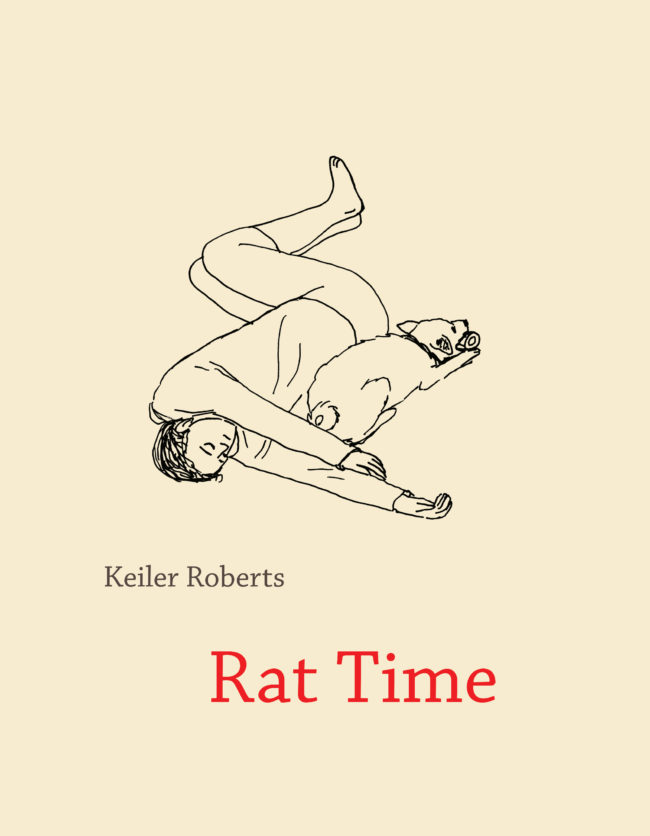
Tears Of A Clown: Rob Clough reviews RAT TIME by Keiler Roberts


There is a subtle tonal shift in Keiler Roberts' latest collection of autobiographical vignettes, Rat Time (Koyama Press). That tone is slightly lighter than many of her other books, especially with regard to her own life. In previous comics, when Roberts wrote much more about her daughter Xia, those segments usually proved to be comic relief (with some darker overtones), as opposed to the often darker explorations of her own life (with comedic overtones). Now that her daughter's older, she's still an important part of Roberts' supporting cast, but subjects like toileting, bath time, and malapropisms are no longer the focus. Roberts has written extensively about post-partum depression, having bipolar disorder, and her recent diagnosis of multiple sclerosis. One gets the sense that in Rat Time, Roberts is almost tired of talking about these topics and prefers instead to unleash her hilariously deadpan sense of humor on page after page.
Opening with a few pages of the sort of minute observations that she does so well, Roberts introduces the reader to the narrative and emotional crux of the book: purchasing pet rats for her daughter Xia. Roberts loves animals, and there are several pages of tender, loving, and sincere depictions of Roberts and Xia playing with and loving on their fuzzy new friends. This allows Roberts to segue into a hilarious sequence of her discussing a supposed TED talk about rats that builds on a reasonable premise and escalates into increasingly silly assertions. The sincere affection she has for her new pets makes this joke all the more effective, as she takes that warmth and redirects it to humor unexpectedly.
After about twenty pages of this rat-based humor, Roberts casually drops this bombshell: "I got the rats because I wanted to stop thinking about MS. They were a kind of alternative medicine--something to love and be optimistic about." This is one of only three times Roberts mentions MS in Rat Time, a dramatic contrast from Chlorine Gardens' focus on the process of getting her diagnosis. One gets the sense that Rat Time, in general, is Roberts' way of not thinking about MS and the ways it affected her life -- especially her ability to create art. While Roberts has always been willing to talk about her medical issues and mental health, it just seems clear that in Rat Time she doesn’t want the focus of her work to be her pathologies.
Instead, Rat Time is about embarrassment, awkwardness, and humiliation. There's a sequence where a friend talks about thinking about going to clown school and defines a clown as someone who, "when faced with a problem, goes deeper into it." Problems escalate and compound on each other for humorous, cringe-worthy effect. This speaks to the Yiddish concepts of schlemiel and schlimazel: the clumsy clown who drops things and the unlucky person who constantly has bad things happen to them, respectively. Rat Time is all about Roberts' experience being both, especially in a public and performative sense. 
At home, there are sequences where Roberts disastrously tries to make hot chocolate and pancakes, respectively. The latter is especially hilarious, as Roberts compounds a single error (over-oiling the pan) into a series of pratfalls, burned food, smoke alarms, and burns. An attempt at cooking two things at once fails and results in Roberts storming off in a rage. Best of all was Roberts needing just a moment of privacy to change her tampon while three-year-old Xia was banging on the door, resulting in a mess, yelling, and a crying child. Roberts' willingness to portray herself as the "Keiler Monster" (as described by Xia, referring to how much Roberts hates traveling) is bold because she makes no apologies for her behavior on the page. However, this makes her a perfect vehicle for this humor of anxiety, making her a sympathetic figure even as she plays up how badly she behaves. The difference between her and a clown is that the clown at least has makeup, funny shoes, and a silly wig to indicate that we should laugh at them, while Roberts deliberately leaves the audience hanging with tonal ambiguity.
Roberts sharply explores social awkwardness in other ways in Rat Time. There's a sequence where she relates being massively underprepared to teach an art class, putting up an image of the Pieta`, telling her class "Let's all just look at it for a few minutes." Roberts makes it even more excruciating by noting that there seems to be a single student "rooting for me to pull it together." Roberts digs the knife in a little further when she reveals that the student dropped the class the next day. Roberts sells the scene by making her loose, expressive, and spontaneous line a little more lush and detailed than usual. The key detail is her wearing a blazer to indicate her gravity as an instructor, which makes her lack of preparation seem even worse.
The loose structure of the book allows Roberts to spring these kinds of stories on the reader while alternating them with more conventional, quotidian anecdotes and even full-page illustrations. A loose set of strips about teaching and being taught goes back and forth from her experiences as a teacher and understanding how embarrassing it can be to draw in public, to recalling times she had been humiliated by teachers in high school. Roberts has an uncanny knack for weaving together multiple emotional and narrative through-lines, blending them into each other and using quick call-backs to reestablish themes.
For example, there's a strip about her knocking over and breaking a jar of nail polish when she comes out of the shower. Roberts loves depicting being naked as a way to further establish awkwardness in comedic situations. After cleaning up, she writes in a "gratitude journal" how she is grateful for not getting glass on her feet, that she can buy another jar of polish, etc. Then on the next page, she reveals there is no gratitude journal and makes up entries in her head. The final panel is a reference to depression, one of the few in the book, and it segues neatly into the second half of the book.
That begins with a sequence about crying; Roberts has noted that she cries all the time, often for no reason. A group she's with gives her a patch for her pencil case that says "I cry every day". Ever subverting the narrative, she notes in the strip that she hasn't yet cried that day, to which a friend answers, "There's still time." That's a great gag, but it also points to a real truth with regard to the way she often feels a lack of control of her feelings. Just as Roberts makes her funny stories uncomfortable by adding a tinge of sadness or a reference to illness, so too does she go in the opposite direction and lightens the expected weightiness of the discussion of mental illness in some strips.
That said, the second half of the book is more downbeat and reflective than the first. The humor is subtler and more time is spent in particular on interactions with her parents and family, as well as reflecting on the importance of certain routines in her life. They're more reminiscent of her earlier strips in this regard, but there's a depth with regard to her relationship with her parents that she didn't quite attempt in her older work. Roberts isn't digging at trauma here, but rather remembering certain silly past events and old habits that she hadn't considered or shared much before.
It's all a part of the marvelous tensions of her working method. While her art is bolder and more detailed than ever, she still maintains an essential looseness and spontaneity designed to make the reader feel like an invited guest and observer. While the storytelling structure feels freer and more inclined to comedy, Roberts finds ways to tie back into the book's essential themes. While the book seems at first to be less personally revealing, Roberts pulls back the curtain from time to time to reveal that there is a lot under the surface that she’s not discussing openly. Roberts has expressed that, above all else, she doesn't want to bore people with her accounts of having bipolar, and I imagine the same is true for MS. I think another thing at work here is that Roberts doesn't want her medical conditions to hijack her own narratives.
That's something that sets Roberts' work apart from the sort of thing that Ellen Forney does with regard to bipolar disorder or any number of artists who talk about cancer or other serious illnesses. Those books are about the illness more than they are the person. We only get to know the person by way of the disease, and the narrative almost always serves that end. That said, Roberts still throws in occasional reminders to let the reader know that nothing has changed: Roberts' mental and physical challenges are still there, but she's much more than those challenges. Finding a way to create a sense of hope, warmth, and meaning in her life through the pet rats, seeing her daughter increasingly as a creative force of her own, and passing on kindness to her students is as important as the humor.
First and foremost, Roberts is an entertainer. She wants to make her audience laugh, but she also wants those laughs to sting a little. Like any good clown, she will dive further into her problems until we laugh, even if she has to cry to make it happen. With Rat Time, Keiler Roberts has given herself permission to go all-out in an attempt to be funny, knowing that her commitment to emotional honesty and deep sincerity will keep her and her readers grounded in reality.
-----------------------------------------------------------
Rob Clough has written about comics for Cicada, the Comics Journal, Sequential, tcj.com,sequart.com, Savant, Foxing Quarterly, Studygroup Magazine, as well as for his own blog, High-Low (highlowcomics.blogspot.com).
October 30, 2018

A Garden More Cyclical Than Linear: John James Dudek reviews ROAMING FOLIAGE by Patrick Kyle

Profound and silly, abstract yet story-driven, Roaming Foliage encompasses all of the nuances of the wildly talented Canadian comics artist Patrick Kyle. His newest book is a marriage of the different types of abstract, fine art, and narrative-led comics work he’s done over the last several years. Following in the footsteps of 2016’s Don’t Come In Here, this book also delves into untamable and ever-shifting landscapes and individual change. While it certainly maintains a lot of the experimentation that Kyle is so well known for, this book is a return to a more recognizable narrative form. The story isn’t linear, nor is it particularly easy to follow. Nonetheless, this is Kyle at his finest, using abstract imagery alongside goofball character antics to tell a larger story about friendship and the importance of community.

Roaming Foliage follows a handful of characters as they traverse a wild and magical garden, each trying to find something they’re missing: acceptance, the ability to better oneself, a new suit, a battery-like fungus… the narratives shift, cross paths, and split up, making it feel like a cohesive world. While set in the garden, the location is also a functional character in relation to its seeming autonomy. As its “maze-like and chaotic” nature is affected directly by the emotional state of Rotodraw, a humanoid robot who has lived for hundreds of years, its shifting and changing affect the paths of other characters, who cannot control it. Kyle’s penchant for crafting physical spaces shines here. The world itself is as important to the story as any other aspect and the experimental layout of the book is right at home because of it.

Within this world, there are two main groups making the journey. The first group consists of two boys in search of a fungus that powers Rotodraw. They help one another push their way through the garden as it becomes increasingly unstable, facing unexpected adversaries like a gigantic elf and a conscious fungus. It’s classic Patrick Kyle, a romp seemingly unbound by time and space; the kind of rambling, fun adventure he excels at in his short stories, expertly woven into this larger narrative.
    
The other main arc of the book, in which a girl and a small head without a body traverse the garden together, is profoundly beautiful and rife with the pro-community and friendship themes that Kyle sneaks into much of his work. The two work together for most of the book as one body is stacked two heads high and the narration and dialogue don’t hold back from exploring their newfound partnership. “Look at us, unification of two friends into one perfect person,” the girl says. “Power and influence through team-work.” Their conversation is almost heavy-handed at times, but it’s beautiful and soft in a year that really needs more friendliness in the comics space. 

Even more poignantly is when the bodiless head is given limbs, and, thus, independence from being carried everywhere. Without batting an eye, the girl states, “I’m so proud of you! You were so brave!” The head’s independence only strengthens their friendship bond as they move forward on their journey. In a book somewhat cluttered with multiple storylines and unrelenting visuals, one can almost gloss over the sweetness the characters exhibit toward one another. There is almost no malice or cruel action in the entire book, and the characters openly praise and encourage characteristics they find admirable in one another. Community is praised and characters who help one another are rewarded.

Kyle’s writing style is enviable here in that he effortlessly shows off his ability to create dense blocks of narration and over-simplified dialogue which is captivating, serious, and funny all at the same time while still allowing the story to progress. Exposition and dialogue are interwoven with narrative seamlessly in a way that in a weaker writer’s hands might feel clunky and forced. The writing often tells what’s happening instead of letting the visuals simply show the reader, but in the end, words service the art, which is able to constantly shift and change to craft a unique tone.

If it suffers from anything, Roaming Foliage can be hard to follow as Kyle seamlessly shifts point of view around in a physically inconsistent world. This doesn’t necessarily drag the story, it just requires more of the reader’s attention. The density of more cluttered pages requires the book to be read carefully and one cannot simply skim the dialogue boxes and understand the plot of the book. There is more to it than an illustrated conversation and the book challenges you to find out what it’s all about.
    
In fact, where Roaming Foliage really excels is in its experimental use of the comics medium itself. It’s the kind of comic that can only really exist as a comic, yet, even with this, it eschews classical page layouts and paneling schemes allowing each page to become a piece of art in its own right. Kyle is as much a cartoonist as he is a fine artist and illustrator and it’s here he uses those skills to masterfully construct each page. Panels are only used when necessary, full bleed backgrounds run elements off the edges to emphasize the wild and endless state of the environment, and often a page is used to set a tone as much as it is used to advance the story. As an example, Kyle includes a page purely focused on a handful of items that the characters do not have. The page doesn’t need to be there as it doesn’t change the relationships between the characters and their space, but it sets an undeniably unique tone.

Further experimentation can be found in almost every page element. Sometimes hand-drawn, but more often set in type, the lettering is integral to the collage-like tone of the comic. Words litter the page, handwritten dialogue overlaps with typed dialogue, some words are even hidden within blocks of ink, only visible when the light catches the page just right. It’s ambitiously hectic and gives the book an improvisational feeling that lends to the ever-changing nature of the magical garden setting.

The heavily-experimental page layouts and intermittently drawn-out pacing require more from the reader than a casual afternoon read… and yet it somehow all works. Despite being visually cluttered, the characters still move through the pages in a way that unconsciously guides the eye and is marvelous to look at. It’s a delightful adventure comic rife with detail that plays with readers expectations in a way that most other artists aren’t quite doing.

Through it all, friends work together and grow closer, a community is strengthened, the world proves itself to be a cyclical more than linear, and, when it’s all over, the reader finds themselves back where they started, and eager to read through a second time.
----------------------------------------------------------------------------
John James Dudek is a comics artist and a graduate of the IPRC Comics & Publishing Program. He cares a lot about worldbuilding and how people develop stories. If you like these things too, please talk to him about it! He can be found around the internet @funwithjohnjames. He makes art in Portland, Oregon with the Soft Skills Comics Collective. He is friendly.

October 15, 2018

The Laughter Is On Her Side: Rob Clough reviews CHLORINE GARDENS by Keiler Roberts

On the face of things, little has changed in Keiler Roberts' work from her earliest days doing her Powdered Milk minicomics. Using an immediate, expressive, naturalistic style, Roberts emphasizes small moments in her life and tells them in brief, anecdotal bites. There's not much in the way of an overarching, personal narrative. She tells stories about her perfectly ordinary and reasonably comfortable life in the suburbs as part of a family of cartoonists, her young daughter, and her friends. Roberts also dives back into her memories to pluck out the occasional narrative. Throughout it all, Roberts maintains a comedic tone that is bone-dry. 

Of course, because Roberts' work is predicated upon small, subtle changes over time introduced with little fanfare, it requires a careful look at her comics in order to see precisely how she's evolved as an artist since her early days. The key to understanding her work is that though she talks about subjects that are sometimes quotidian and sometimes deeply personal and serious, Roberts always thinks like a performer. However deadpan she might be on a page, she tends to think of whether or not an audience might find this interesting or funny. I recently interviewed her as part of a panel at SPX on writing about having bipolar disorder, and when she really went off on a subject, she was hilarious. Her success as a humorist is a reflection of her overall wit and ability to think on her feet, combined with a sense later of how to capture moments like that on the page. She's not flashy as a performer or cartoonist and reminds me a great deal of Gabrielle Bell in that regard, only Roberts' perspective and subject matter is completely different. That said, they both seek to entertain their audiences.

That's why Roberts was initially reluctant to talk about having bipolar: she thought it might bore her audience. Powdered Milk was initially built on the wacky things that her young daughter Xia said and did, giving her an incredible amount of cute-kid material. However, Keiler's depression couldn't help but bleed through in her early work as she frequently drew herself crying without any context. Ultimately, she decided it was an important thing to share and naturally found ways to draw humor from depressive episodes later, as she was able to think about them from a different perspective. At that SPX panel, she joked that she made sure to develop a new disease or condition for each new book. Miseryland introduced bipolar, while Sunburning explored that further and introduced a host of neurological problems. Her new book, Chlorine Gardens (Koyama Press) introduced Multiple Sclerosis to the mix, and she joked that her next book will be about ringworm. 
Chlorine Gardens seems like more of the same at first. She does indeed explore what it means to possibly have MS. There are strips about her husband Scott, her daughter Xia, and her parents. However, this book represents a big shift in her work in that for the first time, Roberts makes herself the star of her own comic. Certainly, it's always been from her point of view and she was honest about her feelings and experiences, but she was often the straight woman in her own gag strip. The biggest difference is that Xia, who was the star of Miseryland and still a major character in Sunburning, is relegated to being more of a funny side character here. That's due in part to Roberts talking about stepping back from focusing on her as a gag machine because she's older and aware of what her mom is doing. Roberts replaces that void by talking much more and more directly about herself and positioning herself as the comedic star of the book. Roberts also uses a slightly more formal structure in creating longer, themed comedic stories instead of the loose flow of her other books.

For example, the book opens with nine pages devoted to her recollection of the birth of Xia. While there are wacky characters like her doctor, Roberts' own observations (and they are often withering) are far more important with her narrative captions than what the other characters do. Indeed, whereas in past books she tended to eschew first-person narrative captions, this book is dominated by that storytelling technique. There is still a great deal of fluidity in Roberts' storytelling in terms of how she lands on one idea or memory and then jumps to another, but the structure of the mini-chapter makes those connections more concrete. The first chapter ends with Roberts talking about her poor short-term memory and how it is a constant source of anxiety. She manages to play it for laughs, as per usual, but there's something about the anxiety she feels during unstructured time that feels familiar and disturbing. That sense where one knows something is wrong but can't quite remember what is wrong is agonizing, like an itch you can't quite reach or a sneeze that's trapped. 
A trademark of Roberts that is continued in this book is her utter deconstruction of anything involving sentimentality. Roberts loves animals, yet she loves depicting her (admittedly very strange) dog Crooky as frequently being a terrible pet. This idea of Roberts as an iconoclast is played up the most in the section where she explores that tendency of hers to want to be alone almost as much as she wants to make connections with others, expressed in the crankiest ways possible. It's not just that she wants to be alone, but that sometimes her entire aesthetic viewpoint is completely divorced from others. In the bit that kicks off this chapter, she laughs at a sign that says "This Thanksgiving, you don't want to be my pants" because she imagines it to be about someone shitting their pants. It's part of a magnificent page in a crowded mini-van where she goes on and on about this idea, laughing until she was crying while everyone around sat in stony silence. It's one of the few times Roberts has used a deliberately awkward but comedic set-up for laughs, as opposed to being relentlessly dry and deadpan. Of course, in the follow-up to this page, she sees the sign again and laughs till she cries once again, but notes that the physical act of crying actually makes her feel sad afterward. It's a brutally honest observation that acts as kind of a landmine for both herself and the reader. 

Other pages in the chapter feature her asking her husband Scott when he was planning to leave the room, being angry at a friend for moving away, Scott catching her being on-brand when she says "Our marriage has been an eternity" and promptly putting it on Facebook, and that misanthropy being reflected back at her when Xia simply grabs a blanket that Roberts was using and walking away with it. Roberts obviously plays it up to get laughs, but it was interesting to see her feature this aspect of her persona in such a concentrated dose. The chapter where she and her family travel to Ireland for a gallery show, only for Roberts to reveal how much she hates traveling, further plays this cranky aspect of her personality for laughs. At the same time, Roberts digs a little deeper beyond the punchlines to reveal genuine anxiety about being overwhelmed in new environments. Whereas before Roberts made a point of examining mental illness front and center and in short bursts, in Chlorine Gardens she's made it a secondary aspect of nearly every chapter. 
Though Roberts' drawing style is restrained and naturalistic, that's not to say that she doesn't choose specific images to draw a reaction. In a story about "favorite things", she talks about her disinterest in sports: "I've never had a favorite athlete or team. I don't understand the strategy, or even the rules of any sport." The image she used for this panel was that of fitness guru Richard Simmons, who not only has nothing to do with any sport but is the polar opposite of the macho sports mindset. Making that her choice as an avatar for all of sports was a hilarious, deadpan choice that both mocked her own ignorance and emphasized her total indifference. 

Roberts dips into a wide variety of subjects elsewhere in the book: the latest shenanigans from Xia (who is now exhibiting some pre-teen tendencies); funny things her parents and siblings do; grappling with the idea of being special and her creative process; the death of her grandfather; and an extended section on belief and prayer that of course winds up with her ass submerged in a bedpan. The indignities of life are something that greatly amuses Roberts because it's an easy thing to laugh at. That's opposed to, say, having an incurable neurological condition like MS. The chapter where she's getting all sorts of tests has some of her funniest work, starting with a panel where she got "out-deadpanned" by a friend, only it didn't count because Roberts was on valium after an MRI. Roberts integrated all of her usual elements into this chapter: her husband, her dog not comforting her ("you're a dis-service dog"), coping with a new set of symptoms and side-effects, and an experience with a friend at another hospital.
The final three pages recapitulate the whole book. There's a page about Crooky again being an annoying dog before Roberts realizes that her pet might be going deaf, and she says, "Oh Crooky. Are you going to be my next tragedy?" The next page was an MRI report that finally confirmed her MS diagnosis. That's a jet-black way of Roberts saying "womp womp", but she chose not to leave readers on that note. Instead, the last page is a sort of non sequitur of an exchange between Roberts and her mother, about a bunch of blueberries exploding in a freezer. It's a statement that reveals that no matter what health problem or life challenge she encounters, it won't alter Roberts' dedication to telling her story and entertaining her audience. It reminds me of the aphorism from Soren Kierkegaard, where he goes before the gods and is granted one wish. They offer him youth, beauty, power, sex, etc, but he responds that he only wants the laughter on his side. They laugh in response, which is how he knows he got his wish. In response to the question of what is your favorite thing, for Roberts, I think it might be the sublime ability to tell her story honestly and still have it be funny. Her wish has certainly been granted, many times over. 
------------------------------------------------------------------------------------------
Rob Clough has written about comics for Cicada, the Comics Journal, Sequential, tcj.com,
sequart.com, Savant, Foxing Quarterly, Studygroup Magazine, as well as for his own blog, High-Low (highlowcomics.blogspot.com).

February 23, 2018

Exploding The Senses: Rae Epstein reviews CRAWL SPACE by Jesse Jacobs

I still remember the grass shivering, like we lived within a waking dream. We could see the plants sprouting, the sky’s womb-like curve, and how, maybe, if we reached out in just the right way the air would smear onto our palms like fresh paint off a canvas. I danced in that dream, trying to merge with it while simultaneously knowing it already possessed me within its physical dimension. The Earth was motherly. Beauty was within everything. I was a toddler again. 

This is how I felt while tripping on mushrooms with a close friend of mine in a local park just a few months ago. Mushrooms smooth out your consciousness, making the simple things the grandest you’ve ever seen, transporting you to a mindset long forgotten thanks to age. Providing that the trip goes well, most people report lifted moods. Some say they feel like they visited or saw other dimensions. Many never want to leave. 
In Jesse JacobsCrawl Space, published by Koyama Press, these other dimensions exist inside of a washing machine belonging to his protagonist’s house. Crawl Space opens up as Daisy, the said teenaged protagonist, takes a new friend named Jeanne-Claude out for a trip across this rip in cosmic fabric. There they experience a number of incredible things, such as creatures shaped like teapots and color transferring into sensation. 

And boy is it sensational. 
Jacobs not only uses all the colors of the rainbow to evoke this otherworldly dimension’s beauty, but also builds within it a kaleidoscope-like movement. These colors wind and swell and burst, creating an effect so powerful that one cannot help but become absorbed by their intensity. Reading Crawl Space is too akin to hallucinating; it takes over the mind as much as any illicit substance. As long as one reads, one trips

But Crawl Space doesn’t entirely take place in this awestriking dimension. The comparatively dull physical realm, which Jacobs positions in the suburbs, is depicted in black and white. The suffocation of these suburbs — as indistinguishable from any other that Daisy, new in town, has surely already lived within — is further evoked by the blockiness of Jacobs’ depictions of Daisy’s house and the schoolyard. When in their normal states, as opposed to the unique rainbow forms they each take when visiting the other dimension, all of the kids have heads that are precisely geometrically shaped. Within the physical realm, you see, there are rules. There are rules in how matter is shaped, the rules set by your parents, and also there are the unspoken rules that link together relationships and create the valuable currency of reputation. 

One can control and manipulate these rules to an extent, which Daisy attempts to do. “Hey, can you not tell any of the kids in school about all of this? I’m still trying to fit in,” she asks of Jeanne-Claude, trying to set the parameters so that she can blend into her new home. In the past, her fellow students have spent time with her only for the experiences she can offer them, not because of who she is as a person. Like any other teenager, she wants to be just another house in a suburban lane rather than draw attention as a novelty. 
Unfortunately, Jeanne-Claude isn’t so dissimilar to the people who have used Daisy in the past. She almost immediately betrays her, and soon all of the kids at school learn about the magical washing machine. 

*** 

Like people who trip on mushrooms, there’s some disagreement between the kids in Crawl Space about the other dimension and whether or not its effects take place internally or externally. “It’s just chemicals in the brain,” says one of the more cynical individuals in a two-page spread of kids — most still covered in the other dimension’s abstract rainbows —  contributing their opinions on the other world. On the other side of the spectrum reveals something striking: the grid of human inventions is missing representation in one area. 
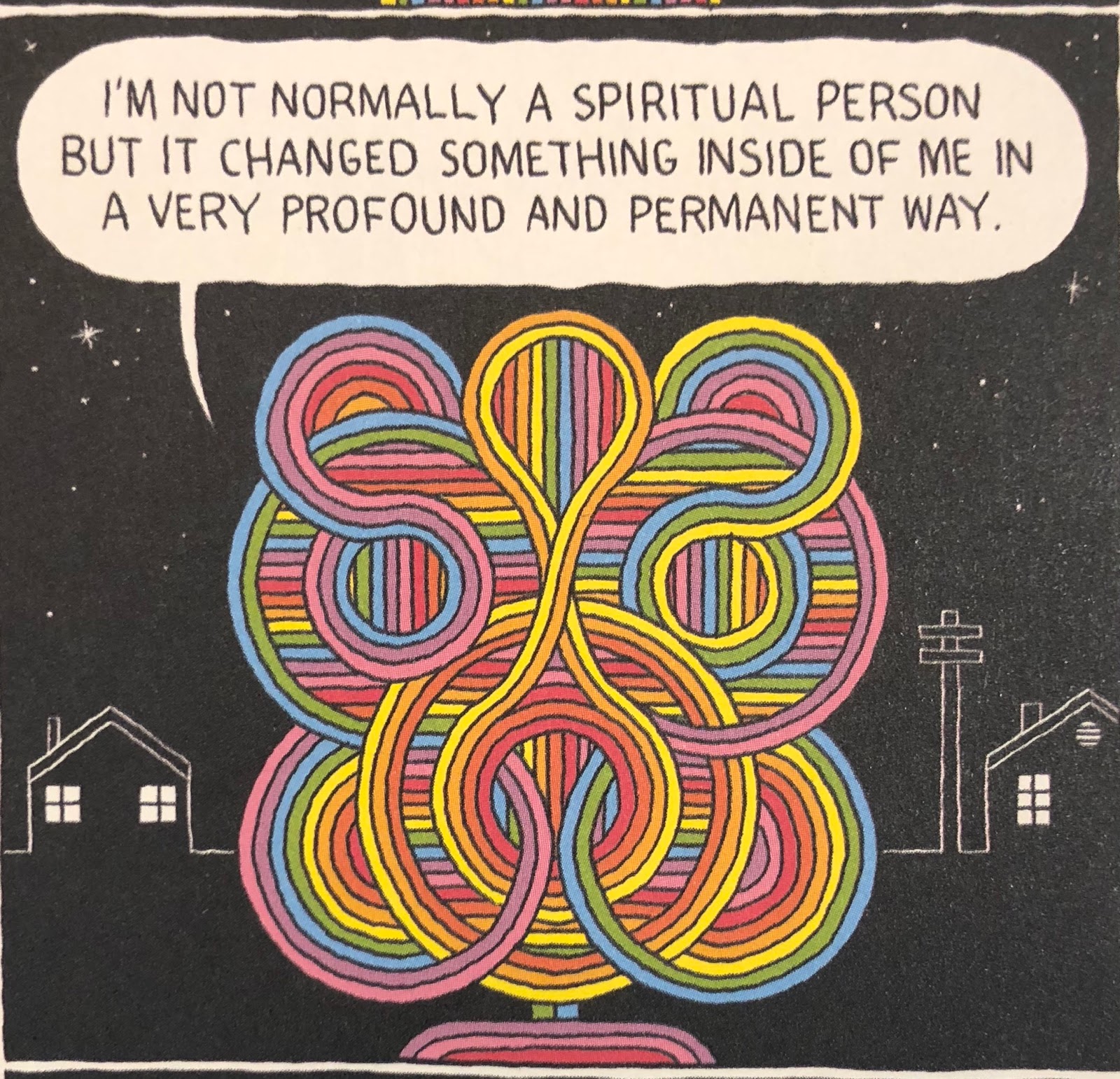
I’m not normally a spiritual person, but it changed something inside of me in a very profound and permanent way.” 

We never see who says this, which is surprising given that they hit upon one of Crawl Space’s main elements. Jacobs, via expository narrative, states the other world’s source and form quite factually, as how Genesis explains the Hebrew God creating the world in seven days. Of course, the concept itself of there existing “several known worlds beyond the physical,” is more akin to other religions and spiritualities, such as Buddhism’s Ten Realms. What the kids experience in the main storyline is typically “reserved for highly enlightened beings.” With panic, we witness Daisy going so deep into the other world that she reaches some form of nirvana. This allows her to carry the world inside of herself even as the entrance to the cosmic rip is removed. 

(Religion makes sense! I shouted at my friend at some point in the beginning of our trip, uncouth and overwhelmed.) 

What defines spirituality? While the rules of the physical plane betray us as Jeanne-Claude betrays Daisy, spirituality — much like Crawl Space’s other world — contains no limitations. It twists and brightens you into something unique from all others around you, freeing you from the confines of the mere external. As surely as Thich Quang Duc burned and the Jews survived centuries of persecution, spirituality has reigned in times and places where literacy, science, and math have not. 

The rules of the physical plane do not work for Daisy. She doesn’t belong where she lives. Her parents are strict. She has no true friends. But when she finds the other world, she understands her place in the universe. 

That thing will never survive out here in the suburbs!” she says while chasing a rainbow worm that Jeanne-Claude stole from the other world. In truth, that “thing” is herself. Jacobs highlights this via aerial shots of the streets, fenced in by neat rows of houses that are each indistinguishable from its neighbors. Crawl Space admits that we are all unique in our own way via Jacobs’ painstakingly individual rainbow designs for each kid, but most are not in tune with higher concepts that define how we’re unique. After all, when you grow up in a black and white world, without even a shade of gray in sight, it can be hard to see how the rules of that world can be different. How you can be different, both as an individual entity and how you connect to others. 

However, Daisy is already different. She converts herself so far into the other world that she does not, and cannot, come out again. 
*** 

But then again, perhaps we all cannot come out again if exposed to something as marvelous as a drug trip or a good comic. Both explode the senses, translating one experience into another. As surely as mushrooms split the qualities of a miso eggplant into four thrashing stages in my mouth does Crawl Space assemble colors and shapes into something so ecstatic that it activates something deep inside the mind. 

As cheesy as it sounds, Crawl Space asks us to acknowledge our own internal rainbow forms, to open our minds and envision a world that goes beyond the rules we live within. And by having us follow Daisy’s story, it asks us to do so with empathy and pure intentions. While Jacobs’ brilliant art and vision breaks barriers for how color and abstraction can be used to weave a narrative, we can break barriers in our own lives. 

-------------------------------------------------------------
Rae Epstein is the writer of comics Gently Murder Me and Rubies, and has written criticism under the name Ray Sonne. You can find her previous work on The Guardian, Women Write About Comics, Loser City, and Comics Bulletin. Her bark is worse than her bite. Find Gently Murder Me and Rubies at gumroad.com/rebeccaepstein. Follow her on twitter @REpsteinWrites

June 3, 2014

Review -- Jesse Jacobs' SAFARI HONEYMOON

SAFARI HONEYMOON is the New Evolution

Elkin:4 stars
Sacks:4.5 stars
Elkin: There is something inherently evolutionary about the human urge to travel. It puts us in touch with new ideas and vistas which, as a result, allow us to return to our homes with a fresh perspective regarding our normal day-to-day. It's that “didn't know you were thirsty until your well ran dry” kind of thing.
You know how it is – you take what you have for granted. Time breeds blindness. How long is it before you stop noticing the hole in the wall where that picture once hung? Comfort brings complacency. Without something new to look at we reflect ourselves back to ourselves in an Inception-style delusion of change.
And clicking pages on Google Maps doesn't count. You need full engagement, the one, two, three, four, five senses working overtime. Especially smell. True travel does not exist without the smell of new places – an olfactory adventure in itself.
Without travel, cultures stagnate, people ossify, and nobody ever questions the trammels of custom. Yet also inherent in travel is the fear of the unknown. By stepping out of your comfort zone you open yourself up to the horrors of misunderstanding and perturbation. You trade assuredly for possibility, which either makes all the difference or breaks you apart.
The mid-twentieth century Italian writer and translator Cesare Pavese once wrote,“Traveling is a brutality. It forces you to trust strangers and to lose sight of all that familiar comfort of home and friends. You are constantly off balance. Nothing is yours except the essential things: air, sleep, dreams, sea, the sky - all things tending towards the eternal or what we imagine of it.” Jesse Jacobs' new graphic novel, Safari Honeymoon, from Koyama Press upends Pavese's idea to a certain extent. In Safari Honeymoon even the things we hope to see as eternal have become almost unrecognizable, beyond perhaps what we can understand. Part jungle adventure, part “psychedelic sojourn”, part biblical allegory, part gender study, part contemporary commentary, Safari Honeymoon is much more than the sum of its parts; it becomes its own thing by being unlike almost anything else.
As these sorts of things tend to engulf with the weight of their intent, there are strata to Jacobs' narrative, theme, and metaphor. His vision and cartooning make the layers visible through the veneer, and, with seeming abandon, allow a reader of Safari Honeymoon to make what he or she wants of it. The rungs of the ladder are there, it is up to you to decide just how high you want to climb. You take from it what you are willing to work for. It is an active reader who experiences the most from this safari. The passive observer will get lost quickly and succumb to the numerous and various parasites that abound in this jungle. It's helpful to have a guide, but even a guide can show us only so much.
It's a question of how much you are willing to give up to see where you are. “Everything at some point is reduced to its most primitive state.”
Sacks: "Predetermined patterns of thinking are inadequate. Your thoughts are nothing more than meaningless clouds passing across and endlessly blue sky."
One of the strange creatures in Safari Honeymoon says that cryptic statement directly to the reader in a full-page illustration. And while that comment may be psychedelic and existential, it also comes close to sounding like a manifesto, for being the spear-point in an argument to escape your mental boundaries and allow the world that Jesse Jacobs creates to wash over you.