Showing posts with label Uncivilized Books. Show all posts

November 19, 2018

The Moment Eating Monster: Spencer Hicks reviews ONE DIRTY TREE by Noah Van Sciver

Childhoods are not shaped by design but by the random accumulation of thousands of moments. Moments form the childhood, the childhood forms the adult. This kind of moment: the discovery of dozens of dead cockroaches accompanied by the lingering scent of bug bombs. Those dead roaches may leave as large an imprint on the young mind as the living brothers and sisters he passes in the hall daily. More moments: digging for fossils in an empty riverbed, a bumpy drive to church, contemplating God in the ruins of an old cabin in the woods, cat pee on the laundry pile. The cumulative months a father spends in bed instead of providing for his family can have equal effect to the single moment; one of those days in bed, he casually dismisses a frivolous question about the Incredible Hulk from his curious son. That moment of dismissal doesn’t feel any different from any of the countless other mundane moments and was, in fact, different only because of the impression that it left.

In One Dirty Tree, Noah Van Sciver does more than catalog these meaningful childhood moments from his own life, he examines how they formed and haunt the adult recollecting them. Switching organically between the past and more recent present, often devoting whole pages to single quiet moments, Van Sciver visits the ways in which his troubled childhood continues to trouble his adult life. The childhood sections of One Dirty Tree are populated by his claustrophobically large Mormon family and the house they cohabit. The family and home are physically absent in the later sections, but psychically present in every alienating interaction Van Sciver has as an adult. A child always hungry for food, the adult later works at a restaurant. A child always hungry for the stability of normalcy, the adult later engages in a relationship with a traditional young woman who not only encourages normalcy but sometimes cruelly discourages abnormality. Before moving into a beautifully remodeled building with her, he was living in a cheap, run-down apartment—a miniature repeat of his childhood home. By all appearances, Van Sciver is successfully leaving his wretched past behind. But the effects of his childhood and the poverty that pervaded it cling to him. He can’t forget and neither can his girlfriend.

Poverty itself struck as many blows to young Van Sciver as the physical blows his father and brothers did. The shame of growing up poor and different manifests itself in adulthood as an inferiority complex that cripples his relationship and eventually renders him a literal monster. As his personality develops from childhood into adulthood, so too does this alter ego monster of his. There is a duality to Van Sciver’s growth and each moment experienced feeds one or both sides to this duality--his burgeoning yin and yang. On one side we have the budding artist, on the other, the tortured monster. From the beginning, young Van Sciver showed a talent for drawing and this act of creative expression comforted him during moments of strife. The consumption of art, in the form of his brothers’ comic books, was also a comfort. Drawing or reading, he fed the artist within. Looking over his shoulder to ensure nobody witnessed him entering his ramshackle house fed the young monster.

The monster is an interesting metaphor because while it ostensibly represents for readers Van Sciver’s internal feelings of inadequacy, it also reflects the way others see him. He cannot hide from the monster himself, nor can he hide it from others. While the book version of Van Sciver seems repulsed by his own monstrosity, one suspects the author Van Sciver recognizes his monster’s dual purpose as an asset—a representation of the benefit of his other-ness. The accumulation of childhood traumas damaged but also strengthened the individuality of the man. The monster and artist walk hand in hand. Although only visually rendered in those instances of self-doubt, it isn’t difficult to imagine the monster present at other times, like at the art opening. Here Van Sciver recognizes a difference between the popular art on the walls and his own art, the other artists and himself, but the recognition doesn’t seem to shake his inner resolve, this particular alienation needn’t cause shame. The same childhood embarrassment that fed the monster also fed an individual artistic drive. His youthful curiosity about the Incredible Hulk made perfect sense, coinciding with the development of his own inner Hulk and his start as a comic book artist (portrayed humorously with a recreation of his own childhood scribbled dinosaur comics).

Although the climactic end of his relationship (whoops, spoiler alert) once again evokes his monster-self, we recognize, perhaps at the same time as Van Sciver in the story, that the monster and the artist are inseparable, each strengthened by the presence of the other. Without the artist, the monster would have no humanity; without the monster, there would be no book.
--------------------------------------------------------------------------------------------
Spencer Hicks made a couple of zine comic books that were well received by nearly a dozen people and has a really great idea for a new one that he got 3 pages into drawing several months ago that he'll probably never get back to because its too hard. He also paints. Check out his art at @shpensherhicksh on Instagram!

August 8, 2018

Review: WHITE SUPREMACISTS ARE HUMAN FARTS by Jenny Schmid


In the sixteen pages of what may be one of the best titled responses to the current wave of xenophobia, antisemitism, and racism that is cresting on a global scale, Minnesota-based artist Jenny Schmid tries to put the human face back on the dehumanizing language of the alt-right and other hate groups (including the current US administration). White Supremacists Are Human Farts features Schmid and her adopted daughter in conversation about topics that, because of the world in which we live, more and more parents are having to have to have with their children.

It’s a conversation that has no easy answers. And new questions seem to arise every day.

Using the story of Anne Frank as a framing device, Schmid is able to focus on the ideas that hate is a learned thing, that children have a basic goodness, and that power and concepts of “otherness” are two sides of the same coin. Juxtaposing “Pathetic Posters of the ‘Alt-Right’” and the words of President Trump with the protests that came in response and her own daughter’s questions around hate allows Schmid to put the heavy weight of messaging in substitute hands. This choice not only adds to the themes that the artist is exploring but also helps the reader feel the impact of both the hate engendered by fear and the love possible through understanding and empathy.

Schmid tells the stories of her “Immigrant” friends and daughter by focusing on their inherent goodness and accomplishments. And she chooses to end the book with her daughter reciting Anne Frank’s final words: “I still believe, in spite of everything, that people are still truly good at heart.” 

This final decision brings a note of hope. As bleak as things can seem sometimes, whether you are hiding from Nazis in a secret annex in Amsterdam or you are cleaning swastikas off of the walls of your synagogue or you are just inundated by a 24-hour news cycle that survives by highlighting the worst in us, there are still people who will fight back, not succumb to fear and division, and bring joy into the world.
In the face of all the rhetoric, Schmid seems to be saying that we all need to stand up and let the children lead the way. This sort of simplistic seeming sentiment almost reeks of being a meaningless platitude. But, at its heart, it’s true. As brutal and stupid and unreasonable as White Supremacists are, if we all remember that they are just pathetic, frightened Farts, we can play joyful music to drown out the vibrations that emanate from their ass-faces, and we can release the embracing scent of love to deodorize their shit stench.

And if that doesn’t work, I’m all for you punching them right in their fucking face, twice. Fuck Nazis.

July 9, 2018

Artfully Wage War on Nostalgia: Nick Hanover reviews CARTOON DIALECTICS #3 by Tom Kaczynski and Clara Jetsmark

There is an envelope in the mailbox. You pick it up, intrigued by its handwritten address. This is nothing you’ve ordered. It is an artifact from another time. You open it. A nearly monochromatic little comic slips out. Purple and white dominate the page. The paper feels raw, there’s no gloss to it, but also none of that try-too-hard matte. As you flip through it something else slips out, a postcard-sized print that only says “Nostalgic Blob.” You grin because that little blob gets you in too many ways. You proceed.


***

Inside the pages of Cartoon Dialectics #3, Tom Kaczynski and Clara Jetsmark force you to consider the cheerful yet ominous reach of the nostalgic blob, that cultural motivator that compels us to look backward even as we’re moving forward. Connecting nostalgia to Trump’s Make America Great Again movement as well as the styles and tastes of progressives and, in its potent final section, Kaczynski’s own relationship with his past, the central question of Cartoon Dialectics’ third installment isn’t “How did we get here?” but “Why do we keep returning here?”

When I spoke to Kaczynski in 2013, that question weighed heavily on both our minds, running through our discussions of gentrification, global warming, the mystification of technology and beyond. Kaczynski told me that the frequently bleak stories collected in his impressive work Beta Testing the Apocalypse were inspired not by dystopian works but his interest in utopian fiction and his time growing up under communism, a system that was itself utopian in design but nonetheless broke down in execution. Responding to a point I made about the negative outcomes of his stories, Kaczynski said: “If my stories seem really negative, it's only because I'm examining the negative to see if a positive can be teased out eventually.” 

At that point, less than a year into Obama’s second term, the concept of “failed utopias” was more theoretical but, looking back on it now, it seems clear that Kaczynski instinctively knew catastrophe was looming and, more importantly, realized that it would come in large part because of our fetishization of a nonexistent, utopic past. 

That aspect of Kaczynski’s vision, both as a comics creator and a comics curator, is most explicit in the opening story of Cartoon Dialectics #3, “Trump and Nostalgia,” created with Jetsmark for The Nib in October of 2016, shortly before the election when most experts emphatically stated Trump had no real hope of winning. Rather than tackle Trump’s prospects as a candidate, “Trump and Nostalgia” bluntly examines his now ubiquitous slogan at face value, wondering when the “Again” aspect actually refers to.
For most of the past couple years, The Nib has been a toothless, overly simplistic purveyor of progressive editorial cartoons, and though “Trump and Nostalgia” certainly doesn’t erase that history, it does serve as a reminder of what the publication is capable of when it is at its best. Avoiding the trap of merely stating some variation of “America has never been great/has not yet achieved greatness,” “Trump and Nostalgia” achieves the twin goals of proving the slogan’s vagueness is a core part of its success because it allows the target audience to fill in the blank themselves, and that for Trump, in particular, it hearkens back to the Reagan era both in terms of the semantics (it was lifted wholesale from a Reagan speech) and in terms of when Trump’s dog whistle politics actually became mainstream.

The stark but emotive art helps the complexity of the “Trump and Nostalgia” arguments land with minimal effort. This is notable because even now, Democratic and Republican leadership try to argue that Trump’s approach to politics is new and unexpected, and that we must listen to his rabid base in order to appease them. In a mere 14 laid-back pages, Kaczynski and Jetsmark not only destroy that claim, they did so before the election even happened. The nostalgia half of the title, therefore, doesn’t just critique the bigots who voted in Trump, but it also critiques Democrats and Republicans both for nostalgizing a nonexistent time when politics were “clean” and naively falling prey to bad faith opponents.
The follow-up to “Trump and Nostalgia”  in Cartoon Dialectics #3, simply titled “Nostalgia,” has Kaczynski expertly laying out the culture-wide retromania that set the stage for our utopian aspirations to break down. Rougher in linework and more lecturely than Kaczynski’s usual material, “Nostalgia” nonetheless moves at a brisk pace as it details nostalgia’s growth from an actual malady afflicting touring Swiss mercenaries in the 17th century to its modern development as a viral, commercialized impulse. 

While it recycles some quotes and panels from “Trump and Nostalgia,” the section waxes more philosophical than historical, weaving in quotes from cultural theorists Svetlana Boym and Simon Reynolds, the latter of whom coined the term “retromania” specifically in regards to music but, as Kaczynski shows, it’s a useful theory for everything from politics to comics’ own terminal nostalgia infliction
Kaczynski also connects Boym and Reynolds’ work to Alvin Toffler’s “future shock” theory which essentially states that as we become more technologically advanced, we will suffer a kind of cultural shock that will prompt many of us to latch on to regressive ideas and lash out at intelligence in general. Kaczynski’s style is perfectly suited to illustrating this phenomenon, with his lines seamlessly transitioning between architectural precision and scribbled looseness to drive home the escalating divisions between thought and feeling. 

Later in Cartoon Dialectics #3, in “The Nostalgic-Critical Method: Praxis,” Kaczynski even provides some yoga-esque suggestions for recognizing and controlling your nostalgic impulses as they happen. The key, according to Kaczynski, is to allow yourself to notice the nostalgia as it appears and then isolate the memory triggered by it rather than simply giving in to the compulsion to purchase goods related to the nostalgia.

That’s likely what Kaczynski is doing on some level with “Skyway Sleepless,” the fictional yet personal story that makes up the entire second half of Cartoon Dialectics. Set in a near-future city where people can live in “skyways,” bridge communities situated above and between streets that function a bit like terrestrial space stations, “Skyway Sleepless” is a love letter to Kaczynski’s own past as an architecture student. More specifically, it’s an intense and deep interrogation of Kaczynski’s internal architect/artist conflict.

One of the first interactions in “Skyway Sleepless” is between the protagonist and Professor Ecke, who calls the protagonist his “best pupil” before immediately lamenting his protege’s choice to never become an architect. Prof. Ecke’s missing arm makes it clear he’s modeled on famed Minnesota architect Ralph Rapson, head of the University of Minnesota architecture program from 1954 to 1984. Kaczynski told me in that interview in 2013, before “Skyway Sleepless” was originally published, that Rapson’s academic interactions with Kaczynski, as well as his contributions to the aesthetic of Minnesota, had caused a fictional version of Rapson to loom large in his stories.

But “Skyway Sleepless” seems to confront Rapson’s influence on Kaczynski’s art far more directly than anything in Kaczynski’s other material, portraying Ecke as both a genius mentor and a villain of sorts, while the unnamed protagonist struggles to find his own identity within what is essentially Ecke’s city. “Skyway Sleepless” also provides an impressive platform for Kaczynski’s Escher-like tendencies, the titular setting twisting into physical and mental labyrinths, with Ecke at the center, putting the citizens to sleep as part of some grand artistic statement.

Architecture and urban design are really interesting to me, because that's where we live and that's where we form our character, our ideas,” Kaczynski explained to me back then in our interview, stating that architecture is “something that we don't know overtly and we struggle with it, and if we knew what it was maybe we wouldn't struggle so much.” 

That struggle is at the core of “Skyway Sleepless,” as the protagonist appears to lose his grip on reality as a result of probing it. But on the meta-level, it’s Kaczynski’s application of his own Nostalgic-Critical Method that is the driving force, isolating the memory of the person who had an influence on his meta-city fiction and confronting it rather than seeking out the more immediate pleasure of, say, a model of one of Rapson’s designs.

The resolution at the end of “Skyway Sleepless” is as nebulous and mysterious as the nostalgic blob Kaczynski cutely drops into random panels, squeezing its way out of definitively stating whether the revived interest in Ecke’s design work is good or bad. But it fits perfectly with the question connecting all of Cartoon Dialectics: why do we keep returning to certain places, certain culture, certain objects, even when we know they won’t fix anything and might actually make things worse? And it’s even more fitting that Cartoon Dialectics offers no real answer, except that perhaps to overcome our past, we must look ahead more often than we look behind.


***

You put the book down. You look at the old posters on the walls. The vinyl gathering dust in the corner. The trinkets on the shelves. You pick up the Nostalgic Blob print. You smirk. You stick it to the fridge. You stare at it. It reminds you of one of the ghosts that would chase Pac-Man in the arcade cabinet at the pizza place you used to go to after school. You wonder if maybe you can buy it as an enamel pin. 

---------------------------------------------------------------------

Nick Hanover got his degree from Disneyland, but he’s the last of the secret agents and he’s your man. Which is to say you can find his particular style of espionage here at Your Chicken Enemy as well as at Comicosity, Loser City and Ovrld, the latter of which focuses on the Austin music scene. You can also flip through his archives at Comics Bulletin, which he is formerly the Co-Managing Editor of, and Spectrum Culture, where he contributed literally hundreds of pieces for a few years. Or if you feel particularly adventurous, you can always witness his odd .gif battles with his friends and enemies on twitter: @Nick_Hanover

April 12, 2018

Spring 2018 Box from UNCIVILIZED BOOKS!

Minneapolis-based small press comics publisher
Uncivilized Books 
has recently announced it's offering its 

Included in this offer is:
The Clandestinauts
by Tim Sievert 

Tsu and the Outliers
by E Eero Johnson

Cartoon Dialectics Volume 3
by Tom Kaczynski and Clara Jetsmark

Draw Stronger: Self-Care For Cartoonists and Other Visual Artists
by Kriota Willberg

Uncivilized is one of the great small press comics publishers operating in 
North America today. 
You can trust them to publish some of the best comics being made.

January 19, 2018

Cities As Symbols: Philippe LeBlanc on STRUCTURES from Uncivilized Books

(Editor's Note: I've been following Philippe LeBlanc's writing over at The Beat for quite some time now, and I've always been impressed with his ability to write reviews about small press comics that come from a clear critical eye and a certain fearlessness in taking on difficult work. When Philippe said he'd like to write about the Structures series from Uncivilized Books for this site, I gave him carte blanche, as I knew he'd write something spectacular. As you can read below, I wasn't wrong.)


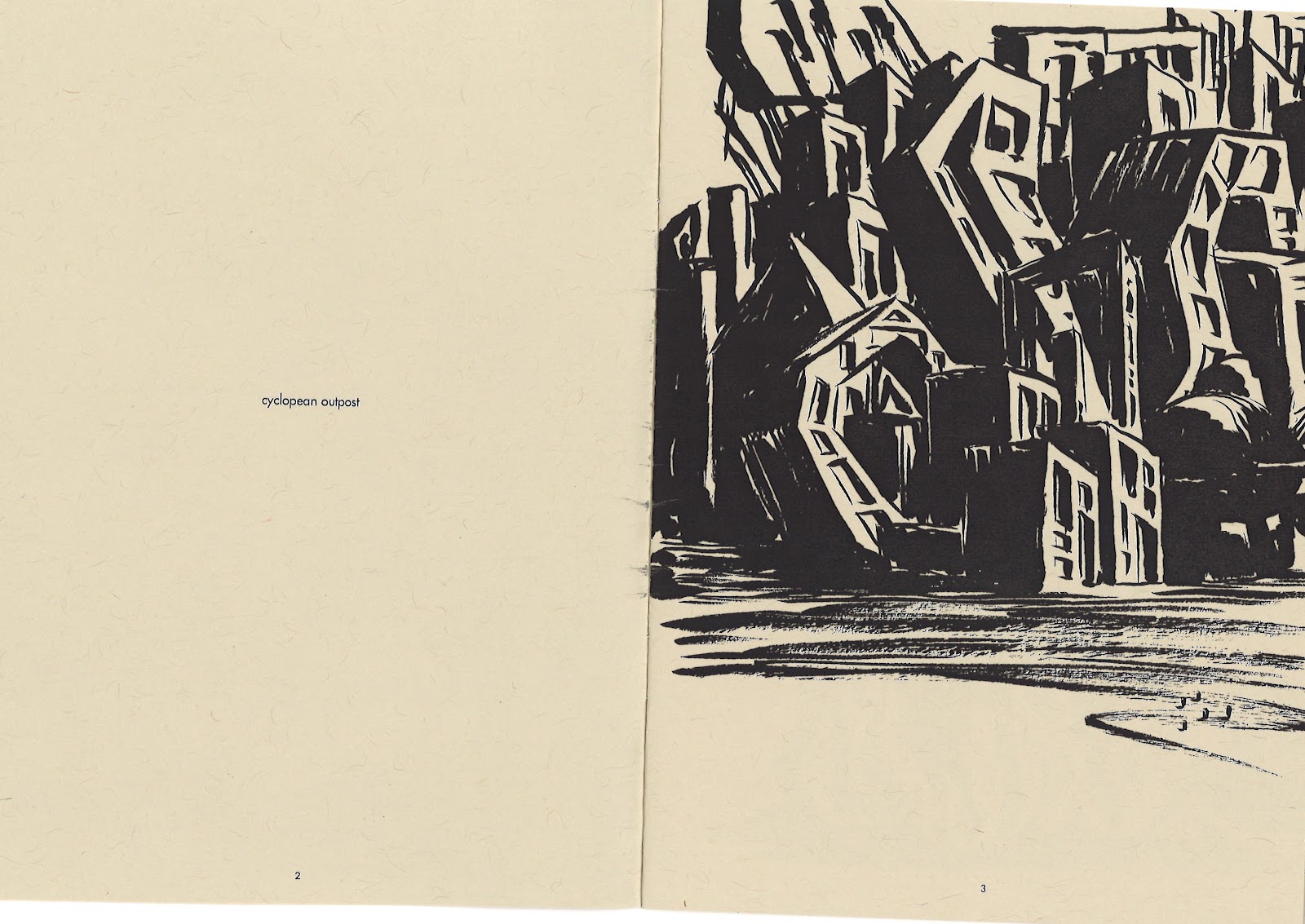
The first illustration comes next to the ominous words Cyclopean outpost. We see minuscule human shapes walking towards a massive metropolis, humongous in size. The figures are featureless, they barely register. How can a person matter when facing such an enormous city? We are minuscule, meaningless. These first pages marks the start of a multiyear, multi-artist project called Structures published via Uncivilized Books.

I remember meeting Tom Kazcynski, the publisher of Uncivilized books and cartoonist, at TCAF in 2014 and talking about the Structures project was going to materialize and now, four years later, I am reading Structures 1-11, the building block of this series.The book takes place in an immaterial void reflecting only a sliver of reality and not bound to a specific time of publishing. It is timeless. It’s about the structures we built and how we see them once they’re built. They become symbols. 


Art by Tom Kaczynski, Structures 1-11

I remember visiting Toronto for the first time and how being in the city felt. I’m from Quebec City, a much smaller city in comparison to Toronto’s enormous size. It was massive, tall and expanding into infinity. I remember the overwhelming feeling of invisibility, of worthlessness amongst a sea of human beings walking through the core of downtown in the winter, surrounded by towers hovering so far above me, I could barely register where they ended. I had been to major cities before, Montreal or New York are close relatives after all, but Toronto was something else. Perhaps it was this heterogeneous architecture, one that seems empty of planning or logic, skyscrapers surrounding townhouses, a lake with very little waterfront access on the ground (at least downtown directly), and other varied odd bits of patchwork creating the city. I remember when I first saw Denis Villeneuve’s film Enemy, it captured similar feelings as he depicted Toronto as a cage, a massive city with streetcars electrical grids constantly overhead, claustrophobia abounds. I wondered how a Metropolis such as this could have expanded this way, and how the modern wonders of architecture felt so dehumanizing and oppressive. 

Structures 1-11 stands as the foundation of this exploration of objects, space, and big ideas and it comes in deceptively small packages. It is not interested in depicting reality, but rather, it explores concepts on the outskirt of reality. What do our modern cities look like? What would the end of days look like? What is reality? All of those are contained within this series through abstraction and cryptic notes. The juxtaposition of words on a blank page and drawings on another is an interesting way to explore these concepts and a reminder of how comic books work. Comics are really just words over drawings, but what you can do with that is endless. 

Another example of these cryptic explorations of structures as symbol echoes across the two pages depicting The Tomb of Jack Kirby. It's a beautiful reminder of the massive legacy Kirby has left the comic book world. I remember reading about Kirby for the first-time in the pre-internet era of my childhood (in a copy of Wizard #33. I think). I believe it was a sort of a tribute issue, complete with a massive array of praise from a number of comics artists, editors, etc. Without having even seen his art, I knew how important his legacy was and how much comics owed to him. His creations fuel the big publishers to this day and his concepts are still the object of admiration. Depicting his legacy as a towering edifice of grief and wonder is bold and spot-on. Kaczynski creates a futuristic metropolis just on the edge of reality filled with tall concepts and ideas. Exploring our relationship with our landscapes and urban environment in our modern ages in 11 images is incredible. That four other cartoonists explored similar concepts is remarkable. 


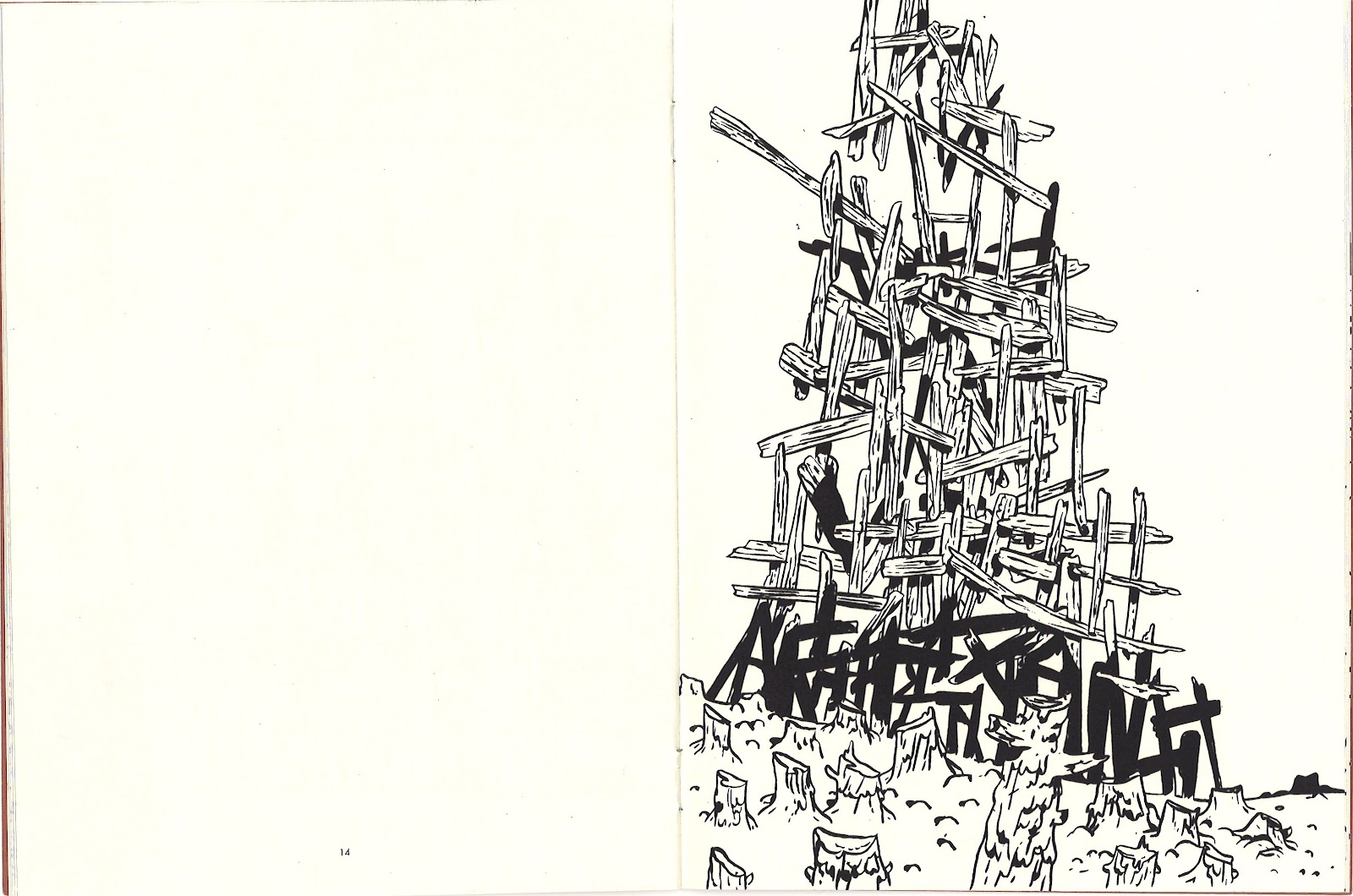
Art by Vincent Stall, Structures 12-23

The following issues follow in the footsteps cleared by Kaczynski. Each artist tackles big, bold ideas about our modern world, and explores them in their own way. The recurring element of each comic is the structure of the comic itself, a blank page with text followed by a page with an illustration. Vincent Stall’s Structures 12-23 begins with a seeming collapse of civilization, leaving the world in ruins. From these ruins, a new type of architecture rises to impose its grotesque will on nature. We only see the structures built by the survivors as they cannibalized the past, the landscape, and nature itself to create a series of temporary habitats. Stall focuses on the way we accommodate ourselves by repurposing our surroundings. 


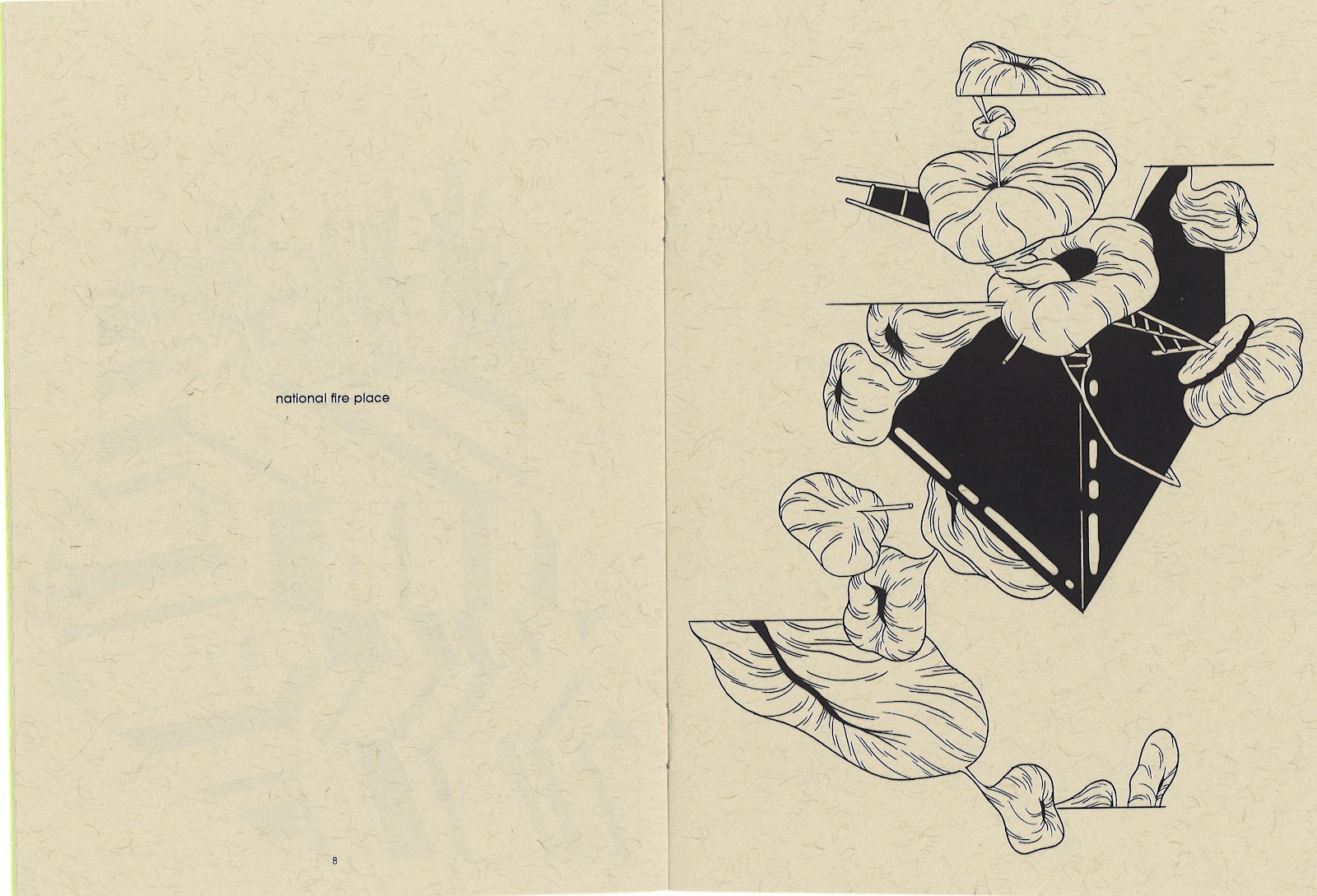
Art by Michael Deforge, Structures 24-34

Michael Deforge pushes these ideas forward in Structures 24-34 by moving away from physical structures and on to ideological ones. Deforge is looking at how nonsensical national myths can be. We take certain things for granted, but what we build as part of our national myth is often arbitrary. Some things are easier to understand, but others seem haphazard. Deforge shows various shapes and forms that are supposed to be items of national significance, whether it’s national ladders or national living rooms, and each image is twisted and unrecognizable. It forces the reader to consider how we build myths and why we take some things for granted when they can be, in fact, just irrational and subjective. Our inspiring stories and symbols are not always self-explanatory, if we’re thinking about some of our Canadian myths and how they take on a significance of national importance, one can understand how Maple syrup or the resilience of the beavers but some other elements are more nebulous than others. Canadian niceness, for example, is one of those that are harder to wrap your head around. Are people nice, or passive-aggressive, and how did this become part of our myths? 


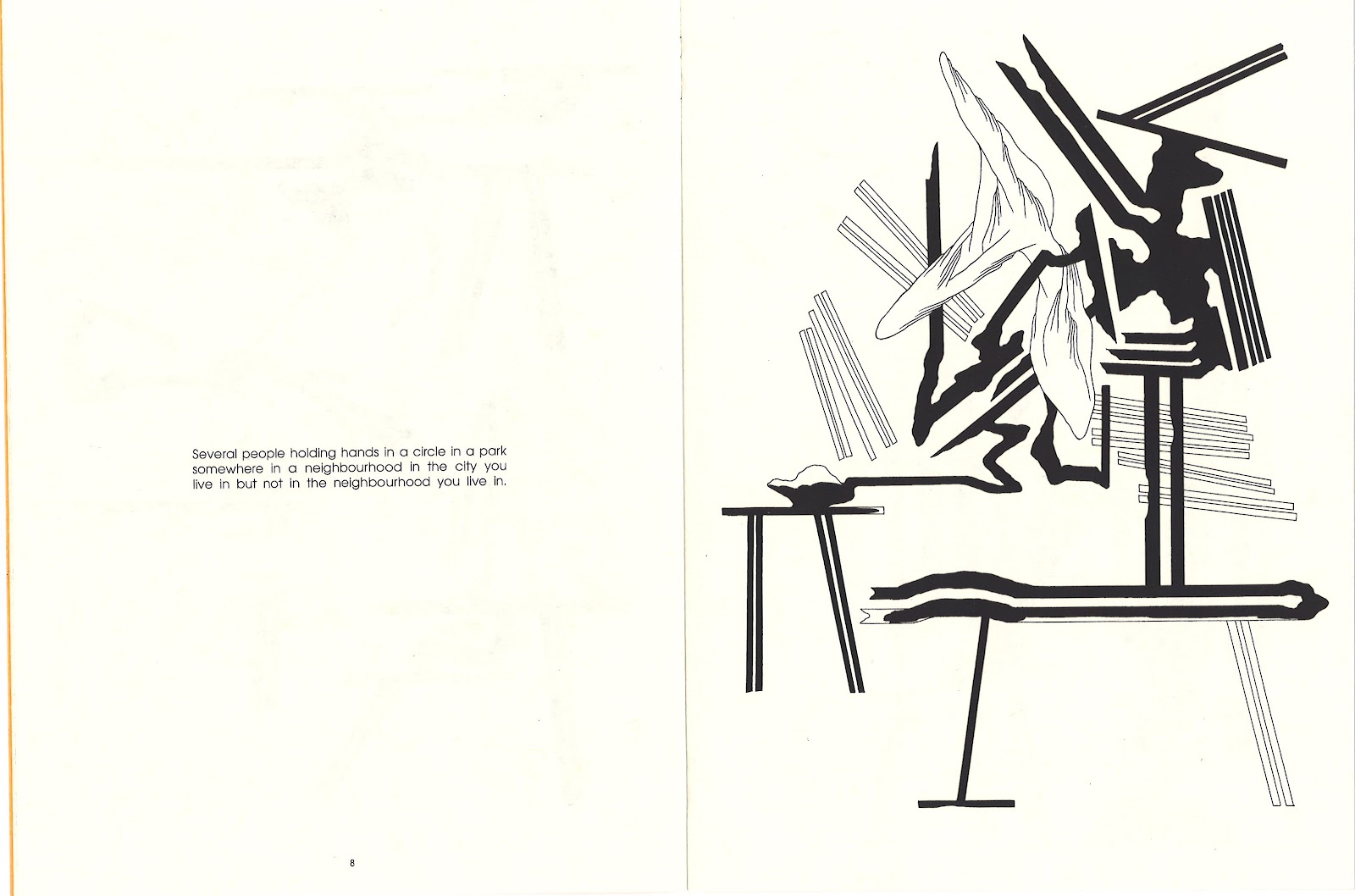
Art by Patrick Kyle, Structures 35-45

In Structures 35-45 Patrick Kyle looks at the twisted structures of our mind. Kyle creates a world where everything is twisted into abstraction. It’s almost like navigating a dream, or a nightmare. You can almost recognize the structures he’s depicting, they are just twisted enough that you see the foundation of a table, or a chair, but the rest is barely decipherable. The text doesn’t talk about a structure, but of a construct of the mind, just bizarre enough to feel familiar, but strange enough to be horrific. My favourite example might be “Several people holding hands in a circle in a park somewhere in a neighbourhood in the city you live in but not in the neighbourhood you live in”. Kyle builds a nightmare for us to consider. How does our mind organize information and what happens if those structures are twisted? Kyle forces us to consider that, much like the construction of myths, habitats and cities, our psyche may not be as structured as we think. 

Structures is a series that has been exploring interesting topics throughout its short publication history. From the creation of modern society, to how we destroy nature for our own purpose, to how we construct myths and how our mind behaves, Structures show that comics can achieve thoughtful explorations of philosophical topics and existential questions even in small formats. The medium is made better by work like these, each piece builds onto the previous one to create something bigger than the sum of its part. Uncivilized Books can be very proud to publish such a strong and experimental comic series.


-----------------------------------------------------

Philippe Leblanc is a Canadian comics journalist. In his regular life, he improve Canadian medical education, and is the co-host of the Ottawa Comic Book Club. He reads alternative, indie, and art comics at night and writes about them for The Comics Beat and Your Chicken Enemy

June 10, 2017

In Lieu of Reviews Two: Eight Books For You

Elkin’s note: I’ve been busy with end-of-the-school-year shenanigans, and now I’m going on a two-week vacation. I have a bunch of books that are mostly spectacular which have been piling up on my “to-review” stack. I kinda want to come back from my trip relaxed, calm, and unconcerned, so I’m just gunna dump a whole bunch of these books in this week’s column. Know that if they are featured on this list, they are worth your time and money. I may come back to them again for full-length reviews in the future.

WHAT IS A GLACIER?
By Sophie Yanow
Published by Retrofit/Big Planet
Available HERE

Retrofit writes: Sophie Yanow, acclaimed creator of War of Streets and Houses, returns with another autobiographical tale of her trip to Iceland. Air travel in our environmentally fraught times is juxtaposed with her reflections on a relationship that ended a year prior.

Simply stated and drawn, emotionally powerful, this short book demonstrates why Sophie Yanow is one of the best cartoonists working today.

THE MAN WHO CAME DOWN THE ATTIC STAIRS
By Celine Loup
Available HERE

Celine Loup writes: Inspired by film noire and the works of Ira Levin and Shirley Jackson, The Man Who Came Down the Attic Stairs is a horror comic about motherhood and post-partum depression. Emma is excited to start a family in her new home, but motherhood brings far more isolation and despair than she is prepared to handle. If only her husband could understand, but he hasn't been the same since that day...

Highlighting Loup’s art, this one deals with some serious issues and takes the reader deep into the experience she is exploring.

THE CHRONICLES OF FORTUNE
By Coco Picard
Published by Radiator Comics
Available HERE

Radiator Comics writes: Originally published as a series of minicomics, The Chronicles of Fortune is a quirky and idiosyncratic adventure of Fortuna, the greatest superhero who could do anything to improve the world, but is tragically stricken with ennui. Coco Picard’s The Chronicles of Fortune follows the lives of Fortuna, and her alter-ego, Edith-May as they learn to cope with loss and recruit a team of friends along the way! Discover a temperamental stove, a nosy mountain, a goofy crocodile, a loner moth, and a singing goldfish as they lead Fortuna on her greatest adventure! At once charming, sad, funny, poignant, and bizarre, The Chronicles of Fortune keeps one foot in mundane reality.

Kinda bonkers, kinda sweet, kinda sad, this one is definitely a keeper.

COSMOS AND OTHER STORIES
By Rozi Hathaway
Published by Good Comics
Available HERE

Good Comics writes: Cosmos and Other Stories examines themes of loneliness and longing, with Hathaway’s uniquely expressive and dreamy paintwork taking the reader on a journey through various cities, towns, bedrooms and celestial realms. If you’ve ever been lost in a crowd, stayed up all night to talk to someone long distance, or felt the ache of an absent love, then this collection will speak to you.

More like comics-poetry than a straight narrative, this book demonstrates Hathaway’s evocative use of color and pacing to capture mood, tone, and theme.

PRETENDING IS LYING
By Dominique Goblet
(Translated by Sophie Yanow)
Published by New York Review Books
Available HERE

New York Review Books writes: In a series of dazzling fragments—skipping through time, and from raw, slashing color to delicate black and white—Goblet examines the most important relationships in her life: with her partner, Guy Marc; with her daughter, Nikita; and with her parents. The result is an unnerving comedy of paternal dysfunction, an achingly ambivalent love story (with asides on Thomas Pynchon and the Beach Boys), and a searing account of childhood trauma—a dizzying, unforgettable view of a life in progress and a tour de force of the art of comics.

This book is spectacular. Buy it.

EVERYTHING IS FLAMMABLE
By Gabrielle Bell
Published by Uncivilized Books
Available HERE

Uncivilized Books writes: In Gabrielle Bell’s much anticipated graphic memoir, Everything is Flammable, she returns from New York to her childhood town in rural Northern California after her mother’s home is destroyed by a fire. Acknowledging her issues with anxiety, financial hardships, memories of a semi-feral childhood, and a tenuous relationship with her mother, Bell helps her mother put together a new home on top of the ashes. A powerful, sometimes uncomfortable, examination of a mother-daughter relationship and one’s connection to place and sense of self. Spanning a single year, Everything is Flammable unfolds with humor and brutal honesty. Bell’s sharp, digressive style is inimitable.

It’s Gabrielle Bell. It’s good. Of course it’s good.

EARTHA
By Cathy Malkasian
Published by Fantagraphics
Available HERE

Fantagraphics writes: Eartha is Cathy Malkasian’s fourth graphic novel — a metaphorical fable that resonates with contemporary themes. For a thousand years the unfinished dreams from the City Across the Sea came to Echo Fjord to live out their lives. Sex fantasies, murder plots, wishful thinking, and all manner of secrets once found sanctuary in Echo Fjord. Emerging from the soil, they took bodily form and wandered the land, gently guided by the fjord folk who treasured their brief and wondrous lives. But recently, city dreams have stopped coming to Echo Fjord, and without their ethereal tourists the fjord folk suddenly feel lost. Has their ancient way of life ended for good? Has something happened to the city? Are all the dreamers gone? One of Echo Fjord’s inhabitants wants answers: The story’s eponymous protagonist Eartha wants to visit the City Across the Sea, but how will she get to a place no one’s gone to for a thousand years? The city isn’t on any map, or in anyone’s memory. Without thought or hesitation she ventures into the limitless waters, hoping to find the City and solve the mystery. Cathy Malkasian’s Eartha is an expansive tale of pastoral life, city corruption, greed, and addictions, and reverberates with questions plaguing us today, such as the alienating effects of hyper-connectivity and the self-destructive obsession with novelty. Malkasian’s drawing is notable for its rigorous draftsmanship, stunning landscapes and depictions of nature, the gestural nuances of her characters, and her sophisticated storytelling, all of which are on display in Eartha, making this the author’s lushest and most impressive graphic novel yet.

I’ve been working on a full-length review of Eartha in fits and starts for the last couple of months, but I just can’t seem to make it stick. My thoughts on theme keep falling apart. Regardless, this is a beautiful book. Malkasian’s pencils are breathtaking and, while it doesn’t entirely hold together, in the end, it’s worth owning just to look at.

THEN IT WAS DARK: A PARANORMAL ANTHOLOGY
Edited by Sarah Benkin
Published by Peppermint Monster Press
Available HERE

Have you ever seen something you can't explain? Heard a voice speak a warning to you as you drifted off to sleep? Ever see a woman with no face singing to herself on a long, empty road? Ever talk to a serial killer? From the strange, nighttime experiences of a man deployed in Iraq to the story of a house haunted by a slightly mad old Jewish matriarch, from a chaplain's experience performing an exorcism to the history of spiritualism, to a ghost that seems to love LARPs, Then It Was Dark collects a variety of strange experiences from talented and diverse voices. A collection of personal paranormal experiences, true ghost stories, friend-of-friend tales and brushes with the unknown.
Check out the now-funded Kickstarter for further details. This book has many spooky, scary, and unnerving tales. As with many anthologies, the contents are hit-or-miss, but those that do hit, hit hard and well.