Showing posts with label Big Planet. Show all posts

April 10, 2019

They Really Do Say So Much: Ryan Carey reviews ALL THE SAD SONGS by Summer Pierre

The connective tissue linking music and memory is very strong indeed --- most of us can remember fairly clearly where we were and/or what we were doing the first time we heard a favorite song; hearing one we haven't heard in years often takes us right back to what was going on in our lives during the period when it was in heavy rotation; feelings attach themselves to songs permanently, inflexibly, the record in question causing at the very least faint echoes of the same particular mood or frame of mind again and again and again.

But there's a lot more to it than "that song always cheers me up" or "oh my God, this one  makes me think of  (insert former lover's name)!" Melody and memory are so inextricably entwined that Alzheimer's and dementia patients often respond to songs from their younger years while words and even tactile sensations have no effect on them. The union of the two is so powerful, in fact, that it might even be argued to be primal in nature --- so the idea that a cartoonist would tell the story of her or his life (or a part of it, at any rate) by means of musically-anchored reminiscences seems like a natural. And there's probably no one better qualified to make such a conceit work than Summer Pierre.

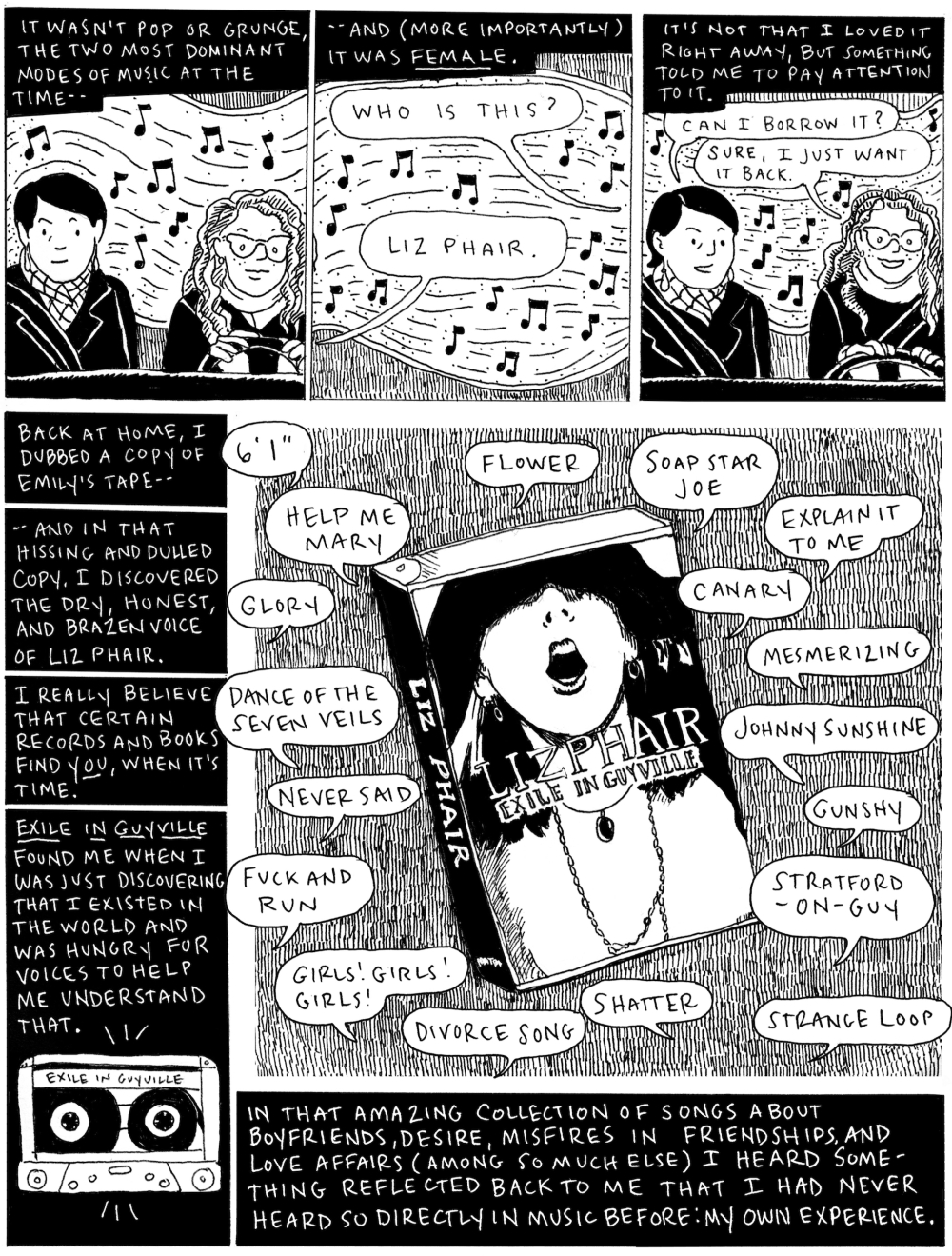
The auteur behind Paper Pencil Life hails from a musically-rich family background and is no stranger to singing, songwriting, and guitar-playing herself, but her own personal musical journey isn't precisely what her 2018 debut full-length graphic novel, the Retrofit/Big Planet-published  All The Sad Songs, is about. Rather, it's about how music has shaped her life on the one hand, how her life has shaped her shifting taste in, and relationship to, music on the other --- and how the two have become symbiotic halves that make up the whole of her identity and existence.
Put like that it probably sounds more grandiose than Pierre ever intended it to be, but this is truly an ambitious and innovative graphic memoir about her life in the early 1990s, a period that saw her move from California to Boston, follow her musical inclinations into the city's open mic "scene," and subsequently attempt to navigate her way through a series of interpersonal relationships that largely sprung from it. Nothing, perhaps, terribly ground-breaking on paper, but it is the method that is key here.

It's not only her own music that informs these proceedings, you see, far from it : Pierre also affixes events in time in around albums that were contemporary with them and, even more interestingly, she extracts rich veins of memory from the mixtapes that she made for people she knew (for you youngsters out there this is how we used to do it in the days before slapping together a playlist for someone --- it took hours and was often a genuine labor of love) and the ones that they, in turn, made for her. She has many of these tapes to this day and literally remembers people through music, while also remembering songs in relation to the people who introduced them to her.
I made brief mention of the relationships Pierre forged while part of the Boston folk milieu, and much of this book's dramatic tension stems from the fact that, it has to be said, not all of them were entirely healthy --- and it's one particularly tumultuous one that not only leaves her suffering from PTSD but re-evaluating her relationship with music altogether, eventually setting her on an entirely different path of creative expression. There's a wistful tone to this work on the whole, as one would expect given its subject matter and essential character, but this de facto "break-up" with something woven so deeply into the metaphorical "DNA" of her being --- hell, of her soul, if you prefer such a term --- borders on the harrowing, and whether or not she makes it through with a new, healthier perspective or ends up a shadow of her former self seems very much an open question for a time. It's probably not "spoiling" things to say that it all works out in the end, but it's a difficult and painful period that's communicated with admirable, even disarming, emotional honesty --- and keep in mind this is a comic that places readers pretty deep inside the cartoonist's mind and heart more or less from the outset! So, yeah, like all lovers worth remembering, music puts Pierre through the wringer.
Her new medium of choice is sure proving to be an inspired one for her, though, it must be said --- Pierre is one of those rare artists who use every last millimeter of space in every panel to communicate information visually, her detailed cross-hatching, thick black shading, and precise rendition of minor details forming a highly emotive backdrop for her naturalistic figure drawings, and the candor and unpretentiousness of her narrative tone is mirrored perfectly in the faces of her characters, each a truly singular individual with expressive reactions and mannerisms utterly unique unto them. Even the folks we meet briefly make an impression --- go ahead, say it, just like a lot of songs.

I'll be the first to admit that the fact I'm roughly the same age as Summer Pierre may go some way toward explaining why this book resonated so deeply, even indelibly, with me --- I remember these times, I was young then myself, and there's a character and ethos to the "slacker" or "Generation X" years that simply can't be communicated with any sort of authenticity by someone who wasn't a part of it. Yet All The Sad Songs knocked me for a loop not just for the overwhelming sense of nostalgia it engendered --- nope, I was (and remain) in awe of the work of one of the very best cartoonists in the here and now, one who is fully arriving into her own and knows how to make every one of her pages sing.
-----------------------------------------------------------------------------------------

Ryan Carey lives and works in Minneapolis, Minnesota. He writes about comics for Daily Grindhouse, Graphic Policy, and at his own blog. He also maintains a long-running film review blog, Trash Film Guru.

January 23, 2019

The Most Subtle Traps Are The Most Insidious: Ryan Carey Reviews JOHN, DEAR by Laura Lannes

"There is nothing in the dark that isn't there when the lights are on."

So Rod Serling told us, at any rate, but there's simply no convincing the subconscious mind of that, is there? As a result, darkness, through no fault of its own, has become the go-to metaphor for negativity, depression, evil, you name it. Difficult or challenging times in life are "dark" times. The historical era dominated by superstition and anti-intellectualism is referred to as the "Dark Ages." Encroaching despair is the "darkness closing in on us."

It's primal. It's instinctive. Our rational minds know that it makes no sense, but nevertheless --- darkness isn't just symbolic of fear, it's symbolic of all fear, of the fear. The fear of losing ourselves into all-encompassing, all-devouring nothingness.
Laura Lannes understands this more intuitively than any cartoonist working today, and I say that without a moment's hesitation. Her strips in the anthologies Bad Boyfriends (which she edited) and Mirror Mirror II (which she didn't) hinted at the darkness that can slowly, inexorably creep into unhealthy relationships, but her recent solo release from Retrofit/Big Planet, John, Dear goes the full distance, charting in brief but exacting detail something well beyond the simple loss of individuality, the loss of identity, that are part and parcel of too many interpersonal relationships --- rather, her protagonist undergoes a process of complete and total self-negation the likes of which, I again say without hesitation, have never been committed to the page in so harrowing a fashion.

She meets a guy. Things seem okay at first, He's reasonably attentive and seems accepting of her flaws and foibles, but, in truth, he's silently cataloging her insecurities for later use as wedges to metaphorically burrow into her and, ultimately, hollow her out. He moves into her place with little or no discussion, bringing, figuratively and literally, almost nothing of his own. His small talk turns to cutting insults. His facile flattery morphs into neglect --- emotional, physical, sexual. And, of course, when pressed, he makes it known this is all her fault.
Somewhere along the way, subtly at first, of course, the body horror starts. Something is wrong with this young woman's physical form, strange changes are happening to her, clearly and inarguably an external manifestation of her inner turmoil. It's hinted, as these grotesque transformations escalate, that maybe it's only happening in her mind, but you know what? Even if that's the case, it's no less real. Her thoughts, her feelings, her wishes, her self --- they're all slipping away. And the darkness that's been bleeding in from the margins is starting to consume her being even as she becomes utterly unrecognizable to herself.

For some, I would suppose, interjecting the visceral horror of bodily mutation (let's just call it what it is) into a psychodrama plenty terrifying enough on its own terms may seem too heavy-handed, too obvious, but don't doubt for a moment that, thanks to the quiet power of Lannes' graphite illustrations and the absolute precision of her sparse text, it not only works, it's absolutely essential to the proceedings. The changes undergone increase in their severity even as the imagery is increasingly taken over by shadow, until shadow becomes complete and inescapable blackness, the woman whose loss of everything she was, is, ever will be subsumed from without precisely at the moment she's consumed from within.
Needless to say, comics (or, if we want to be precise about this book's format, illustrated short stories) don't get more soul-shattering than this, but Lannes also understands, intuitively, the seductive power of the darkness she's both channeling and utilizing here, so much so that there is most certainly an uncomfortably seductive quality to her horrifically beautiful (a contradiction in terms only on paper, I assure you) drawings --- and this slow seduction becomes a key component of the narrative itself, the ease with which one is drawn into the dark communicating so much of our protagonist's fracturing, shattering state of mind.  Less-confident cartoonists would rely, no doubt clumsily, on the text to convey this --- Lannes has no need for such a crutch.

In point of fact, it's entirely fair to say that Lannes' aesthetic choices do something more than tell a story: they approximate, as closely as possible, the experience her character is going through within the mind of the reader. Lannes’ deft deployment --- in an artistic sense, and for entirely different purposes --- mirrors many of the same techniques of the emotional and psychologically manipulative abuser lulling us, with something less than our consent but no actual resistance on our part, into what we know, from the outset, will be as far from a "happy ending" as one can possibly imagine.

There's absolutely no way that the crafting of John, Dear could have been anything other than a fucking terrible experience --- it's too powerful, too searing, too authentic not to have come from a place of deep understanding. The act of exorcizing it must have left its own series of intensely-painful scars. It certainly leaves plenty of 'em on the reader. And yet, as portrayals of abuse go, they don't come any more realistic than this. 

Putting work this personal and this demanding in terms of its execution out into the world for others to experience is an act of bravery in and of itself, one for which Lannes is to be not just applauded but thanked --- but don't for a moment go into it thinking that just because it's one of the most unforgettable, and frankly best, comics in recent memory that it's anything other than one of the most challenging, unsettling, even devastating. This book is the abyss that doesn't just gaze back --- it sucks you in and swallows you whole. Even, yes, when you read it with all the lights on.
--------------------------------------------------------------------------------------------------
Ryan Carey lives and works in Minneapolis, Minnesota. He writes about comics for Daily Grindhouse, Graphic Policy, and at his own blog. He also maintains a long-running film review blog, Trash Film Guru.

July 11, 2018

Review: THE WINNER by Karl Stevens


The Winner, Karl Stevens new book from Retrofit/Big Planet, is a beautifully rendered, cranky celebration of the power of inspiration. While autobiographical in nature, it is ultimately a book that explores as it reveres the healing power of the creative muse, while questioning the concept of what one has to give up in order to be “saved”. 

One could easily fill a thousand word review of The Winner just lauding Stevens’ art. Ranging from meticulously crosshatched pencils to vibrant and alive watercolors to delicately inked brushwork, Stevens’ cartooning is, by far, some of the best work being produced in the industry, hands down. His fine arts background shows itself well in The Winner, and even becomes a central part of the narrative, at one point he even asks his wife, “Am I a painter, or am I a cartoonist? I need to choose. The fine art world thinks I’m just an illustrator, and the comics world thinks I’m a painter.” 
This question of place, of where one fits in, circles back to the larger themes surrounding creativity and connection that suffuse The Winner. While Stevens often mocks his own pretentions surrounding notions of being an “artist”, deep down this book is a powerful statement about the importance of art itself. Stevens fills The Winner with images of his wife, Alex, the person that acts as his foil, his muse, and, most interestingly, as his savior. She provides Stevens with material to explore, a subject to scrutinize, and a reason to be better to himself. In the narrative of The Winner, Stevens admits having had a problem with alcohol when he first met Alex. She provided him the inspiration to give up drinking and to lead a more healthy lifestyle. His love for her gave him the incentive to move away from self-destructive behavior and move into a more modulated space. 

And yet, even throughout his embrace of a more life-affirming attitude, Stevens constantly complains about the world, its hypocrisy, and his lack of a firm footing in it. There is an insular tone to The Winner as a result. The claustrophobic interiors of Stevens’ job as a security guard at a museum only add to this, pulling the space in. The wall of monitors watching patrons as they walk through the museum adds another layer of distance between Stevens and the world around him. The idea of watching people as they look at art increases a further dimension and commentary about the nature of art itself and Stevens’ own place within. 
Much of the book is about the interactions Stevens has with Alex. He even casts her in the lead role in one of the fantasy stories that operate within the book. Through these interactions, Stevens gives the reader a filtered access to the small moments of his life with his wife, and in doing so, shows the power she holds as a creative force for him. Essentially, Stevens casts his wife as a muse and a large part of The Winner is an artist learning to understand both the possibilities of interacting with his inspiration and becoming worthy of that spark. It’s a love story to his wife, it’s an honoring of his craft, and it’s a cry against the insecurities people feel that keeps them from connecting to the world. 

The Winner is a ravishing and sublime book to look at. In being so, it doubles down on that which it is trying to convey.

April 4, 2018

Kickstart Your Part: Retrofit Comics Announces 12 New Books For 2018

12 new comics by Yoshimoto, Stevens, Pierre, Cobb, Aulisio, Lautman, Sakugawa, Tobin, Craghead, Williams, and Lannes!

BACK THIS KICKSTARTER TODAY!

As usual, the new slate of comics coming from Retrofit looks amazing:
  • All the Sad Songs - Summer Pierre
  • Fashion Forecasts - Yumi Sakugawa
  • I Love You - Sara Lautman
  • John, Dear - Laura Lannes
  • Our Wretched Town Hall - Eric Kostiuk Williams
  • The Prince - Liam Cobb
  • Survive 300 Million 1 - Pat Aulisio
  • Survive 300 Million 2: Serpentine Captives - Pat Aulisio
  • The Troublemakers - Baron Yoshimoto
  • TRUMPTRUMP vol. 2: Modern Day Presidential - Warren Craghead III
  • Understanding - Becca Tobin
  • The Winner - Karl Stevens

September 12, 2017

Review: HOW TO BE ALIVE by Tara Booth

Got a review of 
HOW TO BE ALIVE
by Tara Booth
Published by Retrofit/Big Planet
over on Comicon.com

"This is humanity writ raw. Booth is holding up a mirror to aid in our reflection of all the minor struggles that our brains trick us into interacting with on a monumental scale. The reader sees themselves in Booth’s paintings, sunburned or killing houseplants, popping zits or choosing shoes, and says, “Yeah, that’s me. I see myself in that moment.”"

March 25, 2017

In Lieu Of Reviews

Tiny Pages Made of Ashes is Comic Bulletin’s Small Press Review Column

This week, in lieu of reviews, I’m just unloading all the fantastic books that have been sitting around in my “TO REVIEW” pile for embarrassingly too long. These all deserve thoughtful reviews, but I’ve either been overwhelmed by all the great books being published of late or unable to find the right words to describe these gems. Please know that if they are featured here, they are spectacular works and deserve your attention.


(Ed. Note: All text featured below comes via the respective publishers)


THE ONE HUNDRED NIGHTS OF HERO
By Isabel Greenberg
Published by Little, Brown, and Company
Available HERE


In the tradition of The Arabian Nights, a beautifully illustrated tapestry of folk tales and myths about the secret legacy of female storytellers in an imagined medieval world.


In the Empire of Migdal Bavel, Cherry is married to Jerome, a wicked man who makes a diabolical wager with his friend Manfred: if Manfred can seduce Cherry in one hundred nights, he can have his castle--and Cherry.


But what Jerome doesn't know is that Cherry is in love with her maid Hero. The two women hatch a plan: Hero, a member of the League of Secret Story Tellers, will distract Manfred by regaling him with a mesmerizing tale each night for 100 nights, keeping him at bay. Those tales are beautifully depicted here, touching on themes of love and betrayal and loyalty and madness.


As intricate and richly imagined as the works of Chris Ware, and leavened with a dry wit that rivals Kate Beaton's in Hark! A Vagrant, Isabel Greenberg's One Hundred Nights of Hero will capture readers' hearts and minds, taking them through a magical medieval world.


TURNING JAPANESE: A GRAPHIC MEMOIR
By MariNaomi
Published by 2dcloud
Available HERE


MariNaomi’s newest graphic novel tours the mid-90’s US and Japanese illegal hostess bar scene and her own personal cultural awakening.


TEENAGE GRAPHICS
By ElevatorTeeth
Published by Hardcore Ambient Press
Available HERE


TEENAGE GRAPHICS is a collection standalone images possibly with an overriding theme but possibly without. All of the images were created in silence between this year and last year.


BABYBEL WAX BODYSUIT
By Eric Kostiuk Williams
Published by Retrofit/Big Planet
Available HERE


In Babybel Wax Bodysuit, cartoonist Eric Kostiuk Williams presents a collection of short stories delving into self-worth, Internet culture, and the fascinating grotesqueries offered up by our science-fiction present, all rendered in what curator Luis Jacob ("Form Follows Fiction: Art and Artists in Toronto") has referred to as a "unique visual style, narrated in a fabulous spirit of liquid intelligence."


In this issue: our author, as a closeted teen, navigates comic book message boards and befriends a Pentecostal Christian! Keith Haring fights off gentrification in the 1980's East Village! A familiar pop star breaks free of her Las Vegas promoters, one hundred years in the future! And more...


AND THEN THERE WAS NOTHING
By Patt Kelley
Available HERE

An ecosystem emerges from a sink full of dirty dishes. Eighties mall rats kidnap an unsuspecting man and love ensues. A fart catastrophically ends Thanksgiving Dinner. And Then There Was Nothing is a collection of short stories previously published in various anthologies or seen somewhere on the internet.

March 11, 2017

Lovers and Secrets

This week's Tiny Pages Made of Ashes for Comics Bulletin
LOVERS IN THE GARDEN
By Anya Davidson
Published by Retrofit/Big Planet
Available HERE


There’s a profound sense of longing at the heart of Anya Davidson’s Lovers in the Garden, one that’s coupled with an endearing self-defeating optimism. Characters find themselves stuck in a nebulous state of existence, either pining for that next, higher plateau, or aspiring to break free of their circumstance altogether. Utilizing a tandem narrative, Davidson is able to explore the perspectives and desires of multiple protagonists that culminate in a shared climax that tacitly examines both kismet and tragedy.


It’s this structure, this multi-faceted reflection of the same longing to either climb the ladder or jump off the ladder, which prevented me from ever putting the book down. Lovers in the Garden feels like a sort of rotating peep show into the vulnerabilities of its cast, and the sense of voyeurism is addictive. While reading, I was less interested in seeing how its disparate parts would form a whole than I was in continuing each individual perspective to their natural conclusions, and yet Davidson supplies both with ease. It’s intimate and honest, yes, but it’s surprisingly light in tone. It’s…funny. Or at least, it’s funny in that awkward way of seeing reflections of yourself so clearly presented in fictional characters for you to both laugh and cringe at. There’s an irreverent tone in Davidson’s work, a bluntness to the relevant and familiar truths as we chuckle at the comically poor choices made by Shephard and as we empathize with the devastatingly poor choices made by Elyse.


The 1975 New York City setting is indispensable to informing the motivations of the myriad cast. I was born nine years after this specific era, but growing up a New Yorker you become aware of a shared history that lingers in its denizens and in its streets. That time is still visible despite the temporal distance, and Davidson’s combination of markers and colored pencils, reinforce that 70’s grit and psychedelia to a tee, while also mirroring the narrative structure in how they blend in and out of each other. It was an era of rising expectations where women, including women of color, could see advancement in the workplace as something actually achievable against the backdrop of cultural revolution and the end of a deeply unpopular war.


We have a trio of women each motivated to move upwards: Rosa to earn a promotion, Elyse to nail the big break, and Mystic Blue to screw over her boss. With the male characters - who delightfully turn out to be the titular lovers (not romantically, but equally intimate as brothers in arms) - we have Flashback and Shephard looking to escape the gradually boiling pot in which they’re trapped. For Flashback that means returning to the freedom of who he was before the war forever changed him, to be the free loving roadie that saw only possibilities ahead. For Shephard, well, it’s the microcosm desire that every character here has: to be able to control one’s own destiny and define one’s own identity.


Through it all, Lovers in the Garden takes these longings and doles out various perspectives on the means and motivations to achieve them. Davidson constantly pushes the edges of her characters’ lives inward, so that the question of what is tangential and what is significant becomes hazier. What are the big moments in our lives that shape the future? Are they as mundane as changing your usual lunch order? Are they about realizing how ephemeral the relationships we thought we needed truly are?  It’s like the fortune in the cookie we all laugh at for its ambiguity at the table, but then gets secretly put in your wallet with the hopes that perhaps there’s some great wisdom, some truth in fate, that will sneak its way into your life. Lovers in the Garden tells you that it’s not likely, but there’s just as much harm in hoping as there is not.

-- Alex Mansfield @Focusedtotality

SECRETS OF THE GOAT PEOPLE #1
Edited by Megan Purdy, Ardo Omer, and Amanda Vail
Published by Bleating Hearts Press
Available HERE

What does it mean to “have a voice”? The idea of “voice” is different than the idea of “ words”. We understand the power words can have, but when powerful words are used by the voiceless, they often go unheard. To have a voice means to have influence and the ability to exert it  —  to not just be heard, but to be listened to.

When those in power take away someone’s voice, that person becomes discounted. When the marginalized find their voice once more, the powerful try to silence them, spewing madness like, “Don’t raise your voice to me!”

Is “voice” then the sound of confidence?

I ask all this because I recently got a review copy of the new literary zine from Bleating Hearts Press, Secrets of the Goat People #1. Bleating Hearts Press is the publishing arm of Women Write About Comics, one of the great comics criticism sites on the web right now. Stretching out into the world of publishing is a way of bringing further awareness of the many amazing critical and creative perspectives that have found a home at WWAC and to amplify their reach.

As WWAC and Bleating Hearts Press Editor in Chief Megan Purdy writes in her introduction to Secrets of the Goat People #1, “For the first issue of our first print project ... we decided to go back to the start, to state firmly, again, that we’re here. That’s why the theme we’ve chosen for Goat People #1 is simply: voice.”

This inaugural issue is a declaration, a shot across the bow, a statement of purpose that is saying, in effect, “This is Us.” The 40 plus pages of original comics, illustrations, and prose from 17 international creators that make up this zine all point to giving power to intent, to demonstrate that here are individuals that have something to say, that here are voices that will be heard.

Sometimes the voices here are loud or messy or painfully young in development, but each is earnest, each speaks a truth, each deserves to be heard. Whether it’s the beautiful artwork of Zed Alexandra in “L A G”, the profound exploration of “My Russian Voice” by Masha Zhdanova, or innovative prose of Coral Moore’s “Most AIs are Jerks”, there is a breadth of expression here, a cornucopia of voices.

Secrets of the Goat People #1 is mostly about opportunity and amplification. It’s not perfect and some of the pieces it contains seem amateurish and awkward. But what Bleating Hearts Press is doing is providing a platform for voices that may otherwise have no other venue.

And sometimes when you amplify voices that have been quiet for so long, they come out seemingly too loud at first, maybe too rough around the edges, unrefined, immature, sloppy, or “unprofessional”. This happens a few times in this first issue of Secrets of the Goat People. Some of the pieces suffer from the poor execution of a powerful idea. Some of the pieces falter just as they start becoming something more. A couple of the pieces simply are just not good, really. But each piece creates a spectrum; what works well helps point to the possibilities of what doesn’t, what doesn’t, in turn, adds strength to what does in comparison.

Secrets of the Goat People #1 all adds up to something important: an assertion that this is a zine that will have power, will have something to say, will be worth listening to, and will not be silenced.

It only stands to reason that the theme of issue #2 is “Resistance” -- they are accepting submissions until March 31st.

-- Daniel Elkin @DanielElkin

October 5, 2016

Review: OUR MOTHER by Luke Howard

My pal, Ray Sonne, and I take a look at 
OUR MOTHER by Luke Howard (published by Retrofit/Big Planet) 
for Comics Bulletin.


"And this seems to ultimately be the thematic center of this book. A person can only contextualize their childhood experiences when they become an adult. The process of looking back creates a new understanding; we count on our future selves to make meaning of our present — a present that is in the past but informs who we are today."

August 27, 2016

Poetry Comics on Comics Bulletin

This week I got to explore what's going on in the world of Poetry Comics 
over on Comics Bulletin.

First was THIS ESSAY by Alexander Rothman, the Editor-in-Chief of the premier Comics Poetry journal, Ink Brick

As a new form (or at least one where precedents are rarely accessible), comics poetry is difficult and uncharted. Practitioners must figure out what they’re doing. And more fundamentally than with most work, audiences must figure out how to read it. Our media environment encourages quick consumption of content that is increasingly custom tailored. This work, on the other hand, asks us to walk a mile or two in someone else’s brain.

Next, I badgered Austin Lanari into writing THIS REVIEW of Ink Brick #5

My favorite thing about Ink Brick is not just that the work is often challenging: it’s that the challenges it often presents to the reader do not in any way resemble the often more literary challenges of more traditional comic books.  This has an effect of broadening any reader’s appreciation for sequential art as a whole (and arguably fine art or poetry as well).  That kind of expansive rewiring is in stark contrast to the often insulating effect that sticking to one kind of work can elicit.  

Next came an INTERVIEW I did with Chrissy Williams, one of the Editors of Over The Line: An Introduction to Poetry Comics

So I suppose the thing to say, even though I realize how obvious it sounds, is that the genre needs to be defined fundamentally as an inextricable combination of both comics and poetry, neither of which should be dispensable. In the best poetry comics, I believe, the piece would fail utterly (or at best be horrifically diminished) if you removed either the poetry or the artwork from the composition.
That may not be what you mean though. You may mean “yes, fine – but what is it?” Or, in other words, what does it do that distinguishes it from either comics or poetry? Well, poetry is used to creating meaning with text alone (either on the page, or audibly), so putting it into a visual sequence makes it something different. It now finds it has help in building imagery that it didn’t have before, and has to ask itself “how can we keep this interesting and make sure we’re not just repeating ourselves?”
Finally, for Tiny Pages Made of Ashes (our small press review column) I got Ray Sonne to write this REVIEW of Sarah Ferrick's SEC

Ferrick’s poetic lines hitch and groan, interrupting the speaker’s passion (“I want to fuck you!” screams one page in a curly, nearly unreadable red) with their anxiety and frustration as they fail and fail and fail again to find completion. “One sec, one sec, one sec” evolves into the speed and tempo of a bedsheet mantra. The sickening desperation of the speaker only ceases as the comic becomes wordless, giving into the blossoming of bright red, vulva-like flowers with brown pubic hair drawn on the higher points of their stems. Orgasm has no words and neither does its post-coital peace, which is represented on the last page via a flower of purple and yellow, two colors previously unused.

While I wrote reviews of LATE BLOOMER by mare' odomo

Ultimately framed as a journey, Late Bloomer examines that which is without, within, as odomo works through what it means to be an individual in world among others: how we interact, what we desire, how we perceive and are perceived, what we reject and are rejected for. It’s messy business, and odomo’s work reflects this. Page after page are filled with smudges and things almost violently crossed out. Some pages are only half-filled, others framed, yet left blank. Thoughts are begun, reflected upon, abandoned or tossed aside in frustration caused by either an inability to understand or the necessity to move forward. Moments of tightly rendered landscapes are juxtaposed with the crosshatch of window screens or almost oppressive urban streets.

And TIME CAPSULE by Maggie Umber

Umber’s work is comics poetry insomuch as it is neither narrative nor sequential. It is, instead, a series of images — landscapes, bats, insects, snails, snakes, birds, chimpanzees — boxed in panels, sometimes alone on a page, sometimes crowded together, juxtaposed with numbers and letters, as if apartment addresses, our own little boxes. Everything is rendered in a moment, sometimes nimbly as if to record it as it happens, other times tightly detailed as if by capturing each element of her subject she can give it some permanence. Placed together, her pages resonate with her final admonition, “We are now entering the sixth great mass extinction event. If it is allowed to continue life would take many millions of years to recover and our species itself would likely disappear early on.