Showing posts with label Good Comics. Show all posts

July 8, 2019

Living in the Moment when the Moment is the Problem: Matt Vadnais on NOVELTY by Mohar Kalra

The cover of Mohar Kalra’s Novelty looks like poster art from a World’s Fair or state tourism campaign. Replete with spheres that look like unified and peaceful planets, the image appears to be selling unity and joy. The word “novelty!” – written in a buoyant and futuristic font deserving of “Sunny California” or “Cities of Tomorrow!” – erupts from a mustard yellow and suggests that readers will find some kind of innovation inside the pages of the book. The stylized and stylish design elements of the cover mask, at least for a moment, the much more serious image that they frame. Two figures share a bench in the rain. One man is bedraggled and haggard in an ill-fitting coat; the other is a featureless, white humanoid with terrific posture.
            
Taken as a whole, the cover suggests that this is a story about the remarkable invention of an unlikely friendship. Such an assertion isn’t far from what happens in the comic; however, unless one knows what to look for, the cover does little to communicate to the reader that both figures sharing the bench are aspects of the same person, an undergraduate named Allen who spends the book navigating a mental health odyssey initiated by having been cut loose from college counseling services because of budget cuts. In the hands of someone else, the cover might feel like false advertising or a trick of Tyler Durden-sized proportions. However, Kalra treats both figures – figures that correlate loosely but hardly exactly with mania and depression – with such respect and gratitude that a reader is invited to trust the visual metaphor. While Allen himself spends a lot less time on the page than either of these voices or personas or aspects of his personality – Kalra doesn’t spoon-feed readers the antecedents of the metaphor – both are rendered as real. Neither is a demon to banish nor a voice to silence. 
            
For me, at least, the result is one of the most affecting depictions of mental health that I’ve encountered. Too often, art interested in negotiating a crisis of depression, mania, or anxiety ends up suggesting that such things can be tamed or defeated, the way an adversary might be thwarted in a cape comic. Sure, Kalra’s simple but ambitious line work draws from the superhero genre, particularly in the Silver Surfer-esque stature of Allen’s bolder companion, as well as in the way that his weather-beaten friend begins to melt and blob in the face of complication. However, such choices allow Kalra to depict Allen’s mental health as a power set, suggesting that the purpose of therapy is not to treat weakness but to negotiate the complications created by one’s strengths.  
The comic opens with the bold, featureless version of Allen standing at the edge of a cliff. Kalra explains the narration as things Allen is saying to the therapist, just before being left to his own devices. Allen explains that falling is much less upsetting than the notion that he might be caught by a safety net before impact. By conflating self-harm with a kind of freedom, and by re-thinking a reprieve from death as the true object of fear, this short fantasy sequence effectively draws this particular iconographic depiction of Allen as impulsive and bold but hardly happy. Throughout Novelty, this embodiment of Allen, this alter ego, has big, important thoughts, announces himself as a kind of aesthete, and serves as a tour guide for some of the most visually poetic sequences of Kalra’s art, usually rendered in take-you-by-surprise, two-page spreads that are legitimately staggering. Though Kalra suggests that this alter ego has existed long before the therapist’s office, this featureless version of Allen can be understood as a creation of Allen’s psyche that allows Allen to do exactly what his therapist told him to do: live in the moment. This version of Allen appears to have the ability to literally sink into images, to speak directly to the audience, and to engage with ideas regardless of social convention or anxieties. He can go where Allen cannot. 
            
Kalra draws attention to the abilities of this featureless void by paring them with another alter ego, Allen’s shabbily dressed counterpart who is much less eloquent: mostly, he says “fuck” multiple times in the same panel while attempting, desperately, to melt and disappear from any moment he is in. The characterization of one aspect of Allen informs the other so that this downtrodden, blobby manifestation does not come off as ill-defined or oversimplified but as someone having an earned reaction every time he cusses or begins to melt. In other words, Kalra manages the neat trick where, because of Allen’s particular cocktail of invasive thoughts, his less equipped avatar constantly has to cash the checks written by aspects of himself so preoccupied with the beautiful chaos of the world that they have little time to consider the consequences. For example, the featureless alter ego stands motionless as he watches a white man chase a black child into traffic in order to observe what will happen because it seems interesting; this decision will torment Allen for several pages. Kalra depicts this memory as a painting in an art gallery that serves as a proxy for Allen’s mind; even the memory is something that the featureless thinker can marvel at, hand on his chin, while the other Allen is tormented on the opposite page.          
This is not the only scene that features Kalra melding images of Allen – any version of Allen – into other kinds of imagery. Cinema, photography, fine art, and the poster design of the cover are all used to suggest dissociation. I was reminded of a question in the survey I needed to fill out before receiving a single therapy session as an undergraduate – does your life feel like a movie? – only to discover, like Allen, that my very real concerns weren’t serious enough to warrant an ongoing relationship with student services. Like myself and dozens of similar students I have encountered as a professor, Allen is given little option but to try to find his way to follow the advice generated in this single session, advice that is little more than a cliché. 

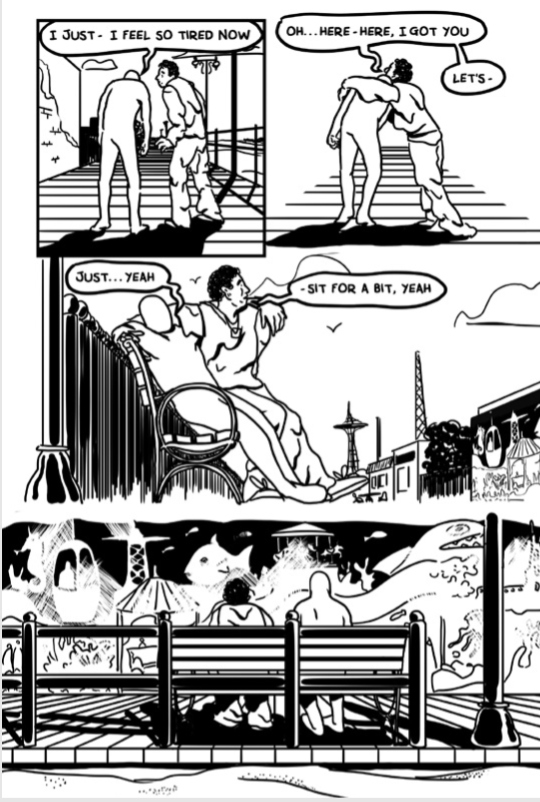
Thanks to Kalra’s brilliant art, the reader comes to understand that this advice itself is complicated for Allen; throughout Novelty, he sinks too deeply into individual moments, so much so that he ceases to look like Allen or exist in an image that looks like his “real” world. Throughout the comic, Kalra provides narration that sometimes belongs to one of Allen’s alter-egos and sometimes floats above the action as a disembodied third person; Allen, until the very end, is not able to provide words to describe or frame his own story. By showing the complicated distinctions between living in, being fearful of, and being distracted by “the moment,” Kalra quietly comments on how fully dissociation is misunderstood as disinterest and again complicates the idea that mental illness is somehow about weakness. While a reader might be tempted to understand the over-confident, solipsistic void-like alter ego as a coping mechanism designed to offset the anxiety embodied by Allen’s melting and blobby alter ego, it’s just as possible to understand the relationship as inverted: Kalra presents Allen’s weakest self as a coping mechanism, making this especially clear in a moment where the shabbily dressed avatar physically supports the exhausted and overwhelmed alter ego. It is this moment that leads Allen to emerge as Allen when he asked to take a picture of two people.  
On the one hand, the fact that Allen is able to find some kind of momentary unification and genuine happiness at the comic’s end might suggest that he is fully capable of negotiating his mental health without professional help or that the counselor’s assessment of his crisis was accurate. However, at least for this reader, the genius of Novelty is that, though the moment of peace is presented as a kind of breakthrough or novelty, the book reads as an origin story. Kalra hasn’t written a story about Allen coming to any kind of destination, so much as he has outlined the ways in which – and the reasons why – Allen will be the beleaguered and unwise hero of his own story from here on. The moment is new and it is, as Allen tells the reader in the only moment where he speaks as his own narrator, good enough; his fearful self has powers too, able to comfort and focus the part of him that is so interested in the moment that he’s willing to relinquish himself to it.
Still, this moment is only a moment. And even this moment is presented with a helping of dissociation, rendered as yet another photographic representation of living that Allen is literally sucked into, complete with a shark and an octopus. As such, Novelty is truly a novelty, the rare piece of art about mental health that does not pretend that the peace one might find with one’s self has to be any more lasting than the moments of chaos that come before it in order to be real and meaningful.
--------------------------------------------------------------
Matt Vadnais has taught college literature and creative writing classes for twenty years. He is the author of All I Can Truly Deliver and a contributor at covermesongs.com. For more comics coverage and the occasional tweet about Shakespeare, follow him @DoctorFanboi. For short takes on longboxes, subscribe to his channel of video essays. 

May 13, 2019

Matt Vadnais on Gareth A. Hopkins’ PETRICHOR and the Trouble with New Ideas

One of the very first scenes we get in Gareth A. HopkinsPETRICHOR mentions spending an afternoon in a Modernist art gallery. Though we see many panels that appear to have been inspired by Modernist approaches to representation – which is to say close-ups and shapes and movement where we might expect identifiably things – we don’t get a rendering of the scene itself. This is not a surprise for readers familiar with Hopkins’s brand of abstract comics; in fact, mentioning the Modernists as an influence is more of a clue regarding what one is to do with the images than he often provides. Modernism, in the visual arts at least – though there were similar things happening in literature, philosophy, and even chess – got its name in the context of a supposed revolution of ideas, overturning classical notions of one-point perspective and a variety of other methods of artistic training and techniques of representation in the favor of, for example, Cubist attempts to record all of the images of an object being reflected by light in every direction at the same time.

According to one notion of Postmodernism, Modernist complications of the idea that art was to record the world as it looked from a single perspective gave way to post-modern skepticism that a single perspective could see the world at all. Even as Petrichor is rendered in a visual idiom frequently more in-touch with the moderns than much of Hopkins’s work, he still creates pages that feel skeptical of the notion that anyone can actually draw the world. Though the book often includes shapes suggestive of buildings and stairways, they are frequently fractured or otherwise fragmented to a point where any attempt to fit them together into a meaningful representation of something specific would be impossible.
            
And yet, the title of Petrichor refers to the specific smell immediately following the rain after a long period of intense heat. Few things are more personal or more closely linked to individual memory than the sense of smell. To create a book that draws on Modernist and post-modern apprehension regarding the relationship between art and the real world in service of a comic ostensibly defined by a hyper-specific smell is brilliantly paradoxical: the comic that refuses to even attempt to show us depictions of the scenes it narrates – the author in a meeting, the author receiving news that someone he was once close to has died, the author with his family on the first day holiday – draws its name from a word that suggests that everyone would experiences a similar moment in the same, deeply personal way.
As the art loops and meanders with images that involve spirals and what look potentially like stairs, it occasionally returns to a nearly identical page layout, adding an additional color with every loop. Identical sentences, hinting at the scenes described above, repeat. Hopkins tells us, multiple times that “there are no new ideas.” Unlike his art that attempts to evoke things through unlikely juxtaposition and the forwarding of a new or at least highly individualized notion of how comic panels and images work, his text suggests such novelty is impossible. Like petrichor, a smell that has been documented since the origin of the word thousands of years ago, no idea – no matter how personal – is new. In other words, Hopkins decries the existence of original cognition against a backdrop that provides evidence of what sure appears to be original cognition in the form of artistic composition.
            
One way that Hopkins utilizes this paradox, as the comic progresses and loops its way into more boldly colored pages, has to do with subjectivity itself. “It’s easy to forget how many times you’ve fallen in love,” he says multiple times; the statement colors the pseudo-scene in which he feels unexpected grief upon learning that someone he knew intensely, if briefly, has died, suggesting that he indeed fell in love with her. However, the sentence is also colored by the one that came on a previous page – “there are no new ideas” – suggesting that the supposedly unique experience of falling in love with a specific person is so fully framed by one’s previous experience with love that each iteration becomes impossible to remember. The suggestion that our experiences of individual moments are all derivative of previous experiences of previous moments applies to each of the specific emotional moments described by the narration – rendered in language that would appear to be describing a unique experience – that Hopkins uses to evoke the boredom of an office meeting and joy of a beach scene. No idea – not even the most surprising emotion or cognition – is new for a brain that is constantly understanding the new in the context of the previously experienced.            
And yet, as troubling as it is to suggest that the purest or most memorable moments of one’s life are rendered in a mental or emotional language that is derivative of previous experiences, the comic goes a step further in troubling the notion of newness. In addition to depicting the dissonance created by Modernist art supporting the idea that there are no new ideas as a dissonance that happens in one’s own brain, Hopkins suggests that the lack of new ideas extends to the world as a whole. By juxtaposing deeply personal moments, art drawing on techniques meant to undermine traditional ways of representing reality, and a very old word for a specific smell, Petrichor suggests that Modernism itself – and its supposed revolution of the foundations regarding art, literature, philosophy,  and even chess – was never new. Many of the objects described by the narration are distinctly modern: computers, traffic, offices. And yet, “there are no new ideas.”
            
In other words, though a reader might be tempted to attribute the kind of emotional alienation of the self that Petrichor describes to the contemporary world and the particular ennui created by its social media and constant noise, Petrichor itself suggests that this is a mistake. Even our observations of the potentially redundant nature of experiencing individual moments of clarity or meaning or love aren’t new. Like the smell created by rain after a long stretch of heat, the awful realization “that it’s easy to forget how many times you’ve fallen in love” is one that has existed long before one personally experiences it.
The question for Petrichor, then, is whether or not newness matters in the face of something feeling undeniably present or meaningful. Does alienation from the self – the subject of so much art and music right now – mean any less if it also existed in the time of the Greeks? Do the ideas that drove Cubist attempts to depict an object from every direction simultaneously matter any less if they were little more than specific iterations of things previously experienced and contemplated? Is the smell right after the rain starts any less potent if it has already been named?
            
My personal – and, if we can believe Petrichor, definitely not new – experience of the comic suggests that the answer to each of the above questions is yes. When confronted with something as potent as the smell described by the titular word or a work like Petrichor, I find myself feeling and reveling in evidence that contradicts the work’s thesis statement. Even if the feeling of newness is itself something that can’t be new, it is a feeling.
---------------------------------------------------------------------------------------------
Matt Vadnais has taught college literature and creative writing classes for twenty years. He is the author of All I Can Truly Deliver and a contributor at covermesongs.com. For more comics coverage and the occasional tweet about Shakespeare, follow him @DoctorFanboi. For short takes on longboxes, subscribe to his channel of video essays. 

June 14, 2018

Review: DADDY DAY by Samuel C. Williams


There are life-affirming, life-changing, life-defining moments that occur in all of our lives, powerful in their arrival, profound in their intensity. Memorable. Momentous. Monumental. Often these are the moments to which we reach back in order to make sense of who we are, where we have been, where we might go. When we meet new people, these usually become the stories we tell.

But then there are the quiet moments. Those small, day-to-day affairs that we often breeze by on our way to something else. There are those who claim that it is the aggregation of all these little points in time that truly claim ownership of our identity -- that these small, seemingly inconsequential experiences are really the ones that make all the difference. Sometimes it is the moments which we thought were trivial or not worthy of notice that end up being the ones we miss the most when things change.

Parenthood is something that encapsulates both of these ideas -- combining both the momentous and the inconsequential. DADDY DAY, Samuel C. Williams’ new mini-comic from UK-based micropublisher Good Comics, encapsulates that encapsulation.

In his introduction to Daddy Day, Williams lets the reader know that the strips making up the book acted as “a form of therapy” for him as he dealt with the breakup of a serious relationship and having to transition “from being a full-time parent to mostly seeing [his children] on the weekends.” Both of these things challenged his identity, forced him to reassess how he envisioned life and his role in it, and compelled him to understand the importance of the little moments he had. In this 28-page series of vignettes, Williams is able to grant his reader access to the fruits of that process.
Combining both joy and sadness, Williams takes the time in the components of Daddy Day to not only chronicle each particular moment that he cherished with his kids, but, through his cartooning, register its emotional weight as well. There’s a real grasping in Williams’ work in this book, as if he is trying to both hold on to the enormity of his responsibility while at the same time being fully conscious of the impermanence of each moment.

There’s a couple of pages that are particularly striking in this regard. The first consists of a seemingly simple sepia-washed sequence of four panels in which his daughter plays on a swing. Here, Williams uses the power of the medium to create motion and time out of static images. The final panel of his daughter leaping off the swing with a smile on her face is indicative of so much -- Williams’ hopes, his pride in his daughter, his amazement at the young woman she is becoming. But it also points to the fact that each of these moments, precious though they may be, are just part of a cycle, a continuum of growth and change that no one can control. The small moment writ large.
The same sensibility can be found in a strip devoted to Williams’ son asking his father to “measure how much I’ve grown.” Once again, Williams celebrates his son’s development and, just through the act of documentation, points again to the vicissitude of each moment, that these little snippets of acknowledgment can carry as much weight as the major upheavals do and that both deserve attention and understanding.
Daddy Day is slight but deeply personal. Affecting in a quiet way, Williams expertly uses the medium of comics to transmit ideas and convey an emotional state. While it is one man’s story of healing, it ends up being a reminder to all of us to embrace life for what it is, not what we want it to be, and that every moment is an opportunity to create memories and to move forward.

June 10, 2017

In Lieu of Reviews Two: Eight Books For You

Elkin’s note: I’ve been busy with end-of-the-school-year shenanigans, and now I’m going on a two-week vacation. I have a bunch of books that are mostly spectacular which have been piling up on my “to-review” stack. I kinda want to come back from my trip relaxed, calm, and unconcerned, so I’m just gunna dump a whole bunch of these books in this week’s column. Know that if they are featured on this list, they are worth your time and money. I may come back to them again for full-length reviews in the future.

WHAT IS A GLACIER?
By Sophie Yanow
Published by Retrofit/Big Planet
Available HERE

Retrofit writes: Sophie Yanow, acclaimed creator of War of Streets and Houses, returns with another autobiographical tale of her trip to Iceland. Air travel in our environmentally fraught times is juxtaposed with her reflections on a relationship that ended a year prior.

Simply stated and drawn, emotionally powerful, this short book demonstrates why Sophie Yanow is one of the best cartoonists working today.

THE MAN WHO CAME DOWN THE ATTIC STAIRS
By Celine Loup
Available HERE

Celine Loup writes: Inspired by film noire and the works of Ira Levin and Shirley Jackson, The Man Who Came Down the Attic Stairs is a horror comic about motherhood and post-partum depression. Emma is excited to start a family in her new home, but motherhood brings far more isolation and despair than she is prepared to handle. If only her husband could understand, but he hasn't been the same since that day...

Highlighting Loup’s art, this one deals with some serious issues and takes the reader deep into the experience she is exploring.

THE CHRONICLES OF FORTUNE
By Coco Picard
Published by Radiator Comics
Available HERE

Radiator Comics writes: Originally published as a series of minicomics, The Chronicles of Fortune is a quirky and idiosyncratic adventure of Fortuna, the greatest superhero who could do anything to improve the world, but is tragically stricken with ennui. Coco Picard’s The Chronicles of Fortune follows the lives of Fortuna, and her alter-ego, Edith-May as they learn to cope with loss and recruit a team of friends along the way! Discover a temperamental stove, a nosy mountain, a goofy crocodile, a loner moth, and a singing goldfish as they lead Fortuna on her greatest adventure! At once charming, sad, funny, poignant, and bizarre, The Chronicles of Fortune keeps one foot in mundane reality.

Kinda bonkers, kinda sweet, kinda sad, this one is definitely a keeper.

COSMOS AND OTHER STORIES
By Rozi Hathaway
Published by Good Comics
Available HERE

Good Comics writes: Cosmos and Other Stories examines themes of loneliness and longing, with Hathaway’s uniquely expressive and dreamy paintwork taking the reader on a journey through various cities, towns, bedrooms and celestial realms. If you’ve ever been lost in a crowd, stayed up all night to talk to someone long distance, or felt the ache of an absent love, then this collection will speak to you.

More like comics-poetry than a straight narrative, this book demonstrates Hathaway’s evocative use of color and pacing to capture mood, tone, and theme.

PRETENDING IS LYING
By Dominique Goblet
(Translated by Sophie Yanow)
Published by New York Review Books
Available HERE

New York Review Books writes: In a series of dazzling fragments—skipping through time, and from raw, slashing color to delicate black and white—Goblet examines the most important relationships in her life: with her partner, Guy Marc; with her daughter, Nikita; and with her parents. The result is an unnerving comedy of paternal dysfunction, an achingly ambivalent love story (with asides on Thomas Pynchon and the Beach Boys), and a searing account of childhood trauma—a dizzying, unforgettable view of a life in progress and a tour de force of the art of comics.

This book is spectacular. Buy it.

EVERYTHING IS FLAMMABLE
By Gabrielle Bell
Published by Uncivilized Books
Available HERE

Uncivilized Books writes: In Gabrielle Bell’s much anticipated graphic memoir, Everything is Flammable, she returns from New York to her childhood town in rural Northern California after her mother’s home is destroyed by a fire. Acknowledging her issues with anxiety, financial hardships, memories of a semi-feral childhood, and a tenuous relationship with her mother, Bell helps her mother put together a new home on top of the ashes. A powerful, sometimes uncomfortable, examination of a mother-daughter relationship and one’s connection to place and sense of self. Spanning a single year, Everything is Flammable unfolds with humor and brutal honesty. Bell’s sharp, digressive style is inimitable.

It’s Gabrielle Bell. It’s good. Of course it’s good.

EARTHA
By Cathy Malkasian
Published by Fantagraphics
Available HERE

Fantagraphics writes: Eartha is Cathy Malkasian’s fourth graphic novel — a metaphorical fable that resonates with contemporary themes. For a thousand years the unfinished dreams from the City Across the Sea came to Echo Fjord to live out their lives. Sex fantasies, murder plots, wishful thinking, and all manner of secrets once found sanctuary in Echo Fjord. Emerging from the soil, they took bodily form and wandered the land, gently guided by the fjord folk who treasured their brief and wondrous lives. But recently, city dreams have stopped coming to Echo Fjord, and without their ethereal tourists the fjord folk suddenly feel lost. Has their ancient way of life ended for good? Has something happened to the city? Are all the dreamers gone? One of Echo Fjord’s inhabitants wants answers: The story’s eponymous protagonist Eartha wants to visit the City Across the Sea, but how will she get to a place no one’s gone to for a thousand years? The city isn’t on any map, or in anyone’s memory. Without thought or hesitation she ventures into the limitless waters, hoping to find the City and solve the mystery. Cathy Malkasian’s Eartha is an expansive tale of pastoral life, city corruption, greed, and addictions, and reverberates with questions plaguing us today, such as the alienating effects of hyper-connectivity and the self-destructive obsession with novelty. Malkasian’s drawing is notable for its rigorous draftsmanship, stunning landscapes and depictions of nature, the gestural nuances of her characters, and her sophisticated storytelling, all of which are on display in Eartha, making this the author’s lushest and most impressive graphic novel yet.

I’ve been working on a full-length review of Eartha in fits and starts for the last couple of months, but I just can’t seem to make it stick. My thoughts on theme keep falling apart. Regardless, this is a beautiful book. Malkasian’s pencils are breathtaking and, while it doesn’t entirely hold together, in the end, it’s worth owning just to look at.

THEN IT WAS DARK: A PARANORMAL ANTHOLOGY
Edited by Sarah Benkin
Published by Peppermint Monster Press
Available HERE

Have you ever seen something you can't explain? Heard a voice speak a warning to you as you drifted off to sleep? Ever see a woman with no face singing to herself on a long, empty road? Ever talk to a serial killer? From the strange, nighttime experiences of a man deployed in Iraq to the story of a house haunted by a slightly mad old Jewish matriarch, from a chaplain's experience performing an exorcism to the history of spiritualism, to a ghost that seems to love LARPs, Then It Was Dark collects a variety of strange experiences from talented and diverse voices. A collection of personal paranormal experiences, true ghost stories, friend-of-friend tales and brushes with the unknown.
Check out the now-funded Kickstarter for further details. This book has many spooky, scary, and unnerving tales. As with many anthologies, the contents are hit-or-miss, but those that do hit, hit hard and well.

December 3, 2016

Review: EVERY LIFE I'VE EVER LIVED by Robin William Scott

Sometimes a work of art can come into your life at the exact time that you need it. So it was with the new book by Robin William Scott, Every Life I've Ever Lived.

I've been in a funk of late for various reasons ranging from Nazis to work concerns. My day-to-day had been a grind. Stumbling through it was becoming increasingly difficult.

Then Scott's book showed up in my mailbox (I had pre-ordered it weeks before and had pretty much forgotten about it) and, through reading it, I was healed in some small way, just enough to see the light through the darkness. 

As I wrote in my Comics Bulletin REVIEW:
We all, at some point, question who we are and why we do the things we do. It is our nature. Not one of us, though, if we are really honest about it, has really found an answer to these questions that will fully suffice and reassure. A temporary stay from such thoughts is the best we can hope for, and that comes only either through capitulation or compromise. To continue to ask these questions unmoors us and leads us only towards depression and crisis.

Tomorrow, and tomorrow, and tomorrow / Creeps in this petty pace from day to day / To the last syllable of recorded time…

Yet, like Macbeth, Scott is somehow able to not succumb to the despair in the end; he’s somehow able to throw a “warlike shield” before his body in his own way. He answers his questions neither by making sacrifices nor giving up; rather, he turns to his talent, he turns to his art, he creates meaning through the sheer process of meticulously documenting the moments, discerning the defining beats of the day and capturing them on a piece of white paper with the marks left from a black ballpoint pen.

You get the gist. 

If you are in a similar situation, I'd be honored if you gave the rest of the review a once over, then buy a copy of Scott's book, and see if you can heal too.