May 6, 2019

The Future Is Unwritten: Ryan Carey Interviews RAIGHNE HOGAN of 2DCLOUD About The Publisher’s Recent Struggles And Their Plans Moving Forward

After a long period of silence and speculation, iconoclastic small-press mainstay publisher 2dcloud has re-emerged with their 2019 Kickstarter campaign. I recently spoke with co-publisher/founder Raighne Hogan about matters past, present, and future. Full disclosure: I’m rooting for their campaign to be successful and plan on contributing myself, but there are a number of people in the small-press community who feel that they’d like some more concrete answers as to what’s going on before they make the decision of whether or not to back the campaign themselves. His answers here may or may not satisfy, but after well over a year of shying away from anything resembling the “limelight,” it’s important, I feel, to give Hogan the chance to answer some questions so that people can make an informed decision on whether or not they wish to support his company’s efforts going forward. 


For more information on the 2019 2dcloud Kickstarter, check it out HERE 

Ryan Carey for YCE: 2dcloud has always been known for its unique sensibilities as a publisher, but along with that there's also been, right or wrong, a perception of insularity about your company. I recall, for instance, a general feeling in the Minneapolis cartooning community that you were off in your own corner, doing your own thing, which can be fine, even worthy of respect in a way --- mind you, I say that as a bit of a recluse myself. But lately, there has been a kind of "radio silence" on 2dcloud's part that has given rise to much speculation about the company's future. When word got out about the moving of your base of operations to Chicago, that speculation intensified. What can you tell us about the reasons for the move, your current financial footing, and status of publishing operations going forward?

Raighne Hogan: Have you seen Gattaca? It’s this dystopia, where the populace is split basically between designer babies and those born natural births. The designer babies get the best jobs, and those of natural birth get what’s left.

There’s this scene where these 2 brothers swim in the ocean. One is a designer baby, one is not. They have this regular challenge to see who can swim the furthest before turning back. They would swim in such a way as knowing that they had to conserve some energy for the swim back to shore. And in the film, the designer baby brother always wins. But one time, the brother born of natural birth beats him. And later on in the film, he explains how he did it — he didn’t save energy for the swim back to shore. He gave everything, put everything on the line for this challenge, to defy the fate he was given.

In some ways, that was kinda the model I pushed us to follow. Full of idealist zeal. I viewed my life in service to artists. When I was really young I had this idea that I wanted to help people, I wanted to save the world. But in my twenties and early thirties, I thought, well, if I could just help and support a small group of people, that would be enough.

But you know, that’s a movie. And life is not. Ideas can be powerful tools to motivate people. To give people something to unite behind. They can become totems to life goals, or even totems to life itself. But idealism can be dangerous.

When we were in Minneapolis we were workaholics, and our bandwidth was limited, so we didn’t get out much. Maybe what you are describing as radio silence is 2 people who felt utterly destroyed, completely gutted — after having survived a divorce and the near implosion of their company. Of friendships that broke down, hospitalizations, of being devastated by things that occurred within this community, and just not quite knowing how to navigate all of it.

I initially saw Chicago as a chance for something new, as hope. Full-on idealist vision — after living in my office, sleeping on a yoga mat, I would go on to describe my move to friends as Chicago being the center of the universe. While I love Minneapolis, and a lot of other cities, for the type of comics that excited me most at this stage in my life, Chicago felt like the beating heart of the universe. And I wanted to be there.

My life and the label continued to implode, but Maggie and I are rebuilding now. And this Kickstarter we’re running is a look at what that future looks like.  
Ryan: In response to credible accusations of untoward and highly unprofessional behavior from a former associate of 2dcloud, a new leadership structure for the company consisting of a number of artists from diverse backgrounds was put in place, but it appears the running of day-to-day operations is now being handled once more by yourself and Maggie Umber. Did the board/collective dissolve, did it never quite come together, or is it in place in some fashion the broader public may not be aware of?

Raighne: The structure put in place at that time was not stable, and as such, dissolved almost immediately. Publishing is hard and can be totally heartbreaking. But if anyone were to clean up the label and make things right, it should be Maggie and I doing that. Which is what we are doing. This is our baby.

Ryan: Concurrent with these other situations there have been issues raised in regard to non-payment of artists. Do you have a response to these, or a plan to address them?

Raighne: For the first 8+ years, we paid everyone on time. We’ve been getting caught up with that behind the scenes. It’s been a slow process. Our Kickstarter will get us caught up on these debts at a much quicker rate than if we just stick exclusively with day jobs.

In the interim, we’ve not been touring or publishing new works.
Ryan: How has your view of your publishing mission changed or evolved in light of these various circumstances already addressed?

Raighne: We built this company out of love, and to support the artists we worked with. We gave everything we had for it. But in doing so, we neglected to take better care of ourselves, which has had a pretty direct correlation to the health of the business. Maggie was hospitalized, which she recently wrote about, and I guess I’ve been going through a pretty existential depression. All life lost meaning for me for a good while. I became so delusional for parts of 2018 that I thought maybe I had already killed myself, and simply forgot, and that this was hell (wry laughter).

I recognize that we must go slower, that we have to take better care of our physical and mental health if we are to continue. Sometimes the impossible things we strive for are just survival.
Ryan: You've recently re-emerged from the metaphorical "bunker" with an ambitious 2019 Kickstarter campaign. What can you tell us about the books you intend to publish and the cartoonists you'll be working with?

Raighne: I’m really excited about the artists we’re working with for this Kickstarter. I like that it showcases our history and the artists we’ve worked with over the years, alongside our forthcoming Spring 2019 Box. I’m really proud of what we’ve accomplished through our 12 years of running 2dcloud. And while ya, there are a lot of things I wish we could do differently, we can’t travel back in time. But we can learn from our mistakes.

Mirror Mirror 3 continues our flagship anthology series, where each volume gets new editors and a new vision. This one is edited by Plum Press [Haejin Park, Paige Mehrer, Sophie Page] and features only them inside of it. They are one of the most exciting new artist collectives and publishing labels. I love their work so much and am so excited for their future. They are totally going to blow up. Definitely check them out at TCAF this year and buy everything they publish.

Copy Kitty is by Kyung Me. We’ve really loved her work ever since we saw her Bad Korean, published by Space Face. I was super jealous that Space Face got to publish her first lol. She’s so brilliant. Copy Kitty is mournfully gorgeous. A beautiful beautiful, heartbreaking book by a brilliant artist.

Röhner by Max Baitinger, originally published in German by Rotopol. I love this man. He is hilarious and so charming. We met at a TCAF some years back. I knew that I loved his work and wanted to work with him for some time, but I didn’t know what or when that would be. Love love his dry humor and superb craftsmanship. Röhner is a riot, filled with dark and sometimes violent humor.

Tommi Parrish’s book, Yet Here We Are Dealing With The Things We Should Have Ignored is a deep and wide collection of a lot of their out of print works. It’s a mountain, they are such an epic and badass workaholic. Also, such a sweetheart. Love them. Definitely, support their GoFundMe so they can move to the states, be with their sweetheart, and make a living from their art.

Grand Electric Thought Power Mother, by Lale Westvind. I’ve wanted to work with Lale for a bajillion years and have been hustling them to that end for about just as long of a time. But it was Kim Jooha that was finally able to make that happen. At TCAF last year, Kim suggested the project at a brunch thing, and that she would edit it. Thank you, Kim!

Hotel Vibes by Chou Yi is another title edited by Kim Jooha. I think I first met Chou Yi at Short Run a number of years ago now. But this was a title solicited by Kim and we are so lucky to have it in our line up this season.

And lastly, Diary Comics by Tara Booth. Tara is such a brilliant and funny person. Her work ethic and speed of growth as an artist are so damn impressive. And she has such a wonderful laugh. This book charts Tara’s brief time in Chicago, and on the road, dealing with the struggles of sobriety. I’m still scanning her originals for the book — such a beast. Oof.

So, our Spring Box 2019, at the $99 level brings all 7 of these titles into one box. These are going to be astoundingly gorgeous books by artists at the top of their game.
Ryan: In what ways do your proposed 2019 publications carry on 2dcloud's aesthetic tradition and in what ways do they break from it?

Raighne: I really don’t see it as a break from our aesthetic. It’s more of a return to form. So, I guess to me, our 2019 slate is a bold announcement that we are back. It showcases a pretty wide range of colorful and exciting work that fits perfectly within the oeuvre of our label.

Ryan: In years past, your publishing slate has frequently shared thematic links ranging from the oblique to the direct. Are the 2019 books "in conversation" with each other in a similar fashion or otherwise part of a larger aesthetic or conceptual statement?

Raighne: Definitely. I mean, in my eyes, these works fit so well together. This looks like the future of comics.
Ryan: How have your criteria for selecting works to publish changed in light of the numerous changes your company itself has undergone?

Raighne: I wouldn’t say that it has changed exactly. We remain focused on a balance of bold new works by exciting artists. Some of them are maybe more established than others. But they’re all fantastic. We also still have a focus on supporting artists from a diverse set of backgrounds, subject matter, medium.

The main thing now is trying to have a better balance of commercial viability in a given season, being more careful with some of the riskier bets, and in general, to pursue less overall. We’re a smaller team now, and so we need to be more aware of the limits of our bandwidth so that we can do a better job of supporting the artists we work with.
Ryan: What goals do you have as a publisher that remain unmet? How do you see yourselves crossing the bridge from where things are to where you'd ideally like them to be?

Raighne: Well, right now we’re not quite financially sustainable. This Kickstarter will make great strides to that end. Should this work out, we have more modest, but just as exciting plans for the future.

Ryan: When propels you forward at those times when circumstances seem to be at their most insurmountable?

Raighne: Looking to our history, at all the beautiful books we’ve published, remembering the good times, of how we have brought people together. And knowing that we can do that again, we can learn from our mistakes and right this ship. We can continue to champion up and coming artists alongside spotlighting lesser known ones, and the established giants of this scene wishing to try something new.

Ryan: Having been in the business for over a decade now, what do you look back on and wish you'd done differently? Are there any mistakes you've made that prospective future publishers would do well to learn from, or that you've learned a great deal from yourself for having made them?

Raighne: Know your limits. I think taking risks will always be important, but that has to be balanced against some pretty obvious things like maintaining your own health and mental well being, having contingency plans should some of your risks not pay off when things go south.

I would also say choose who you work with wisely. Know what you are looking for in choosing who to work with. Also, life happens. Things come apart. I mean really, if you do anything long enough, you are bound to make a few mistakes. Don’t operate beyond your bandwidth. You will have a much easier time of recovering if you’re not already overloaded for years at a time.

Pay attention to other small businesses, observe their triumphs and failures. These can aid you in moving quicker to your own successes while avoiding common pitfalls.
Ryan: Innovation and evolution are never easy things to consistently keep going, yet if there's one thing your company is known for it's routinely defying and exceeding expectation almost as a matter of course, maybe even demolishing it all together on a conceptual level. Going forward, what can readers look forward to seeing from 2dcloud that they've never seen before?

Raighne: I could be wrong, but I don’t know if some of the books we publish would be possible at another label. At least not in the ways that we publish them. Also, Maggie and I are going to start making very small scale, short-run works once again.

The main thing is just maintaining a better work-life balance, and keeping the publishing schedule and workload itself balanced as a part of that. None of this will be easy, but I’m optimistic. It will feel good to move forward once again.
-----------------------------------------------------------------------------------------

Ryan Carey lives and works in Minneapolis, Minnesota. He writes about comics for Daily Grindhouse, Graphic Policy, and at his own blog. He also maintains a long-running film review blog, Trash Film Guru.

May 5, 2019

ICYMI -- Small Press Comics Criticism and Whatnot for 4/29/19 to 5/3/19

Highlighting some great small press comics criticism being published, as well as other random things that have caught my eye over the past week.

COMICS CRITICISM

* Andy Oliver on MEMOIRS OF A BOOK THIEF (SelfMadeHero) written by A. Tota, illustrated by P. Van Hove, and translated by E. Gauvin, "a delightfully dark account of a man who buys into his own invented legend."

* John Seven also reviews MEMOIRS OF A BOOK THIEF, writing "And so we, as a society, have all become that crowd of Paris existentialists, fascinated by the forbidden and embracing it as a way of making ourselves seem interesting and different. But in doing this, we’re vulnerable to our own book thieves that hover around us waiting to fulfill the destiny of a parasitic relationship that we don’t even realize exists."

* Kevin Bramer does a quick write-up of Rob Jackson's MERCHANTS, "a thoroughly entertaining read with a few sections where I laughed out loud, which is always a welcome surprise."

* Ryan Carey reviews Max Clotfelter's THE ELEMENTS OF ROUGH VOLUME TWO, writing "Somehow, some way, through it all, Clotfelter seems accepting of “his people,” while not letting them off the hook for the voluntary part they play in their own degradation. It’s a tough balancing act. I’m not even sure how he pulls it off. But he does — and nobody else can, or would even be advised to try.

* Jenny Robins on LULU THE SENSATIONAL ... AND THE FAMILY SECRET by Helen Blejerman, writing "There’s a lot going on in a very spare frame basically, one of those deceptively simple books, but not over-laboured. Deserving of a second or third reading."

WHATNOT

* Alex Dueben interviews DARRYL AYO about his work and process.

* Sloane Leong talks to GLYNNIS FAWKES "about her new projects, process, and her residency experience."

* Nancy Powell interviews MICHAEL DEFORGE "about the absurdity of cults in his newest graphic novel, LEAVING RICHARD'S VALLEY."

* Leela Corman has a new comic up on The Believer called VICTORY GARDEN.

* Anna MoriartyLev has a new comic on Spiralbound called ROSE.

* Irene Velentzas writes this interesting piece over at TCJ called THE ART OF JUXTAPOSITION: BOTTICELLI AND KARL STEVENS.

April 29, 2019

Drowning in Youthful, Vulnerable Romance: Fred McNamara reviews HAZE by Rosie Haghighi

The pleasant, comforting glow of Haze perfectly captures its swooning, playful nature. Bolstered by her sizzling art, Rosie Haghighi crafts a romantically sumptuous tale of love caught in emotional entanglement. Haze fuses together a variety of disparate elements, ones that occasionally have difficulty talking to each other. Yet Haghighi is able to unify these elements together via a pair of intriguing protagonists, whose teasing romance gives Haze a fluid, bobbing feel.

When reading through Haze, the most apparent thing is the blending of shape and color. The romantically entwined protagonists, Wade and Finn, are two high school students with a shared passion for swimming. The comic begins and ends with scenes involving the two boys in water, either in an ocean, in a swimming pool, or a bath. Complimenting this focus on water, Haghighi’s sketchy penciling blends landscapes and atmospheres, create a pleasantly loose, liquid tone throughout the book. 
This use of water as a central theme acts as a reflection of the seemingly fluid nature of Wade and Finn’s relationship. Haze captures their relationship as not being set in stone. Instead, it’s shown as being in motion, traversing from the pair half-acknowledging their feelings for each other to, later, relinquishing the pretense of pretending and admitting their desire to become a couple. The climactic actions in the comic’s final few pages that enable the pair to be together act almost as a dam bursting, a wave of emotions pouring out.

Countering this fluidity is the comic’s panel structure. Often, the characters and their actions are condensed into compact panels which gives the otherwise free-wheeling feel of Haze a welcome sense of confinement. Panels large and small still make room for Haghighi’s swirling art, whose gorgeous, rippling nature comes into contact with everything and everyone featured in Haze, fashioning a cohesive visual voice.
Fractured love is the other chief theme of Haze, and this provides a darker, more stern alternative to the otherwise playful attitudes Finn and Wade have for each other. In contrast to Haze’s emphasis on color and shape, the dialogue in the comic is minimal and vague. Fortunately, Haghighi flexes her narrative muscles in these moments and what precious little dialogue there is does a great deal in telegraphing not only the disconnect between Wade and Finn but also their desire to reconnect. 

The actual story of the comic is equally fragmented. Haze’s narrative is less of a complete story, and more of a series of interlinked scenes, snapshots of a relationship that has withered to some extent but eventually blossoms into something more unified. The pacing feels rough, the scenes occasionally bolted on, but the payoff is well received. The aforementioned skeletal use of dialogue ends up complimenting this narrative structure well. These loosely connected scenes aren’t cluttered by clumps of dialogue and action. Haze’s brief page run reflects Haghighi’s ambition, opting to portray a relationship neither at the beginning or the end, but rather, caught in the middle.
Bonding these scattershot scenes together is Haghighi’s supremely warm artwork. The colors, chiefly composed of a red and blue palette, bear an almost nostalgic quality, the warmth exuding from the pages rise like the temperature on a hot summer’s day, inviting the reader in. There’s a great emphasis on colors as a communicator of emotion

Haghighi primarily uses reds to shade in the characters and blues to illustrate nearly everything else. The shades of red that illuminate Wade and Finn highlight their warmth for each other and the romantic tension between the pair. It’s a subtle bit of business that underscores the tenor of their relationship. Haghighi also expertly uses a colder shade of blue to indicate a series of hallucinogenic flashbacks Wade experiences throughout the comic to rosier days spent in Finn’s arms. This darker blue emphasizes the coldness Wade feels, isolated from Finn and his initial lack of confidence regarding how to amend their relationship.
The story itself buckles somewhat in Haze’s climactic scenes. Throughout the comic, Wade’s flashbacks increase in their severity, culminating in the comic’s final, action-packed scene. The decisive moment in Haze that brings the two back together comes when Wade believes he sees Finn diving into a stormy ocean during a beach party and dives in after him. Seeing Wade make a seemingly odd venture into the sea, Finn pursues him, eventually rescuing Wade from drowning. 

It’s a sweet scene that breaks down the emotional barriers the pair have created against each other earlier in the story, but it’s communicated in a jarring manner. There’s no hint given that what Wade witnesses is nothing more than a false vision. The ensuing drama that swells from the duo diving in to rescue one another is nimble and heartfelt, it’s just that Wade’s triggering of these events feels rushed and jumbled. This perhaps highlights the weaker points of Haze’s brief, scattershot structure and suggests how scenes such as these would benefit from a longer length to allow such scenes to breathe.
Still, in Haze, Wade and Finn serve as the glue that binds all of these intricate elements together. Haghighi portrays them as an empathetic, flirtatious pair, yet hardwired with youthful vulnerability. The fondness they have for each other is juxtaposed by a seemingly self-imposed distance. It’s as if their eventual succumbing to each other marks a leap of maturity for them, with Finn telling Wade to cease with the disingenuous, casual flirting and become more open, more direct, more truthful in his feelings. 

Despite some jagged narrative delivery scuppering its emotional weight, Haze is an evocative, endlessly charming affair. It’s a comic who’s appeal lies in how it shows high emotions through sharp, precise art. Story and art grow around each other with effortless care and attention to detail, and Haghighi’s depiction of a torn love that manages to rectify itself bolsters its value. Haze is an enchanting comic who’s emotionally tuned-in state makes for satisfying reading.
-----------------------------------------------------------------------------------------
Fred McNamara thoroughly enjoys writing about comic books and TV shows you've never heard of. His love of indie/small press comics arose through his role as senior editor for the superhero/comic book hub A Place To Hang Your Cape. He's currently enduring a prolonged period of sleepless nights as his debut book, Spectrum is Indestructible, is gearing up for publication later this year from Chinbeard Books.

April 22, 2019

In the Shadow of the Apocalypse: Fred McNamara reviews WE HAVE TO GO BACK by Jordan Alsaqa and Sally Cantirino

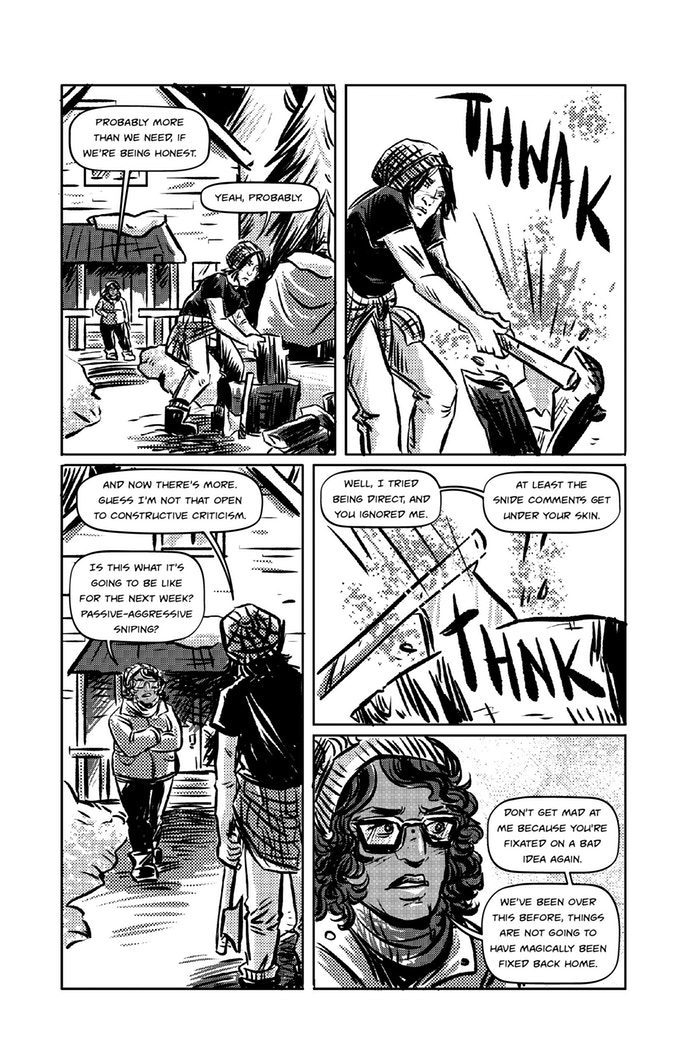
The emotional fallout of an apocalyptic event is a tried and tested formula in character-driven storytelling. The urgency of the disastrous situation flings characters into emotional turmoil, at times forcing them to come to terms with their own mortality. It’s refreshing, then, to find that Jordan Alsaqa and Sally Cantirino take the apocalyptic narrative a step further with We Have To Go Back. This is a comic who’s story is driven by an undisclosed disaster, but it’s not about the disaster at all. Such is the level of detachment We Have To Go Back has to its own propulsive event, i.e. the specifics about what exactly has happened that displaces Jo and Katie from their lonely town to the neighboring desolate woodland.

Instead, the story is about the unplugging and reconnecting of Jo and Katie’s romantic relationship. Across the comic’s brief 39 pages, Alsaqa’s story takes the reader across the ebb and flow of We Have To Go Back’s emotional current. The story is split between two points in Katie and Jo’s relationship, with the bulk of the story placed during the pair’s fractured, tumultuous time in the woodland, post-disaster. The other half of the comic takes place prior, positioning Jo and Katie’s relationship in happier times. 
The dialogue and character traits Alsaqa constructs for Jo and Katie work to form a time frame of their relationship. In the flashback segments, their relationship is just blossoming, with the pair growing used to each other’s quirks and lifestyles. In the present-day segments, on the other hand, their relationship feels aged, weary, exhausted from living their day-to-day existence. It’s as if the passage of time weighs upon their shoulders, to the point where their relationship is starting to crack. This push and pull of emotional states in Jo and Katie’s lives gives We Have To Go Back a tense rhythm. 

Cantirino’s artwork illuminates these contrasting moods effortlessly. Produced in a newsprint-esque fashion, her black-and-white linework carries the stark immediacy of the story. She captures the torn nature of Katie and Jo’s relationship by often drawing them separate from each other, either because of their bouts of sparring or separated because of the panel structure. It’s a powerful visual nod towards the damaged attitude Katie and Jo have for their relationship, how it has dissolved into an antagonistic affair, as Katie becomes fixated on returning to their desolate town while Jo wants to remain within the confines of the safety of their makeshift home.
What’s harder to pin down is the nature of the incident that triggers the breakdown of Jo and Katie’s lives. As previously mentioned, the incident itself is minimal compared to the real focus of the comic, yet is that a justifiable excuse for not giving the disaster a tangible sense of scale? Such is the skeletal amount of information presented to the reader regarding the disaster itself, so much so that it becomes awkward to try to give it a sense of its enormity. It throws the comic into a tonal limbo that’s salvaged only by that lack of information, delivering a haunting, unknown edge to the disaster.

Still, We Have To Go Back’s focus is firmly on its characters, and it never loses sight of that. Cantirino and Alsaqa fuse their skills together in the comic’s final arc when Jo finally agrees to allow Katie to return to their town in search of supplies. As Katie departs, Jo experiences an epiphany that rescues their relationship; she realizes that Katie’s encouragement for her to stray from her comfort zone has been a key factor in their relationship. This revelation is the culmination of the comic’s zig-zagging narrative construct, and Katie and Jo slip back into each other’s arms via Cantirino’s connective art, which, here, finally shows the duo closer together in the same panels. It’s a reflection of their loving nature for each other and for the rescuing of their relationship. 
It’s quite creatively satisfying to see an artist and writer work in tandem like this to ensure that the story and the characters they’re creating are delivered with as much of an emotional impact as Cantirino and Alsaqa have here. So often in the comic’s interior pages, writer, artist, letter, etc distinguish their roles as such. Yet with We Have To Go Back, the duo credit themselves as joint creators. The cohesion in the comic’s intertwined visuals and narrative is a testament to that.

We Have To Go Back is a tense, unfolding read, bolstered by intricate artwork and in-tune moods from its characters. Alsaqa’s empathetic characterization and meticulously constructed, character-driven story ensure that the reader pays heed to Katie and Jo’s clashing frames of mind. Cantirino’s art relays the subtle intensity of Katie and Jo’s situation well, but it is delicate enough to convey the more intimate moments of the story. Cantirino proves she’s equally effective in sketching out barren, open landscapes that mirror both the distance Jo and Katie have for each other and the uneasy nature of the disaster that throws the pair out of their comfort zones.
We Have To Go Back is less of a story and more of an in-depth testing of the romance between its central characters. That level of focus on the comic’s players, the unresolved nature of the apocalypse that kickstarts the story, and the minute number of characters itself require a skilled set of hands to make sure We Have To Go Back hits all the right emotional beats. Alsaqa and Cantirino, coupled with editor Danny Lore, deliver a bare, heartfelt tale of the survival of love in the shadow of a threat larger than life itself. 
-----------------------------------------------------------------------------------------
Fred McNamara thoroughly enjoys writing about comic books and TV shows you've never heard of. His love of indie/small press comics arose through his role as senior editor for the superhero/comic book hub A Place To Hang Your Cape. He's currently enduring a prolonged period of sleepless nights as his debut book, Spectrum is Indestructible, is gearing up for publication later this year from Chinbeard Books.

April 17, 2019

The Ephemeral Comfort Of Their Elders: Sara L. Jewell reviews GONZALO by Jed McGowan

Set against the hellish post-apocalyptic backdrop of a decimated future California, Jed McGowan’s Shortbox comic Gonzalo follows an aging robotic bear who has been “several decades in the field” and her young flesh-and-blood cub, now nearly grown. The robot has been tasked with caring for the young animal by humans who are likely long dead: their conservationism aimed at protecting a single bear seems in retrospect a humorously small and pitiful effort foregrounded by the surrounding environmental collapse – burned forests due to drought, cities gone dark. McGowan’s grainy color palette gives the impression of air that is never completely clear of smoke, and the California drought is the implied result of human-instigated climate change. The pair of grizzlies make their way across a fraught and hostile landscape with no particular destination or goal in mind other than immediate survival. Behind this more personal story, however, is McGowan’s exploration of the human tendency to take destructive advantage of that which nurtures and sustains us, and the way in which this plays into the relationship between mothers and their children. McGowan skillfully sets up a story that interrogates how human nature has fueled the decidedly unnatural phenomenon of climate change, and how the dissolutive sacrifices of the story’s central matriarch mirror the decline of the earth itself. 

Primarily through modeling behavior, the narrator, whom will hereafter be referred to as “RB” or “Robot Bear”, takes on the role of Gonzalo’s mother, utilizing the information stored in her secondary computer to show Gonzalo how to be a grizzly. And make no mistake, Gonzalo is first and foremost a book about motherhood and its sacrifices, though there is a certain irony in Gonzalo being instructed in “real” bearhood by an ersatz bear. RB may look like an animal, but her narrative voice is often very human. 
Despite, or perhaps because of, her human-made consciousness, RB guides Gonzalo with genuine love and devotion. Like any parent, she constantly questions her choices: has she allowed Gonzalo to stay with her for too long, stymieing his independence?  Has he become too reliant on her guidance to find food and water or to avoid danger? Also, like any parent, RB increasingly finds the information in her secondary computer to be antiquated or obsolete. Built by humans who lived in a world that no longer resembles the one laid out before her, the secondary computer cannot offer foolproof data. As they search for water, she follows her internal map to a stream that has dried out.

A profoundly changed topography has rendered the data she has for navigating the world outdated and sometimes useless. To be a bear in this world means something new and different than it once did, as to be an adult changes with each subsequent human generation. Humans, once invested deeply in Gonzalo’s survival - by evidence of RB’s existence - are now a threat to his life, concerned only with their own. “Our human predators hunted us most often during the day,” RB laments. As she observes when they avoid highways: “cars had become rare, but humans still stuck to paved roads…familiar pathways.” But the “familiar pathways” in RB’s secondary computer are not always reliably familiar - she and Gonzalo must forge new pathways to find the evasive resources Gonzalo requires to survive.
Even so, RB keeps a sharp eye out for opportunities to both nourish Gonzalo and show him what to do when she’s gone so that he can take care of himself. The pair come upon a pack of coyotes feeding on a fresh kill. To take their prey, RB roars, attempting to teach Gonzalo that intimidation can sometimes be enough to overcome an adversary. 

However, these coyotes are desperate, and one attacks RB. RB feels “remorse” for killing the coyotes because as there is metal and not flesh beneath her pelt, she has an advantage over them which is “not fair”. This is an interesting parallel to the technological advantages humans often have over animals that enable them to overhunt, overfish, and over strip land, but also to cause the devastating climate change that has wracked the landscape and ultimately made it unfit to support life. RB’s single-minded focus on caring for Gonzalo echoes a human self-interest that puts itself and its children first, no matter the consequences.
RB and Gonzalo are both facing up to their own mortality. RB, though a robot, is soon likely to experience critical system failure as she has been without maintenance for many years. And in all their searches, they have not found a mate for Gonzalo, who RB muses may be “the last grizzly in California”.

RB’s consciousness considers more than terrestrial matters. She also contemplates her own existence, turning her eyes to the stars, now brightly visible and unobscured by city light pollution. She narrates the familiar mythological story of Arcas and Callisto. Callisto, a nymph, carries on an affair with Jupiter, king of the Gods, and bears a son, Arcas. Jupiter’s wife Juno, angered, transforms Callisto into a bear. Coming upon his mother while hunting in the forest, Arcas is about to kill her, but Jupiter quickly transforms him into a bear as well. The mother and son are immortalized in the sky, as the constellations Ursa Major and Minor. RB sees herself in Callisto, who was “both a bear and human,” meanwhile “I was a bear with a mind programmed to be like a human’s…but God hadn’t made me this way. The researchers had.”

Like Callisto, RB is willing to make the ultimate sacrifice to protect Gonzalo, confirming for the reader her deep maternal attachment to Gonzalo which goes beyond her programmed, prescribed role in assisting grizzly conservation. When RB and Gonzalo become separated after fighting the coyotes, she encounters two humans – and father and son – and two competing directives: protect Gonzalo, but do not approach humans. RB doesn’t hesitate to proceed towards the hostile human pair. She remarks that they are “no longer predators”  - no longer at the top of the food chain – and that the tables have turned, and “They had the startled look of prey about to be eaten.” Wrenchingly, RB must use the same roar she used to try and intimidate the coyotes earlier in the story to scare Gonzalo away from her and thus save him; “I had done all I could for Gonzalo. I had done too much.” She violates another directive, biting down hard on a human’s leg so he cannot pursue Gonzalo. The admission that she has “done too much” suggests that RB’s having remained with Gonzalo for longer than a natural grizzly mother would is due to a selfish, human impulse to remain with her son for as long as possible. Her scientific attachment to him has irrefutably transformed into human maternal love, and she has been loathe to leave him. 

Unaware that RB is made of metal and thus cannot provide meat, the human pair crow that they will “eat for a week” after killing her. Like the selfless Giving Tree (perhaps referenced by the spectral tree on the comic’s back cover), RB hopes that the humans will nonetheless take her pelt for warmth as she fades into darkness. Her last thoughts are of Gonzalo.
As a book about the sacrifices of motherhood, Gonzalo also cautions against taking mothers for granted, against believing that they will always be there to nurture and protect us. In doing so, it is also about how we have taken “Mother Earth” for granted, believing that she will always provide for us no matter what iniquities she suffers from human hands. If we shortsightedly depredate the earth to enjoy ease and convenience in the here and now, there will be little left later to sustain our children and grandchildren, or anything else living. However, Gonzalo’s opening lines offer a message of hope, as they describe RB breaking open a burnt tree to reveal ants for Gonzalo to eat: “There was life,” she thinks “within this dead tree.” This hope, that life will out, is couched in RB’s forward-looking, parental love for her young charge, which, in her sacrifice, rejects trading young people’s futures for the ephemeral comfort of their elders. 
---------------------------------------------------------------------------------------
Sara L. Jewell is a freelance writer, artist, comic creator, and educator based in New Jersey. You can find her at saraljewell.com or rambling on twitter @1_saraluna. All email inquiries can be sent to 

April 15, 2019

The Full Spectrum of a Complicated Situation: Rob Kirby reviews A FIRE STORY by Brian Fies

Just after 1 a.m. on October 9th, 2017, cartoonist Brian Fies and his wife Karen woke to a nightmare: the wildfires that had been raging throughout Northern California had reached the vicinity of their home in Santa Rosa, heralded by a power outage, the smell of smoke, and an ominous orange glow in the sky. They grabbed their pets, some clothes, and a few other items, and headed for refuge a few miles away, fully expecting to return very soon. But by late morning they discovered that their house and entire neighborhood had been completely destroyed, incinerated in a literal firestorm. Fies was existentially dumbstruck: “Everything we owned now fit into the back half of a Prius.”  

A die-hard cartoonist, Fies immediately acquired a cheap pad of paper, a permanent marker, a felt-tip pen, and some highlighters, and began writing and drawing comics about the fire. He calls it “bearing witness,” but it becomes clear early on that drawing his experience of this maelstrom was also therapeutic. 

Fies produced 18 pages in four days. He posted them online and they went viral, covered by many major media outlets. He later expanded upon these early pages and the result is A Fire Story — a scary, sobering, and thought-provoking memoir, infused nonetheless with a can-do sense of optimism and hope. 
Though the first 25 pages of A Fire Story give a vivid description of the disaster, the bulk of the story focuses on the aftermath: the steady drip of logistical, financial and emotional trials with which Fies and other survivors are faced - the scramble to locate temporary living quarters and procure basic necessities (“underwear, socks, shoes, bottled water, toothbrush and toothpaste, one light shirt, one heavy shirt”); salvaging, relocating and/or rebuilding; and, above all, coping with the devastating personal and communal sense of loss and grief. We learn that the catastrophe killed 44 people and destroyed about 8,900 structures, including over 6,200 homes, in eight counties. In this unforgiving new reality simply surviving the day-to-day becomes crucial.

Fies acknowledges that he and his family have enough resources to weather the worst material losses and can rebuild their home; expanding the story’s scope beyond his circumstances, he smartly includes 2- and 3-page illustrated oral histories of other victims, some of whom are not as fortunate as he. One elderly woman named Dottie, whose trailer was destroyed, convincingly describes her post-fire housing issues as “hell” (unsurprisingly, the word hell pops up a lot here). These mini-narratives add to the book’s somewhat scrapbook structure, with different chapters addressing various facets of the situation, many filled with almost anthropological detail. With such an encompassing and overwhelming event, this feels like a smart approach. 

In some of the best sequences, Fies describes attempts to salvage items from the ruins of his house and cope with numbingly rote insurance protocols. In one bitterly funny, instantly relatable sequence, he phones a utilities agent to cancel his former home’s electricity and gas accounts. The agency has a list of questions that they are required to ask every customer, and Fies has to reiterate that there are no fences or gates blocking the electric meter (“The entire neighborhood burned to the ground”) and that yes, workers will have clear access to the gas meter (“Unlimited access, but there’s no gas meter there anymore.”). When Fies’ auto-insurance provider asks if the photos Fies has of his “totally totaled” car show the license plate or vehicle I.D. number, Fies, looking completely worn down, tells them, “No, those melted.” It’s all a perfect parody of bureaucratic rigmarole …except that it is real.   

In another section of A Fire Story, Fies vividly describes a process that has become depressingly familiar in the wake of other catastrophes such as Hurricane Katrina, where unscrupulous developers see nothing but financial opportunity after a devastating tragedy, often working with politicians to displace lower-income people to build high-priced housing. I would have loved for Fies to have spent more pages on this subject, as it could make for a book in itself (in the meantime I’d recommend Peter Moskowitz’s 2017 non-fiction tome How to Kill a City: Gentrification, Inequality and the Fight for the Neighborhood, specifically the section discussing New Orleans). But Fies, ever the optimist, balances tales of these rotten people with examples of the kindness and support he and the community received from many quarters—including thousands of complete strangers—who lent financial and practical help. While Fies is admittedly blessed with the relative privilege to report on the positive as well as the negative, this comes across as a sincere effort to offer the full spectrum of a complicated situation, rather than sugar-coating.  
In between longer chapters Fies sprinkles episodes from his one-page, four-panel comic strip, “A Day in the New Life,” which portrays quotidian moments of old routines and habits brushing up against the post-fire reality. In my favorite installment, Fies heads toward the kitchen of their temporary digs, brightly telling Karen he’s going to make a pitcher of iced tea. Engrossed in reading a newspaper, she replies, “Sounds good.” The next two silent panels show Karen silently reading the paper. In the final panel, Fies returns empty-handed. Fies: “No pitcher.” Karen: “Put it on the list.” These quiet strips act as a nice breather between the more fraught sections, adding a soothing texture of the everyday into the mix, as well as highlighting Fies’ Schulz-like comic timing. 
Fies, who won an Eisner Award for his 2009 graphic novel Mom’s Cancer, has his roots in the comics mainstream and that’s obvious from the get-go. While his bright, cartoony drawings for A Fire Story are polished, allowing readers a smooth trajectory throughout the narrative, his style features little that is idiosyncratic or memorable. For me, his work is professional almost to a fault; I actually quite prefer his original strips (included in their entirety in the Afterword), which by their very in-the-moment nature display a looser, more urgent quality. Despite my preferences, his slick style will likely broaden the appeal of A Fire Story to a larger audience, as his clean lines and bright color palate provide an upbeat spin to grim events (I can only imagine how dark this story might have come across in the hands of a moodier cartoonist, such as Gabby Schultz or James Romberger). I finished the book wishing Fies the best of luck with his rebuilding efforts and admiring not only his storytelling chops but his bravery and fortitude in fashioning a new life from (literal) ashes. 

------------------------------------------------------------------------------------

Rob Kirby is a cartoonist, editor, and writer who lives in Minneapolis. He is the author of Curbside Boys and editor/creator of anthologies such as the Ignatz Award-winning QU33R, the Ignatz-nominated series THREE, What’s Your Sign, Girl? Cartoonists Talk About Their Sun Signs, and The Shirley Jackson Project: Comics About Her Life and Work. He also writes for TCJ.com, Publishers Weekly, and other venues. Rob is currently at work on the graphic memoir Marry Me a Little