April 10, 2019

They Really Do Say So Much: Ryan Carey reviews ALL THE SAD SONGS by Summer Pierre

The connective tissue linking music and memory is very strong indeed --- most of us can remember fairly clearly where we were and/or what we were doing the first time we heard a favorite song; hearing one we haven't heard in years often takes us right back to what was going on in our lives during the period when it was in heavy rotation; feelings attach themselves to songs permanently, inflexibly, the record in question causing at the very least faint echoes of the same particular mood or frame of mind again and again and again.

But there's a lot more to it than "that song always cheers me up" or "oh my God, this one  makes me think of  (insert former lover's name)!" Melody and memory are so inextricably entwined that Alzheimer's and dementia patients often respond to songs from their younger years while words and even tactile sensations have no effect on them. The union of the two is so powerful, in fact, that it might even be argued to be primal in nature --- so the idea that a cartoonist would tell the story of her or his life (or a part of it, at any rate) by means of musically-anchored reminiscences seems like a natural. And there's probably no one better qualified to make such a conceit work than Summer Pierre.

The auteur behind Paper Pencil Life hails from a musically-rich family background and is no stranger to singing, songwriting, and guitar-playing herself, but her own personal musical journey isn't precisely what her 2018 debut full-length graphic novel, the Retrofit/Big Planet-published  All The Sad Songs, is about. Rather, it's about how music has shaped her life on the one hand, how her life has shaped her shifting taste in, and relationship to, music on the other --- and how the two have become symbiotic halves that make up the whole of her identity and existence.
Put like that it probably sounds more grandiose than Pierre ever intended it to be, but this is truly an ambitious and innovative graphic memoir about her life in the early 1990s, a period that saw her move from California to Boston, follow her musical inclinations into the city's open mic "scene," and subsequently attempt to navigate her way through a series of interpersonal relationships that largely sprung from it. Nothing, perhaps, terribly ground-breaking on paper, but it is the method that is key here.

It's not only her own music that informs these proceedings, you see, far from it : Pierre also affixes events in time in around albums that were contemporary with them and, even more interestingly, she extracts rich veins of memory from the mixtapes that she made for people she knew (for you youngsters out there this is how we used to do it in the days before slapping together a playlist for someone --- it took hours and was often a genuine labor of love) and the ones that they, in turn, made for her. She has many of these tapes to this day and literally remembers people through music, while also remembering songs in relation to the people who introduced them to her.
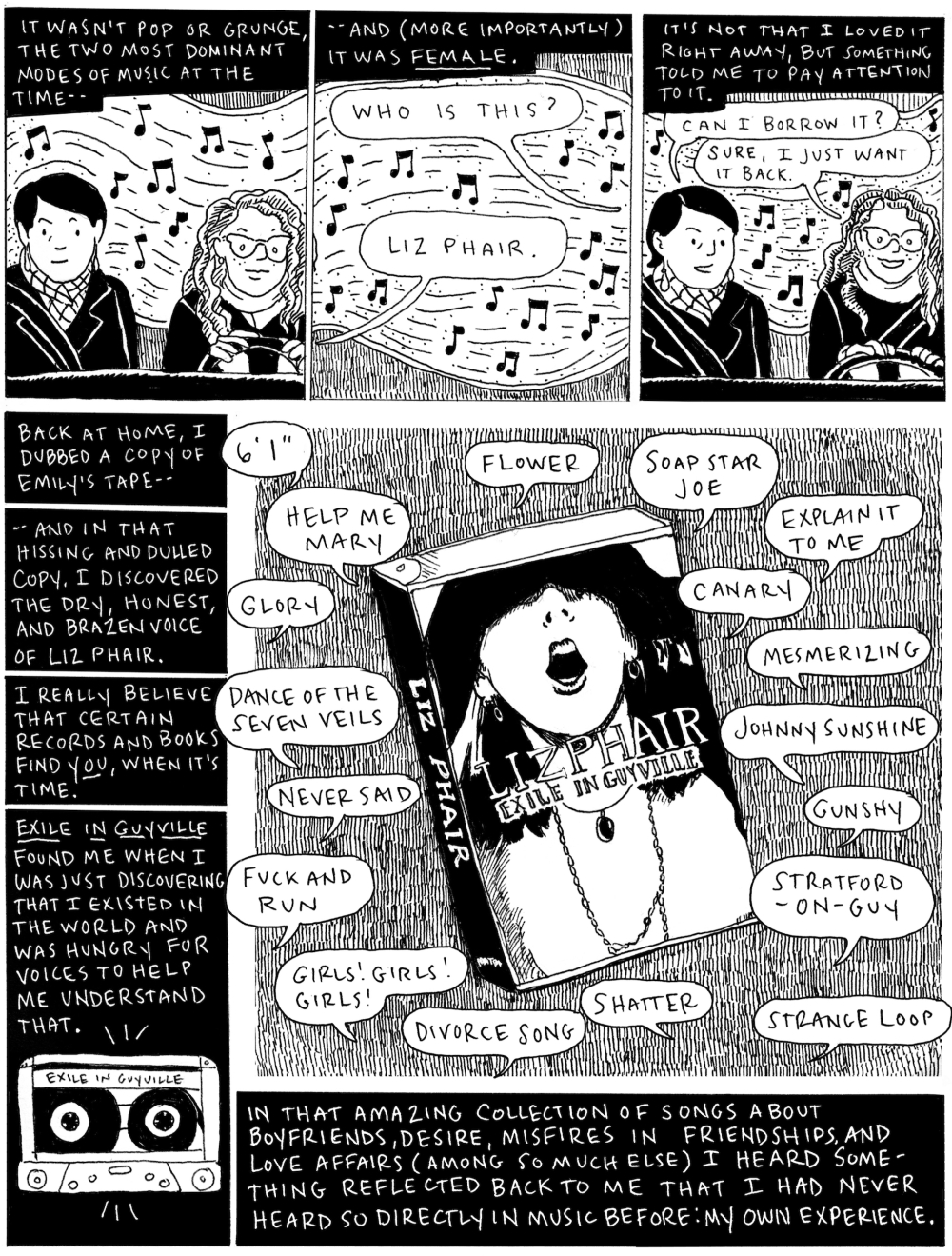
I made brief mention of the relationships Pierre forged while part of the Boston folk milieu, and much of this book's dramatic tension stems from the fact that, it has to be said, not all of them were entirely healthy --- and it's one particularly tumultuous one that not only leaves her suffering from PTSD but re-evaluating her relationship with music altogether, eventually setting her on an entirely different path of creative expression. There's a wistful tone to this work on the whole, as one would expect given its subject matter and essential character, but this de facto "break-up" with something woven so deeply into the metaphorical "DNA" of her being --- hell, of her soul, if you prefer such a term --- borders on the harrowing, and whether or not she makes it through with a new, healthier perspective or ends up a shadow of her former self seems very much an open question for a time. It's probably not "spoiling" things to say that it all works out in the end, but it's a difficult and painful period that's communicated with admirable, even disarming, emotional honesty --- and keep in mind this is a comic that places readers pretty deep inside the cartoonist's mind and heart more or less from the outset! So, yeah, like all lovers worth remembering, music puts Pierre through the wringer.
Her new medium of choice is sure proving to be an inspired one for her, though, it must be said --- Pierre is one of those rare artists who use every last millimeter of space in every panel to communicate information visually, her detailed cross-hatching, thick black shading, and precise rendition of minor details forming a highly emotive backdrop for her naturalistic figure drawings, and the candor and unpretentiousness of her narrative tone is mirrored perfectly in the faces of her characters, each a truly singular individual with expressive reactions and mannerisms utterly unique unto them. Even the folks we meet briefly make an impression --- go ahead, say it, just like a lot of songs.

I'll be the first to admit that the fact I'm roughly the same age as Summer Pierre may go some way toward explaining why this book resonated so deeply, even indelibly, with me --- I remember these times, I was young then myself, and there's a character and ethos to the "slacker" or "Generation X" years that simply can't be communicated with any sort of authenticity by someone who wasn't a part of it. Yet All The Sad Songs knocked me for a loop not just for the overwhelming sense of nostalgia it engendered --- nope, I was (and remain) in awe of the work of one of the very best cartoonists in the here and now, one who is fully arriving into her own and knows how to make every one of her pages sing.
-----------------------------------------------------------------------------------------

Ryan Carey lives and works in Minneapolis, Minnesota. He writes about comics for Daily Grindhouse, Graphic Policy, and at his own blog. He also maintains a long-running film review blog, Trash Film Guru.

April 9, 2019

Enemies of the State #003 – The Song of Aglaia by Anne Simon

Enemies of the State is a monthly virtual book club discussion on a recently published comic, featuring a rotating cast of comics critics.

Episode #3 of Enemies of the State features commentary on Anne Simon’s The Song of Aglaia, published by Fantagraphics in 2018. The Song of Aglaia is the first major release of Simon’s work in the English-reading market; her comics have also appeared in the Fantagraphics anthology series NOW. Song of Aglaia features the oceanide Aglaia who develops a fierce hatred for men in a paternalistic society. Taking advantage of an opportunity, she overthrows a government and throws her life into chaos.

The cast for this episode includes the following critics:


Subscribe to the podcast on iTunes, Google Podcasts, and other podcast apps or listen here and at Sound Cloud. If you are a comics critic and are interested in joining in on the show, please contact me using my contact form or through the email on my contact page. And of course, if you have any feedback, contact us!
We hope you enjoy the podcast!

April 8, 2019

Rob Clough reviews Six New Titles from GLOM PRESS

Glom Press is an exciting new publishing concern located in Melbourne, Australia. The people behind it are Marc Pearson and Michael Hawkins, both of whom are cartoonists in their own right.  They specialize in beautiful Risograph-printed comics, and a recent fundraising campaign produced a half-dozen strange and interesting books. It's hard to pin down their aesthetic as a publisher, other than they are clearly drawn to personal work that explores human empathy and alienation. The comics Glom publishes have a rough edge to them in terms of both storytelling and mark-making, creating an intense level of intimacy between creator and reader. However, the genres and approaches each artist adopts are radically different in some cases, making each book a unique experience. 
Eloise Grills' Sexy Female Murderesses is an example of a Glom artist choosing to focus on alienation mutating into completely antisocial behavior. Grills' use of an almost smeared dark green and purple in the comic makes the pages feel like bruises. Her fascination with the titular subject of the murderesses veers off into her own feelings and life, as she uses them to explore the ways in which women have historically snapped in the face of oppression and boredom. Grills is as interested in the history of people writing about this subject as she is in the women themselves, quoting several men with regard to women who murder. The quotes often mention women poisoning their victims (usually their families) and posits this as a preferred method because women lack the "courage, willpower and strength" to murder in other ways. These quotes are revelatory as they demean women even when it comes to such monstrous, immoral activities. 

Sexy Female Murderesses is a long, funny, and disturbing ramble on the subject that's not unlike the work of Jessica Campbell in terms of her expressive, smudgy line. Grills' personal tangents reveal that this is really a book about not only how she relates to the idea of feeling the need for control in her life but also about how the power of life and death over others -- especially innocents like children -- is the ultimate form of control. It's not just having power, but it's also the idea of flying in the face of everything that is expected of women in society. She relates dreams she's had about being Tonya Harding performing at the Olympics, knowing about the crime she's committed. There's that sense of being consumed by guilt but also understanding that women are ultimately judged for how they look and how they perform. Grills examines the perniciousness of the male gaze as not just objectifying in a reductive, sexual manner but actually forcing women to conform to this soulless, vapid, and dehumanizing gender construct. The rejection of this control, no matter how pathological it might be, is not celebrated by Grills because it is pathological. It is celebrated because it so clearly reveals the ways in which the deck is stacked against women.
Mandy Ord's Galápagos is an autobiographical story about her experience watching two different television shows: The Walking Dead and a David Attenborough documentary about life on the Galápagos Islands. Using a grotesque style for character design, this comic is about Ord's visceral reaction to a number of different things all at once. The grisly zombie violence of The Walking Dead has always represented a sort of exaggeration of society at large, and Ord started watching in spite of herself because of the possibility of resisting the zombies and killing them. That resistance was a denial of death itself, but it was also an affirmation of humanity coming together to resist extermination. When the show started to have humans kill other humans (the old "we were the real monsters all along!" trope), Ord found herself unable to watch. It was too much of a betrayal, and the visceral thrills she experienced were erased by being reminded of the horror that humanity perpetrates against itself. 

Of course, the Attenborough documentary features snakes devouring newborn iguanas, and the camera follows them devouring them like those zombies went after human brains. It triggers the same kind of reaction from Ord, who decides to go to bed. The final scenes depict her imagining snakes and zombies in her bed, a reminder not just of her own mortality but of the fragile nature of the social order in general. The green tone Ord uses for this comic is appropriate: a kind of sickly, unpleasant color that goes along with Ord's exaggerated, grotesque self-caricature.
Psychic Hotline, by Leonie Brialey, is perhaps the oddest entry in this idiosyncratic sextet of books from Glom Press. Consisting of a series of single-page images, it's also a quiet and melancholy story about trauma, depression, and connection. There are two primary characters: a ghostly and depressed figure frequently seen melting into his environment, and a woman working for the titular psychic hotline who talks to him on the phone. She explains that it's her "job to know the exact thing that is wrong with someone before they've even said anything" and then offer them advice without further triggering any trauma. The book is a series of conversations between the two of them, as well as the operator's own musings on her job. 

Brialey takes a minimalist approach and takes care to explore her line both in terms of pure mark-making as well as the emotional impact of each image. There are many zoom-ins and zoom-outs as part of page-long sequences, as well as a number of shots lingering on the ghost on page after page. Brialey here seems to want the reader to really remain in the ghost's sadness and feel that sense of desperation, even in the face of so much empathy and understanding.  Brialey's careful and almost agonizingly slow pacing goes hand in hand with the vast amount of negative space on each page. There's a sense in which any mark on the page is a kind of triumph against the void, just as reaching out and seeking help is its own kind of triumph. Human connection helps but doesn't fix everything, and it's telling that no matter how therapeutic her advice to the ghost is regarding their fractured relationship with their father, it is unclear if it ultimately helps. The final images are of the ghost just sort of going blank and becoming one with the earth.
Sometimes a comic is notable for what isn't said or seen but what is suggested. Such is the case with Rachel Ang's Swimsuit, a slice-of-life comic about a young woman who goes to a public pool with an ex-boyfriend. Everything about this comic is subtext, and Ang's expressive line that emphasizes shadow and the way bodies relate to each other in space serves to highlight hidden emotions and broken relationships. The woman, Jenny, is clearly interested in potentially getting back together with her ex, which Ang communicates by the way Jenny primps before he arrives. When he drops the bomb that he's dating someone new in the least sensitive and most oblivious way possible, one can see her entire mien sink into despair. Her shoulders slump, her arms are crossed, and it's clear that she starts to hate the way her body looks after her ex shows her a photo of his new girlfriend. The only way in which she reveals her feelings is when she says, "I didn't know that was your type" regarding the photo. He doesn't understand what she means by that and she feigns ignorance, but it's clear that she means "I wasn't your type."

Things only get worse from there. There's a moment of shocking violence when a bunch of white kids attack a black kid in the pool and pretend that he started it. Her ex looks on impassively, saying things like "I'm sure they're just playing" instead of acting. She damns herself for her own impassivity, mirroring the impassivity she evinces when she doesn't reveal her feelings. That's true even when he presses and asks if they're "cool", once again oblivious to the situation and her own feelings. When he finally gets the sense that this was a fucked-up situation and he half-heartedly apologizes that "it wasn't a nice time," he adds "I feel like whenever I'm around you, something heavy happens!" Jenny maintains that mix of rage and impassivity by half-jokingly saying "Yeah, I'm a fucking shit magnet!" and then walking away. It's a desolating moment of self-hatred and frustration. 

The final pages, when Jenny goes home, undresses, and then sinks into her bed, highlight her utter devastation. That sinking feeling is conveyed through Ang's use of color. Throughout most of the comic, Ang uses a dark purplish blue for her scratchy line, with the exception of the water in the pool. She uses a light green for those sequences, only the water isn't depicted as comforting. It looks oppressive and claustrophobic in its whorls. That same green appears at the end as she sinks into her bed, looking for comfort but finding only despair. Ang's use of narrative restraint, body language, and visual cues make this story deeply affecting. 
Aaron Billings' Mystical Boy Scout is the tonal opposite of Ang's work. It's literally a balls-out, hilarious, and over-the-top story mixing magic and queer culture in the most wonderful and ridiculous ways possible. It's a high fantasy story involving the latest in a series of Mystical Boy Scouts, a magical being "imbued with the oratory skills of Demosthenes, the wit of Oscar Wilde, the allure of St. Sebastian, and blessed with the greatest capacity for anal penetration in the world.

MBS has to defend his shared space for queers against a housing inspection. He utilizes the diamond he keeps in his ass, a magical smoke being who can summon cigarettes, magical flying prostate power, and the Soviet dog Laika to defeat his opponents. Billings' line is delightfully wobbly and his character design is a mixture of absurdly cartoony and sensitively naturalistic. This is a comic that manages to be a whole lot of things at once: silly adventure, tender romance, queer activism, and bawdy fun. 
My favorite of the six books from Glom Press, though, is the thirty page comic My Big Life by Bailey Sharp. I've been following Sharp's work since her days at the Center for Cartoon Studies, and her work has only become more daring and unusual. Billed as "somebody's memoir," it's an incredibly dense, philosophical, and unpredictable journey through mental health, capitalism, petty crime, tourist economies, and so much more. The nearest comparison I can think of to describe Sharp's work is Gabrielle Bell, only more grotesque and absurd. Her rubbery, elongated line gives her main character an almost serpentine quality, especially since she has just one extended eye that we can see at all times. 

The book begins with its narrator falling out of love, literally crawling out of bed and down the street, and finding a new job at a bookstore. The story touches on her emotionally abusive boss who demanded she read books that he'd quiz her on. The fact that nearly every book was about sad young men with unsated lust is a very witty commentary on gatekeeping in general and how canons are established. Sharp's storytelling is every bit as fluid as her line, as the narrator keeps sliding from scenario to scenario. She goes from living above the bookstore to living with a woman who turns out to be a con artist. That character, Luanne, is a marvel of design. With a conical head, heavy eyelashes, and hair put up in a ponytail, she resembles a bizarre muppet of some kind. 

From there, Sharp accelerates the narrative. The narrator buys a property in a town with achingly beautiful sunsets and starts a tourist industry around it. She meets up with Luanne again. All throughout the book, Sharp keeps things moving using a nine-panel grid. At this point, each panel becomes an entire narrative of its own, like "worked on a ranch" followed by "got caught stealing" followed by "learned to swim." Sharp's narrator comments on all of these events as they relate to her constant headaches and the slow drag of time in reality. Her bullet-pointed version goes by quickly for the reader, but she assures us that it is all very tedious. The final page circles back to the beginning of the book and satirically grants her peace through simplicity. It's especially funny because the break-up she mentions as "her big regret" that caused her so much misery is not described in any detail. We have no idea why the relationship was so significant, what her boyfriend was like, or anything else. In the end, neither does she.
Every one of these books from Glom Press is worth reading. It's clear that Pearson and Hawkins favor the kind of line that goes well with Risograph printing: some version of ratty, minimalist, expressive, or grotesque. The themes are personal and the commentary is pointed. These books are beautiful art objects as well as well-designed for reading. They have the look and feel of minicomics but with no set length; indeed, one of their goals as a publisher is to provide a bridge between classic zines and slicker graphic novels. Their celebration of their artists' idiosyncrasies and the way they make each book look its best are a testament to their belief in the work and the overall alt-comics scene in Australia. 
------------------------------------------------------------------------------------
Rob Clough has written about comics for Cicada, the Comics Journal, Sequential, tcj.com,
sequart.com, Savant, Foxing Quarterly, Studygroup Magazine, as well as for his own blog, High-Low (highlowcomics.blogspot.com).

April 6, 2019

ICYMI -- Small Press Comics Criticism and Whatnot for 4/1/19 to 4/5/19

Highlighting some great small press comics criticism being published, as well as other random things that have caught my eye over the past week.

COMICS CRITICISM

* Ryan Carey on COYOTE DOGGIRL by Lisa Hanawalt (Drawn and Quarterly), which he likes, but can't justify spending $25 on.

* Carey also looks at FATHER by Gabriel Howell (Self-published), "a highly combustible mix of 'breeder' fetishism; of fear of children as our biological replacements; of alienation from one’s body, one’s basic human needs, and one’s desires; of deep-seated misogyny; and of gender dysphoria."

* Oliver Sava on FULL COURT CRUSH by Hannah Blumenreich, "a simple story exquisitely told, with Blumenreich’s rich characterizations making it easy to connect with the young lovers and root for their romance."

* Philippe LeBlanc reviews FOLLOW ME IN by Katriona Chapman (Avery Hill Publishing), writing "Chapman captures the push between inward and outward looking perfectly. It’s a wonderful graphic novel about personal growth and learning."

WHATNOT

* Tom Daly has a new comic up on Spiralbound called DAD'S DOG, DWALIN.

* Tommi Parrish has a new comic up on The Believer called ELIZA.

* Kristopher Jansma has this interesting bit of business up on Electric Lit titled PHILIP K. DICK'S UNFINISHED NOVEL WAS A FAUSTIAN FEVER DREAM

* Mary Norris reports on THE 2019 AMERICAN COPY EDITORS SOCIETY CONFERENCE for The New Yorker.

April 5, 2019

Kickstart Your Part: Three New Books From Little Red Bird Press

Little Red Bird is a comics micropress and visual arts studio based out of New Jersey, USA and Querétaro, México. They just recently started a KICKSTARTER, and, with your help, they're looking to expand their comics catalog for 2019 with three new titles:

BACK PIECE

by Gerardo Alba
Back Piece is the story of Rollo, an insecure tattoo apprentice living under the shadow of his late father and his master. When visitors from another planet arrive at the shop in need of help, they take Rollo on an adventure that forces him to prove his talent and his worth. 
52 pages, color, softcover graphic novel. 
Gerardo Alba is a cartoonist from Mexico City, whose comics range from journalism to slice of life and science fiction. His work has been published by The Nib and in 2017 he won the Jóvenes Creadores ( “Young Creators”) grant for comic book artists from the National Fund for Culture and Arts in Mexico. He is currently serving an artist residency in Angoulême, France to work on an upcoming graphic novel about A.R. Wallace. See more from Gerardo at grrd.mx.

BURN: A TALE OF ILUNEA

by Zak Kinsella
Burn is a refugee story set in a fantasy world. After the brutal destruction of their homeland, Chamal, high guard of the Kingdom of Ilunea, is on the run with the Kingdom's mightiest weapon, Kel, a super sweet sentient fire sword. With the help of an unlikely ally, Michael, the duo sets out to take refuge in the neighboring land of Gelka. The journey, however, is plagued by the forces of Baron Blalqu, an instigator set on the slash-and-burn destruction of Ilunea25 pages, color, softcover comic.
Zak Kinsella is a cartoonist and illustrator making his home in Denver, CO. He is the creator, writer, and artist for the Dinky-nominated comic Outré Veil. As an illustrator, he has worked for clients such as Apple, The New York Times, Popular Science, Warner Bros., Alamo Drafthouse, and Village Voice Media. See more from Zak at zakkinsella.com.

BEARPLANE

by Ally Shwed
Bearplane is the silly story of a man who is forced to share the confined space of an economy airplane seat with a large, ferocious bear.  An all-ages, (mostly) silent comic about not judging a book--or a bear--by its cover. 32 pages, color, softcover comic.
Ally Shwed is a cartoonist and comics journalist who splits her time between New Jersey and Mexico. Her work has appeared in The Boston Globe, The Nib, The Intercept, and Jezebel, and she is currently working on a book about the U.S. Constitution for First Second Books. In 2017, Ally served as a Kickstarter Creator-in-Residence, and in 2018, she was selected as a Denver Independent Comics & Art Expo Fellow and was asked to be a featured contributor to the Oxford Handbook of Comic Book Studies. See more from Ally at allyshwed.com.

Support This KICKSTARTER HERE.


April 3, 2019

Pinball Panoply: Justin Giampaoli reviews COIN-OP CARNIVAL by Ryan Claytor and Nick Baldridge

(editor's note: Justin Giampaoli and Ryan Claytor are both friends and friends of the site)

For the latest publication by Ryan Claytor at Elephant Eater Comics (this time joined by co-writer Nick Baldridge), there is a level of cartooning confidence on display and a sureness with the subject matter that's evident with the first flip open. One will immediately notice that the indicia and table of contents are splashed across the back of an array of pinball machines, as if you've stepped into a collector's secret basement, with tarps lazily draped over the pins which have been partially pulled back from obscuring the mythic machines. It's as if Claytor and Baldridge are pulling back the curtain to reveal the inner workings of their beloved industry - which is exactly, quite literally, what they're doing at times.

That's the very first signal that Coin-Op Carnival: Electrifying Tales of Mechanical Contraptions intends to use both thematic and visual elements working in concert to deliver messages in the best tradition of comics: pairing images and text to reveal a tertiary level of understanding. In an early framing sequence, we see Ryan and Nick's phone conservation that was the impetus for the project, and it showcases a series of panels with the creators inhabiting color-coded backgrounds that correspond to their blue and brown geographic locations. It's a smart subtle choice revealing the level of thought poured into this project. 
It's tempting to classify Coin-Op Carnival as a zine, a term meant lovingly here and not as a pejorative, in the best tradition of underground self-published works that tackle a particular niche topic. But, for me the mere "zine" descriptor belies the strength of the work, perhaps mega-zine is more apropos for this 64-page, full-color work bearing exceptional production values. It's crammed full of comics, spot illustrations that range from small corner accouterments or diagrams to full double-page spreads with considerable artistic weight, reviews, profile interviews, articles, shorts, tech tips, and a melange of content that never skimps. Though the optimal intended audience is a niche audience to be sure, the work is still strong enough to engage someone like me, who is not fully steeped in this particular corner of fandom. 

There are a few particular high points, including the extended interview with industry veteran Wayne Neyens, which (at approximately half the length of the book) really anchors the first issue and functions as something of an artistic statement in terms of what you're going to get from the series. As a fan of Claytor's work who has lovingly analyzed almost every panel he's produced for the better part of a decade, I quickly noticed several of the spot illustrations that used free-floating borders with a type of ink wash effect. They lend the sense of the interviewee recalling selective moments of his own personal history in all their hazy glory, another nice way that thematic and visual elements coalesce to drive meaning. You can instantly glance at these panels and intuitively understand they're about memory recall without having to read the interview - pictures tell stories, you see, informing meaning with their very presence or configuration on the page, even without those pesky words inhabiting them.
I also enjoyed the detailed description of the play field in Mystic Marvel, explaining why this particular configuration is notable in a way that's easy to understand for a layman. It's helped tremendously by Claytor's full-color illustration laying beside it. I was taken with the write-up for Space Pilot, a piece of Cold War-era ephemera that instantly makes you want to give the game a go. I admit to becoming a bit lost in the technical elements of relay technology, and truthfully I'm not really going to remember the difference between a switch leaf and a contact or a bracket and a bakelite spacer 5 minutes after I put the book down, but it's still an admirable attempt to demystify the electromagnetic guts that make the machines go! 
Never one to shy away from trying to induce the feeling of getting the biggest bang for the buck, Claytor has also included foldable paper pins that you can cut out and configure, which are just the right size for your 3.75-inch G.I. Joe and Star Wars action figures to play once you've picked up all your pop culture kishkas on the con circuit! The project is ambitious to be sure, so it was no surprise to discover that Claytor is embarking on another multi-stop tour. It recently kicked off on March 22nd at the Texas Pinball Festival in Frisco, Texas, runs through 16 stops and 10 states including San Diego Comic Con in July, all the way to October 17th at the Pinball Expo in Wheeling, Illinois. You can purchase the book and learn more about their tour and publication plans at www.coinopcarnival.com.
------------------------------------------------------------------------------------
Justin Giampaoli grew up on 1970s Bruce Springsteen tracks and Green Lantern comics by Len Wein and Dave Gibbons. The first movie he saw in a theatre was The Black Hole. The first mini-comic he ever read was Henry by Tim Goody

April 1, 2019

Check, Please: Ryan Carey reviews THE INSPECTOR by Liam Cobb

Confession time right at the outset: I actively despise what's generally known as "foodie culture." Mind you, I absolutely appreciate the fact that there is a real artistry to good cooking and that restaurants which practice things like the so-called "farm to table" philosophy are certainly going about their business more ethically than, say, McDonald's is, but let's be honest: every goddamn chef thinks he or she (and it's far too frequently a "he" --- a major problem with the restaurant industry is the male domination of, and the resultant culture of misogyny inherent in, most kitchens) is at the very least a local, if not a national, celebrity; menus have become pretentious, ego-driven, and hideously expensive; wait staff act like they're the stage performers a good chunk of them wish they were --- the whole experience of eating out has become a nauseatingly garish production.

Which, I suppose, is fine for dinner theater, but for a weeknight out with your significant other? No thanks, I'll stick with a burger and a beer at the corner tavern or tacos at the neighborhood Mexican joint. I never want to be seen in a place full of people with their heads so far up their asses that they have the unmitigated gall to critique food on such disgustingly frivolous grounds as its "presentation" and "flavor symphony" while a good half of the world is literally starving to death. There's something not just tone-deaf, but seriously sick about all of this wretched excess.

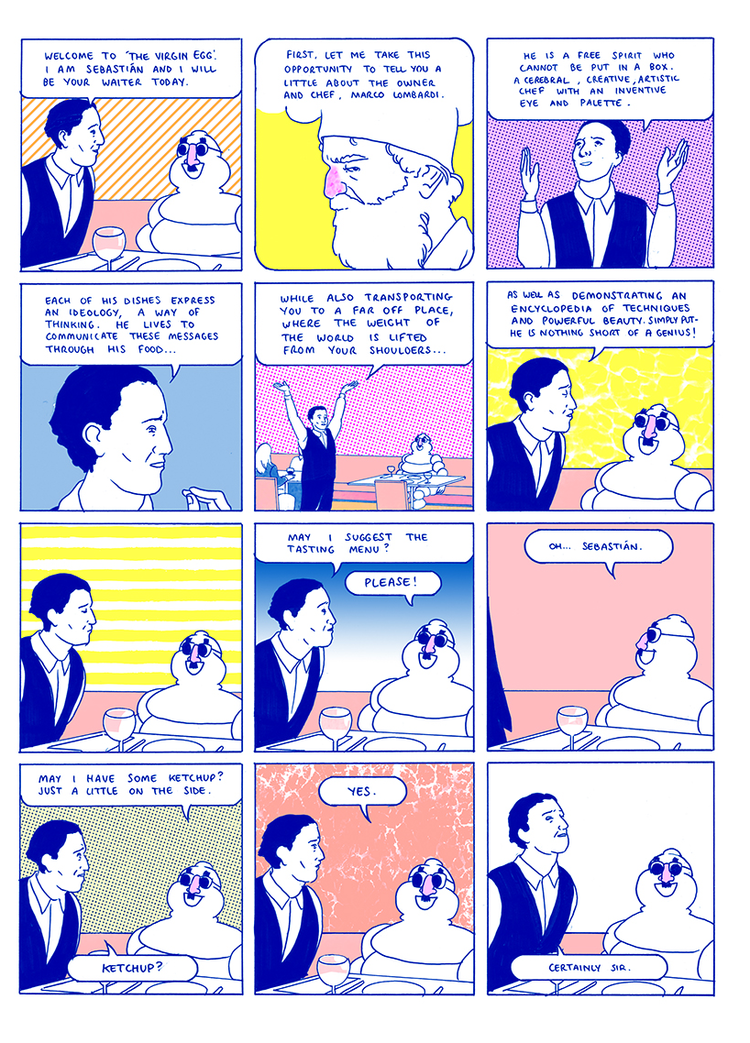
Liam Cobb gets this --- or, at least, I assume he does. Anyone who's read his 2018 Retrofit/Big Planet-published graphic novel, The Prince, can tell you that misdirection, ambiguity, and maybe even a kind of casually callous amorality are prominent features in his work, and these are all present and accounted for in the tone and tenor of his latest work, the short-form The Inspector, released at the very tail end of last year by Breakdown Press. The target of Cobb’s satire (or maybe we can just shorten that to his ire) herein is obvious enough --- but he also seems to offer no real alternative to the gluttony he's skewering, nor even any particular reason to do anything other than go along with its flow.
Which, fair enough, may not really be his job, and a "we're fucked no matter what" attitude can make for something of a conceptually exciting reading experience in and of itself. I don't particularly need my hand held through a comic, and I am perfectly capable of forming my own opinions along the way and conclusions at the finish, but it would be less than honest to say that this story --- which focuses on a careless, thoughtless, Michelin Travel Guide restaurant critic who's well and truly an embodiment of the company's famously weird mascot --- wasn't tinged with a strong undercurrent of resignation bordering on nihilism. If that's cool with you, then you're gonna get plenty of food for thought, as well as a generous serving of belly-laughs (some in spite of yourself) from this comic. If not? You're in for not so much a disagreeable time as an empty, maybe even a pointless, one.

If all of this sounds eerily reminiscent of the pros and cons offered up over the years in regards to existentialism, that's no accident: Cobb's cartooning oeuvre seems to echo the “everything is what it is and even if it were some other way it wouldn’t really matter” outlook of Camus or Sartre more than it does, say, Crumb or Kirby, but there's a sharp wit at its core that steers it well clear of the bleakness of a Ware or a Clowes. In short, he's managed --- and in a fairly brief period of time at that --- to establish an authorial voice entirely his own, one that's equal parts alluring and alienating, realistic and absurd. Reading his comics is challenging, but in no way off-putting --- yet there's an observational quality to them, a detachment that may not go so far as to push you away, but doesn't exactly work overtime to draw you in, either.
There is, for instance, no real plot "progression" in The Inspector until the very end --- our Michelin Man simply goes from town to town, eats ludicrously grandiose dishes prepared by pathetically self-important chefs, and acts every bit as self-satisfied (not to mention self-indulgent) as the self-appointed “superstars” preparing and serving his food. At the last second he learns the disturbing secret behind some "mystery meat" he's about to consume, and then ends up relaxing on a tropical island with a beautiful woman. He may have stumbled onto a scandal that serves the restaurant industry a well-deserved comeuppance, but he's still leading as charmed a life as ever, more by dint of dumb luck than anything else. Maybe Rod Stewart was right, after all --- and that's the first and last time you'll ever hear me say that.

This balancing act of the droll with the intentionally bizarre carries over into the artwork as well, with Cobb's austere and economically-delineated illustrations here counter-balanced with garish riso-printed pastels that catch the eye but almost seem chosen to deliberately conflict with the workaday simplicity of so much of the linework. It's effective, don't get me wrong --- as is the juxtaposition of jam-packed, tight grids with sprawling, double-page "splashes" --- but it's a study in contrasts designed to jar every bit as much as the disparately-paced narrative, which essentially runs in place until it hurries up to the finish line.
All of which leads, more than likely entirely by design on Cobb's part, to the ultimate irony --- and as blindingly obvious as it is for me to describe it as such, it's a little bit of a delicious one. Much like the exercises in conspicuous consumption it mercilessly and deservedly lampoons, The Inspector works because of the combination and interplay of its ingredients. It may not make for the most delicious "meal" you've ever tasted, but it's unquestionably a memorable one, and chances are you'll come back for seconds, as well as feel suitably compelled to see what the chef who crafted it comes up with next.
-------------------------------------------------------------------------------------------------

Ryan Carey lives and works in Minneapolis, Minnesota. He writes about comics for Daily Grindhouse, Graphic Policy, and at his own blog. He also maintains a long-running film review blog, Trash Film Guru.

March 30, 2019

ICYMI -- Small Press Comics Criticism and Whatnot for 3/25/19 to 3/29/19

Highlighting some great small press comics criticism being published, as well as other random things that have caught my eye over the past week.

COMICS CRITICISM

* Edwin Turner reviews KINGDOM by Jon McNaught (Nobrow Press), writing "What does happen though is difficult to pin down here in language though---which is fitting, as one of Kingdom's themes is the failure of articulated language to effectively communicate. What McNaught gives us in Kingdom is a feeling fraught with ambiguity---restless tranquility, joyful melancholy, pleasant waves of boredom."

* Alex Hoffman on PIERO by Edmond Baudoin (New York Review Comics), "a love letter, both to Baudoin’s brother, and to artmaking. It is an intimate vision of [Baudoin's] childhood, and an introduction to the artist he would become."

* Hoffman also writes about THE SEA by Rikke Villadsen (Fantagraphics), writing "In her strange and lilting world, Villadsen uses the fisherman as a stand-in for a toxic masculinity seen all too often across the globe. The events of The Sea lay bare that toxicity and show its inherent worthlessness. Pride and boasting cannot steer a ship, and no amount of tattoos or pipe smoking can make a man a sailor. In this symbolism, Villadsen exposes the fraudulent nature of toxic masculinity. More precisely, not only is the fisherman a fraud, but his fraudulence leads to his demise.

* Robert Kirby reviews BLOSSOMS IN AUTUMN (SelfMadeHero) by Zidrou and Aimée de Jongh which "captures the poetry of human relationships along with the belief that life might hold a few surprises in store, should we allow ourselves to welcome them."

* Kevin Bramer talks about DODO COMICS #5 by Grant Thomas.

WHATNOT

* No offense to Justin F. Martin (or maybe ALL the offense), but sweet holy hell THIS is not ...  you know ... good.

* Sara L. Jewell interviews CARTA MONIR for The MNT.

* Hillary Brown interviews BOX BROWN about his new book Cannabis: The Illegalization of Weed in America.

* Mark Newgarden interviews BILL GRIFFITH about his new book Nobody's Fool.

* Jonathan Dyck has a comic up on Popula called LENT.

* Trying to figure out exactly WHAT the Futures of Comics is...

* Three Poems by Marshall Mallicoat.