July 10, 2019

Darkness On The Edge Of Town: Ryan Carey Reviews RUST BELT by Sean Knickerbocker

There's a sickness at the heart of what used to be called the "American Dream," and we all know it: the consolidation of wealth among the so-called "one percent" has left a wide swath of devastation in its wake, entire regions of the country have been cast aside like so much detritus while the rich wall themselves off from the effects of their greed in secure suburban sub-divisions, the people they've tossed on the economic trash heap as out of sight as they are out of mind.  The modern-day robber barons need these folks every four years, of course, to vote for their latest demagogue of choice --- a hollow exercise that amounts to the devastated giving assent to their destroyers --- but that's never much of a problem: draconian cuts to education budgets, media consolidation, and ginned-up religious and cultural fervor have done the job of convincing large chunks of the working and non-working poor that the real threats to their ever-deteriorating way of life come from south of the border, across the pond, or the ranks of the "other" (racial, sexual, ethnic, religious) within their midst.

Now, don't get me wrong: profiles of the white, male, Trump supporter in the popular press have been done to death, and the idea of "shining a light" on a lot of these folks' retrograde attitudes and opinions amounts to little more than a literal case of "sympathy for the devil," but the ubiquitous nature of these overly-generous "human interest stories," (a phenomenon even comics haven't managed to escape from entirely --- I'm looking at you, James Sturm) and the sad but true fact that the disaffected and dispossessed have always been easy pickings for would-be "strongmen," doesn't negate the reality that for quite literally millions of Americans, the end of the world is no longer an abstraction, it's something that's already happened to their communities; maybe even something that continues to happen every day.

Roll call: factories that employed everyone for miles going dark. Opioid and amphetamine addiction. Home foreclosure. Loss of health insurance. Younger generations fleeing the town, the county, even the state. All that's left? Economic, cultural, and social wastelands where the word "opportunity" is thought of strictly in the past tense.
Perhaps more than any other contemporary cartoonist, Sean Knickerbocker has his finger on the pulse of what's derisively scoffed at as "flyover country," having spent a considerable amount of time in the bleak (in every sense of that term) hinterland of Blue Earth County, Minnesota. To date, he's conveyed the stories of the post-apocalyptic survivors of areas like the one he once called home over the years in the pages of his debut graphic novel, Killbuck, as well as in his intermittently-published series, Rust Belt, portions of which --- in addition to strips culled from parts various and sundry --- have just been collected by Secret Acres in a book that shares that same title. It's a briskly-paced read, to be sure, but one that leaves a mark by dint of Knickerbocker's sheer facility with characterization and his sympathetic (but not less accurate for that fact) portrayal of the sorts of lives that are deliberately ignored by those in power --- unless and until they need to fashion them into reactionary voting blocs.

Stylistically, Knickerbocker's work falls somewhere comfortably within the Charles Forsman/Max de Radigues continuum, and his work addresses many of the same concerns explored not only by said contemporaries but also the likes of Noah Van Sciver. Yet Knickerbocker's elegantly-delineated minimalism is utilized in service of narratives that tend to depict the realities of those from whom alienation and inchoate, unfocused rage aren't a potentially-passing phase of youth. Rather, they have become the inescapable underpinnings of their very existence.
All of which is to say that whether we're talking about an aging alcoholic who's still dependent on his sister, a soon-to-be-demoted retail manager, an underemployed woman caring for a sick parent who has to turn to the local food shelf for assistance, or a plumber trying to make a name for himself as a MAGA YouTuber only to discover that there's no pot of gold at the end of the alt-right rainbow, the authenticity of this collection's protagonists and their situations is as universal as it is uncomfortable to face.  This perpetual unease is conveyed in the book’s aesthetic, as well: accentuated by a rotating selection of single colors that reflect the tone and tenor of the strips upon which they're deployed pitch-perfectly, there's no slack in Knickerbocker's act as his holistic approach to visual storytelling offers no conceivable way to turn a blind eye to the everyday indignities he not only depicts, but digs into deeply.

Are some of these people at least partially culpable for their own existential misery? Of course. But living where they do, under the circumstances that they find themselves, it's not like they're offered much by way of alternatives. Work at Wal-Mart or starve. Seek chemical and/or pharmaceutical escape or wallow in hopelessness. Cling to the past or face up to the fact that you've got no future. Taken in total, Knickerbocker paints a grim picture in Rust Belt, to be sure --- but also an accurate one. And it amounts to probably the most savage and thorough-going critique of capitalism comics have seen in quite some time.
If the whole thing sounds too heavy for you, then fair enough, it probably is --- and far be it from me to shame you if your reading tastes are primarily escapist in nature. But if hard (yet hardly heartless) looks at the world as it is, rather than as we wish it to be, are within your aesthetic wheelhouse, then Rust Belt will immediately leap to the forefront as one of the most vital, most accomplished, most unforgettable, and most absolutely necessary comics you'll read this year --- perhaps even in the last several. Knickerbocker has justly enjoyed a reputation as something of a "cartoonist to keep an eye on" for some time; with this collection, he's come fully into his own and it's high time for everyone to start paying attention to one of the medium's most singular, distinctive, and honest voices.
---------------------------------------------------------
Ryan Carey lives and works in Minneapolis, Minnesota. He writes about comics for Daily Grindhouse, Graphic Policy, and at his own blog. He also maintains a long-running film review blog, Trash Film Guru.

July 8, 2019

Living in the Moment when the Moment is the Problem: Matt Vadnais on NOVELTY by Mohar Kalra

The cover of Mohar Kalra’s Novelty looks like poster art from a World’s Fair or state tourism campaign. Replete with spheres that look like unified and peaceful planets, the image appears to be selling unity and joy. The word “novelty!” – written in a buoyant and futuristic font deserving of “Sunny California” or “Cities of Tomorrow!” – erupts from a mustard yellow and suggests that readers will find some kind of innovation inside the pages of the book. The stylized and stylish design elements of the cover mask, at least for a moment, the much more serious image that they frame. Two figures share a bench in the rain. One man is bedraggled and haggard in an ill-fitting coat; the other is a featureless, white humanoid with terrific posture.
            
Taken as a whole, the cover suggests that this is a story about the remarkable invention of an unlikely friendship. Such an assertion isn’t far from what happens in the comic; however, unless one knows what to look for, the cover does little to communicate to the reader that both figures sharing the bench are aspects of the same person, an undergraduate named Allen who spends the book navigating a mental health odyssey initiated by having been cut loose from college counseling services because of budget cuts. In the hands of someone else, the cover might feel like false advertising or a trick of Tyler Durden-sized proportions. However, Kalra treats both figures – figures that correlate loosely but hardly exactly with mania and depression – with such respect and gratitude that a reader is invited to trust the visual metaphor. While Allen himself spends a lot less time on the page than either of these voices or personas or aspects of his personality – Kalra doesn’t spoon-feed readers the antecedents of the metaphor – both are rendered as real. Neither is a demon to banish nor a voice to silence. 
            
For me, at least, the result is one of the most affecting depictions of mental health that I’ve encountered. Too often, art interested in negotiating a crisis of depression, mania, or anxiety ends up suggesting that such things can be tamed or defeated, the way an adversary might be thwarted in a cape comic. Sure, Kalra’s simple but ambitious line work draws from the superhero genre, particularly in the Silver Surfer-esque stature of Allen’s bolder companion, as well as in the way that his weather-beaten friend begins to melt and blob in the face of complication. However, such choices allow Kalra to depict Allen’s mental health as a power set, suggesting that the purpose of therapy is not to treat weakness but to negotiate the complications created by one’s strengths.  
The comic opens with the bold, featureless version of Allen standing at the edge of a cliff. Kalra explains the narration as things Allen is saying to the therapist, just before being left to his own devices. Allen explains that falling is much less upsetting than the notion that he might be caught by a safety net before impact. By conflating self-harm with a kind of freedom, and by re-thinking a reprieve from death as the true object of fear, this short fantasy sequence effectively draws this particular iconographic depiction of Allen as impulsive and bold but hardly happy. Throughout Novelty, this embodiment of Allen, this alter ego, has big, important thoughts, announces himself as a kind of aesthete, and serves as a tour guide for some of the most visually poetic sequences of Kalra’s art, usually rendered in take-you-by-surprise, two-page spreads that are legitimately staggering. Though Kalra suggests that this alter ego has existed long before the therapist’s office, this featureless version of Allen can be understood as a creation of Allen’s psyche that allows Allen to do exactly what his therapist told him to do: live in the moment. This version of Allen appears to have the ability to literally sink into images, to speak directly to the audience, and to engage with ideas regardless of social convention or anxieties. He can go where Allen cannot. 
            
Kalra draws attention to the abilities of this featureless void by paring them with another alter ego, Allen’s shabbily dressed counterpart who is much less eloquent: mostly, he says “fuck” multiple times in the same panel while attempting, desperately, to melt and disappear from any moment he is in. The characterization of one aspect of Allen informs the other so that this downtrodden, blobby manifestation does not come off as ill-defined or oversimplified but as someone having an earned reaction every time he cusses or begins to melt. In other words, Kalra manages the neat trick where, because of Allen’s particular cocktail of invasive thoughts, his less equipped avatar constantly has to cash the checks written by aspects of himself so preoccupied with the beautiful chaos of the world that they have little time to consider the consequences. For example, the featureless alter ego stands motionless as he watches a white man chase a black child into traffic in order to observe what will happen because it seems interesting; this decision will torment Allen for several pages. Kalra depicts this memory as a painting in an art gallery that serves as a proxy for Allen’s mind; even the memory is something that the featureless thinker can marvel at, hand on his chin, while the other Allen is tormented on the opposite page.          
This is not the only scene that features Kalra melding images of Allen – any version of Allen – into other kinds of imagery. Cinema, photography, fine art, and the poster design of the cover are all used to suggest dissociation. I was reminded of a question in the survey I needed to fill out before receiving a single therapy session as an undergraduate – does your life feel like a movie? – only to discover, like Allen, that my very real concerns weren’t serious enough to warrant an ongoing relationship with student services. Like myself and dozens of similar students I have encountered as a professor, Allen is given little option but to try to find his way to follow the advice generated in this single session, advice that is little more than a cliché. 

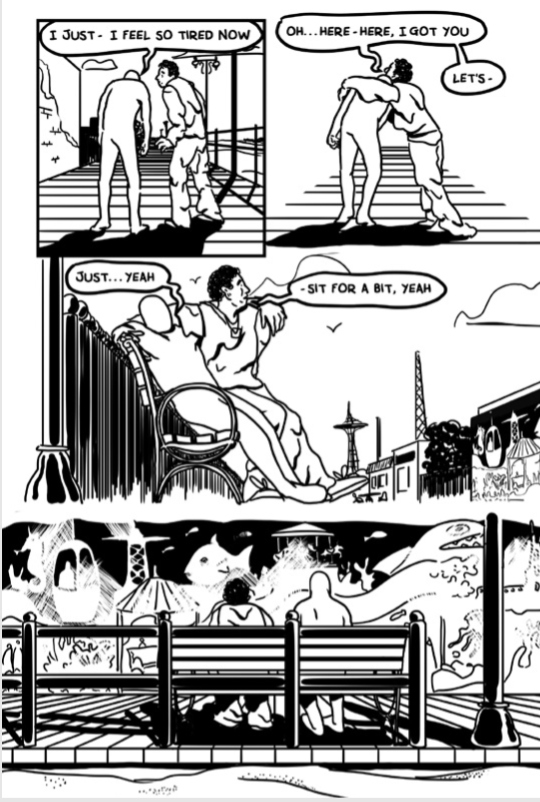
Thanks to Kalra’s brilliant art, the reader comes to understand that this advice itself is complicated for Allen; throughout Novelty, he sinks too deeply into individual moments, so much so that he ceases to look like Allen or exist in an image that looks like his “real” world. Throughout the comic, Kalra provides narration that sometimes belongs to one of Allen’s alter-egos and sometimes floats above the action as a disembodied third person; Allen, until the very end, is not able to provide words to describe or frame his own story. By showing the complicated distinctions between living in, being fearful of, and being distracted by “the moment,” Kalra quietly comments on how fully dissociation is misunderstood as disinterest and again complicates the idea that mental illness is somehow about weakness. While a reader might be tempted to understand the over-confident, solipsistic void-like alter ego as a coping mechanism designed to offset the anxiety embodied by Allen’s melting and blobby alter ego, it’s just as possible to understand the relationship as inverted: Kalra presents Allen’s weakest self as a coping mechanism, making this especially clear in a moment where the shabbily dressed avatar physically supports the exhausted and overwhelmed alter ego. It is this moment that leads Allen to emerge as Allen when he asked to take a picture of two people.  
On the one hand, the fact that Allen is able to find some kind of momentary unification and genuine happiness at the comic’s end might suggest that he is fully capable of negotiating his mental health without professional help or that the counselor’s assessment of his crisis was accurate. However, at least for this reader, the genius of Novelty is that, though the moment of peace is presented as a kind of breakthrough or novelty, the book reads as an origin story. Kalra hasn’t written a story about Allen coming to any kind of destination, so much as he has outlined the ways in which – and the reasons why – Allen will be the beleaguered and unwise hero of his own story from here on. The moment is new and it is, as Allen tells the reader in the only moment where he speaks as his own narrator, good enough; his fearful self has powers too, able to comfort and focus the part of him that is so interested in the moment that he’s willing to relinquish himself to it.
Still, this moment is only a moment. And even this moment is presented with a helping of dissociation, rendered as yet another photographic representation of living that Allen is literally sucked into, complete with a shark and an octopus. As such, Novelty is truly a novelty, the rare piece of art about mental health that does not pretend that the peace one might find with one’s self has to be any more lasting than the moments of chaos that come before it in order to be real and meaningful.
--------------------------------------------------------------
Matt Vadnais has taught college literature and creative writing classes for twenty years. He is the author of All I Can Truly Deliver and a contributor at covermesongs.com. For more comics coverage and the occasional tweet about Shakespeare, follow him @DoctorFanboi. For short takes on longboxes, subscribe to his channel of video essays. 

July 3, 2019

Taking Maturity Into Your Own Hands: Fred McNamara Reviews VISITING by Alivia Horsley

The sparse nature of Alivia Horsley’s Visiting lies somewhere between relaxed and tense. The laid-back and seemingly inconsequential holiday of the protagonist, Dylan, who is visiting his grandparents, is riddled with a soft sense of unease as he continuously avoids having to ask them an important question dictated by his mother. Visiting touches upon themes of domestic unrest and of families making decisions on behalf of others in an attempt to better them, Horsley channels these complex, arresting themes through trimmed, succinct visuals and story-telling. However, that trimmed style serves as Visting’s weakest flaw. Such is the delicacy in Horsley’s execution of the comic’s story, it’s constantly in danger of buckling under the weight of its dense themes.

Visiting’s visuals lend weight to its subtle emotions. Horsley gives Visiting a sparse appearance, using thinly drawn details and panels, sometimes eschewing panels completely. This open space allows for reflective, meditative moods to sink in. Often, the characters themselves are the only things filling up the page space, their wordless expressions emitting the beats of the story. It’s often a quiet comic, with many pages featuring minimal or no dialogue. One wonders if Visiting would be a more robust read if there was greater detailing to the characters themselves since their body language and facial expressions become almost the sole method of carrying the narrative. 
Still, Horsley manages to give Visiting a cohesiveness by enhancing everything with the same minimal detail, but given the comic’s mature emotions, they’re left suspended in mid-air in the comic’s open space thanks to the faintly-sketched characters. Horsley injects just the right amount of detail into the characters to carry the story along, but the general sparseness adds to the overall tension scattered throughout the comic. Dialogue and emotions aren’t masked in any form, they’re left out in the open for all to see. If there was less empty space throughout the comic, those emotions might have registered with a leaner and more immediate impact.

The flipside of all of this is that Visiting’s charming appearance allows its straight-faced ideas to be wrapped in a sweetly digestible casing. While Horsley's artwork is limiting, it gives Visiting an intimate, urban charm. Equally charming is Dylan himself, whose struggles make him a character easy to empathize with. He’s caught in a pointless crossfire between two clashing generational perspectives. His grandparents are content to live out their twilight years as leisurely as possible, reflecting their elderly state. 
Conversely, his mother radiates a different attitude. Despite not making a single appearance in the comic itself, Horsley effortlessly crafts a distinct personality from the mother via the barrage of harassing texts she sends to Dylan. Horsley paints Dylan’s mother as someone seemingly with the world on her shoulders, forced to care for both her son and her own parents. It’s a testament to Horsley's narrative skills how she’s able to craft this persona for the mother solely through text messages. The unnecessary burden the mother places upon her son feel like a natural extension of her world-weariness, whilst the self-inflicted drawing-out of Dylan’s aversion in asking his grandparents to move in with himself and his mother is heartfelt. 

Horsley is slight in depicting Dylan’s moods throughout the comic. Though they are skeletal, they work. Whether it’s an upturned eyebrow, a bead of sweat, or a wrinkled frown, she effortlessly conjures forth Dylan’s conflicting emotions. He’s the most fully realized character of the comic. His unseen yet ever-texting mother and his relaxed, oblivious grandparents are miles apart from each other in their fleshed-out state compared to Dylan, yet their characteristics serve the story well.

Dylan’s own miniature arc in taking the decision about his grandparent’s potential move into his own hands is another element of Visiting that bears its warm, well-paced flow. His eventual choice in deciding how to handle the situation results in him being fashioned into a link between his mother and grandparents, while also elevating his maturity. This is where the mostly sparse narrative is at its strongest, as Dylan sees how happy his grandparents are with their current lifestyle. His desire to not disrupt their happiness cements his own maturity and resilience against his otherwise stern mother. Even with that resilience in mind, it balances out the equilibrium within the family itself. Dylan’s act of selflessness relieves some of his mother’s self-inflicted burden, resulting in Horsley writing a happy ending for all concerned, not just the grandparents.
Horsley creates a natural of growth to Dylan that locks in the emotional weight of the comic. She clearly makes no secret about investing the most into Dylan, and the care and attention she applies to the character are heartwarming to see. He’s clearly the youngest character in the story, and ultimately makes the most mature and sensible decision in improving his extended family’s welfare. 

Likewise, the story itself has a pleasant flow about it. The aforementioned sparseness may make the character’s emotions float rather than hit home, yet, at the same time, it gives the story room to stretch and stroll along at its unhurried pace. This is one of the comic’s greater strengths, as nothing about Visiting feeling rushed or forced. As well, the anthropomorphism of the characters gives the story’s tone a welcome touch of light-hearted humor that adds to the overall delicate nature of the comic. That delicacy makes Visiting all the more charming to read, cushioning the comic’s taught, mature themes.

Visiting is a comic that leaves the reader wanting more, in every possible sense. It doesn’t have any problems telling its story, but it’s how the story is visually presented that makes the comic feel lacking in substance. It skeletal appearance is lacking against its mature narrative, yet the colors and shapes of its appearance remain adoringly intoxicating.

It’s innocent tone and the arc of growth for Dylan ultimately save the comic, making it a sweetly natured read that tugs at the heart. Adding to this, Horsley’s depiction of the characters as anthropomorphic animals adds a sprinkling of surface-level cuteness to an otherwise gut-wrenching situation forced upon Dylan. His actions throughout the comic make him a well-rounded protagonist to carry the comic’s story. His awkwardness around his grandparents and hesitations in answering his mother’s texts make him a naturally flawed individual, yet he eventually resolves the problem before him in a simple manner that pleases everyone. This all helps to give the story itself a clear and definite beginning, middle, and end. Visiting doesn’t have all the tools at its disposal to be the comic it wants to be, yet it makes an honest, endearing effort to be exactly what it is.
-----------------------------------------------
Fred McNamara thoroughly enjoys writing about comic books and TV shows you've never heard of. His love of indie/small press comics arose through his role as senior editor for the superhero/comic book hub A Place To Hang Your Cape. He's currently enduring a prolonged period of sleepless nights as his debut book, Spectrum is Indestructible, is gearing up for publication later this year from Chinbeard Books.

July 1, 2019

Comics As Dance, Comics As Place: Rob Clough on THE BACKSTAGE OF A DISHWASHING WEBSHOW by Keren Katz

Keren Katz's new book, The Backstage Of A Dishwashing Webshow, has a linear narrative that is advanced by the images the text interacts with. However, that plot (along with its characters) shifts, bends, and loops around much like her drawings do. The Backstage Of A Dishwashing Webshow opens with an extended prologue about an opera house. Every show for their season was set up in stages that were right next to each other, and each show practiced simultaneously. In order for the actors to get to their show, they went through a vast, backstage area, going through the backdrops of other shows. The actors had to take care not to have the words or images of other shows seep into their thoughts. This prologue is otherwise unconnected to the action elsewhere in the book, but it is integral to understanding Katz's project here. 

This is a story that is both narrative and meta-narrative. It's like reading Tom Stoppard's play Rosenkrantz and Guildenstern Are Dead without having Hamlet to refer to and understand as its source material. It's about the times and spaces behind and in-between; indeed, it's about giving up on the narrative of one's own life in order to devote it to the machinery of someone else's narrative. It's life as a perpetual backstage scene. To this end, Katz eschews conventional comics page structure. There are neither panel grids nor word balloons. By doing so, Katz creates an interesting tension between static image and sequentiality that's at play throughout the book
The images themselves are flattened and twisted around themselves. The characters are always at odd angles, contorted into strange positions that highlight distorted anatomy. Unlike artists like Chris Ware who describe comics being like music in the sense that there are rhythms to it; there's a sense of flow, it's all there, waiting on the page for a reader to bring it to life as though it were sheet music, for Katz, comics are more like dance, and modern dance in particular. This involves the kind of deliberate distortion and flattening of form on stage to create forms that resemble abstract shapes more than they do people. Motion is essential to dance, yet modern dance paradoxically looks to create this flattening of time and space where individual poses are as important as the movements themselves. Typically, comics is a static medium that looks to create ways to depict motion and sequentiality. What Katz accomplishes is quite a trick: simultaneously creating powerfully abstract and static images in a way that reminds the reader of their sequentiality and the illusion of motion. 

As well, Katz's use of color adds to this tension. Katz's line is thin and delicate, but her use of color is in-your-face on almost every page. It is also entirely decorative and expressive, serving to add weight and beauty to each image. 

The main character of The Backstage Of A Dishwashing Webshow, Rivi, works as an air traffic controller for a time and writes to her long-distance boyfriend, Yakov. She's sent to Mount Scopus, a "school specializing in transmutation," after she was fired from her job for "lack of focus." Transmutation implies transformation, but it goes further than that: the school actively inhibits any kind of certainty of self, especially with regard to temporal focus. Moments of time and interactions, in general, are flattened and abstracted by the strange architecture of the school. How long an activity takes is solely determined by the size and shape of the room of its occurrence. 
Understandably, Rivi and the other students are constantly unmoored. It's why Rivi quickly becomes a sort of shadow to her roommate's webshow, wherein she films herself doing dishes. The students crave the tiniest of gestures and objects as a way to root themselves against the school's relentlessly shifting qualities, and the webshow provides just that sort of structure. Like everything else in the book, however, it is a performance. Its consequences are fictional, as her roommate thinks of the dishes as props, not as actual dishes. This ties back into the prologue because nothing is real. Everything is a prop.

Indeed, the rest of the book recapitulates the prologue, with one notable exception. Backstage, the actors "keep their eyes down, as not to be seduced by the wrong settings for the wrong words."  Seduction is a recurring theme here, especially of the inadvertent kind. Rivi seduces her long-distance boyfriend Yakov with her descriptions of violence. Rivi's roommate seduces their neighbor (also named Yakov) with her webshow. They all wind up in this play of life with not only the wrong words, but they also do not even know who they are playing anymore. Indeed, the problem is that many of them don’t even have a part to play.
The strangest thing about Keren Katz's strange comics is that they all seem to be based on true-life experiences. She really did have a friend who had a webshow wherein she would wash dishes. Katz did serve two years in the Israeli military, and the accounts of her character working in an air traffic control tower no doubt come from her actual doings. It's clear that the "transmutation academy" discussed in the book is based in part on the Center For Cartoon Studies as much as it is Harry Potter, as Katz just finished up a fellowship at CCS. These experiences are all unusual on their own, but Katz's fundamental approach to storytelling is so singular that these details and anecdotes are secondary to her overpowering visual aesthetic.

Throughout The Backstage Of A Dishwashing Webshow, there are running visual motifs, like chickens as props. They express action and emotion but have nothing to do with the actual narrative. It's a repeating motif that's the absurd essence of this fundamentally absurd book. Meaning not only constantly shifts, but it's also possible that meaning itself is a trick. It's a prop, it's a script, it's the behind-the-scenes footage of the illusion. It's a desperate attempt to create meaning through movement and repetition, to flatten form and form a map of what's possible to understand about the world. Even as identities shift and change and people disappear, the goal is to keep dancing. In the end, Katz, through The Backstage Of A Dishwashing Webshow, tells us that we must keep our heads down and keep moving in the face of these metaphysically shifting sands in order to create our own patterns in the world.
------------------------------------------
Rob Clough has written about comics for Cicada, the Comics Journal, Sequential, tcj.com,
sequart.com, Savant, Foxing Quarterly, Studygroup Magazine, as well as for his own blog, High-Low (highlowcomics.blogspot.com).

June 30, 2019

ICYMI -- Small Press Comics Criticism and Whatnot for 6/24/19 to 6/28/19

Highlighting some great small press comics criticism being published, as well as other random things that have caught our eye over the past week.

COMICS CRITICISM

* Rob Kirby reviews MOTEL UNIVERSE by Joakim Drescher, saying "all of this is so wildly imagined and rendered with such good humor that it creates a comfortable distance for the reader. We never have to take any of the allegorical elements terribly seriously if we don’t want to, but we’re invited to thoroughly enjoy it when the heroes manage to seize control and mete out some richly deserved revenge upon some of the villains."

* Alex Hoffman on WAVES by Ingrid Chabbert and Carole Maurel which "is just as much the story of a complicated pregnancy and the death of a child as it is the recovery of a broken home. There’s a linkage in this book between losing what you could have had and losing what you currently have that remains lurking in my mind as I think about the story."

* Alex Hoffman also reviews GINSENG ROOTS #1 by Craig Thompson, writing "Overall I think Ginseng Roots shows a lot of promise as a story; the intersection of global markets and personal experience is a fascinating exercise, and going back to his childhood stories is an area he has already shown facility in. Ginseng Roots doesn’t seem to have the melodramatic flair of Thompson’s earlier writing, probably for the better. And truly, Thompson’s beautiful art is a welcome embrace, a reminder of what he can do, given the opportunity. But I still don’t know that I can trust Thompson to tell this story without significant issues."

* And, finally, Hoffman's review of BTTM FDRS by Ezra Claytan Daniels and Ben Passmore sets the high bar for a critical response to this book.

* Steve Foxe has this short review of THE AMERICAN DREAM?: A JOURNEY ON ROUTE 66 by Shing YinKhor which " is Khor’s attempt, now that she calls Los Angeles home, to confront both sides of America by traveling the entire expanse of that iconic road, beginning in Santa Monica and ending in Chicago. And what begins as a road trip (with small dog in tow) ends up as something more like a pilgrimage in search of an American landscape that seems forever shifting, forever out of place."

* Alea Perez on LAURA DEAN KEEPS BREAKING UP WITH ME by Mariko Tamaki and Rosemary Valero-O’Connell (one of the most beautiful works of cartooning we've seen in a long time), calling it "a story of self-discovery and friendship, and the perils of losing yourself to and in another person while chasing a dream of what could be but isn’t likely to be."

* Dominic Umile looks at BICYCLE DAY by Brian Blomerth, writing "Working in the grandiose, psychedelic style that he has for years, Blomerth’s “Bicycle Day” imports Hofmann’s riveting yarn from the annals of medical history to comics with busy panels and rampant anthropomorphism."

* Chris Gavaler on PRESS ENTER TO CONTINUE by Ana Galvañ, "a welcome expansion of the familiar but still-rich genre of hi-tech futures on the fritz."

* Rob Clough reviews SLIGHTLY PLURAL by Marnie Galloway, which "covers the full gamut of Galloway's skills as a draftsman, cartoonist, and storyteller, as there are poetic comics, gag comics, straightforward autobiographical comics, densely illustrated stories, and minimalist pieces. She keeps each story short for maximum impact as she builds up to an overarching narrative regarding pregnancy, childbirth, and motherhood."

* Caitlin Rosberg on THIS WAS OUR PACT by Ryan Andrews which "establishes itself as a nearly universal experience: children pushing past the limits of what they’re supposed to do, daring each other to go farther from home in order to gain some vague knowledge they don’t really need."

* Arpad Okay kinda gushes over COYOTE DOGGIRL by Lisa Hanawalt, calling it "a series of encyclopedia bookplates on badlands mescaline. Capturing the spirit of the frontier for academic purposes. Head of canine, body of woman, tail, tall, barefoot, armed, frosting pink. Folk art, but where the girl rides on her back, facing the wrong way, flying two birds to the world at large, searching for home."

* Andy Oliver looks at SEVEN STORIES #3, the new issue of O Panda Gordo's anthology series and writes, "If alternative comics are your area of interest then this collection is an essential acquisition." 

* Dan Schindel on BTTM FDRS by Ezra Claytan Daniels and Ben Passmore which "blends discussions around race relations, cultural appropriation, and urban injustice with a creepy plot centered around a mysterious force which metaphorically feeds on those very phenomena."

* Brian Selznick reviews CLYDE FANS by Seth, writing "There’s no room for nostalgia in Seth’s vision. The past is as sharp and painful as the present. In fact, the past is the present, conjured in words and pictures, existing in the spaces between what’s said and unsaid, what’s seen and unseen. It’s in these spaces where Seth knows alchemical reactions occur."

* Andy Oliver on DESOLATION WILDERNESS by Claire Scully, writing "There’s a beauty to the natural world in these pages that speaks of our tangential relationship to its majesty. Desolation Wilderness asks questions of how the echoes of remembrance shape our perceptions and in so doing creates a truly unique sequential narrative experience."

WHATNOT

* Andrea Shockling has Part Five of her BARIATRIC DIARY up this week as part of her Subjective Line Weight series.

* Chris Kuzma is doing this week's A CARTOONIST'S DIARY over on TCJ.

* Hilary Brown interviews EZRA CLAYTAN DANIELS and BEN PASSMORE "about process, ideas, inspiration and tacos."

* Ken Parille takes a deep dive on TCJ in a piece called STEVE DITKO AND THE COMIC-BOOK PEOPLE.

* Wait.... don't tell us that there's a market for mid-year "Best Of..." lists? Gawd, this is troubling. It seems so.... so... unnecessary. Whatever. Leave it to the AV Club to give us THE BEST COMICS OF 2019 SO FAR

* The list of SPECIAL GUESTS for this year's upcoming Small Press Expo in Bethesda, MD is seriously impressive, and we have a feeling it's only going to get better.

* Kawai Shen has a piece on The Walrus called CHINA, PROSPERITY, AND STEREOTYPES THAT WON'T DIE whose subtitle is "Today’s prejudice is just an updated version of the same old racism"

* Steven Hyden interviews DAVID BERMAN about where he's been, why he's been there, and his new album, "Purple Mountains"

* "CHANSONS D'AMOUR" -- a video of the new song by Mike Patton and Jean-Claude Vannier from their upcoming release, Corpse Flower

* TWO POEMS by Tyler Sowa.

June 26, 2019

Lost in Time: Tom Shapira reviews CLYDE FANS by Seth

Clyde Fans begins like a piece of drone music. For almost 100 pages, Abe Matchcard talks to the reader about salesmanship while he goes about his daily routine. Rising from the bed, putting in his dentures, making breakfast, drinking coffee, going up and down the stairs, arranging furniture, etc. Not a detail is spared. Every action is broken down to its tiniest possible fracture until time slows down to a crawl. It’s a dull read, intentionally so. It seemingly tries to break down the reader’s awareness of temporality as if to prepare him for what is coming; the first chapter is the crucible, if you’ve made it through you are possibly strong enough to withstand the pressures of time travel.

Time seems to be the leading function throughout this “picture novel” (the fact that it is called that instead of a “graphic novel” is actually important to the narrative). On the diegetic level, we spend the length of the book skipping from one period to another – traveling across the 20th century as the Clyde Fans company’s fortunes rise and fall. The two protagonists, brothers Abe and Simon, are meant to represent two differing relations to the concept of time in society. Yet for all their philosophical differences the brothers are just two sides of the same coin. The main issue of Clyde Fans is that is unable to see beyond its protagonists, these well-off middle-aged, white men, and how the issues it deals with affect society as a whole. Seth would like to see these two brothers as a microcosm of existence without understanding the relative privilege of their conditions.  

Abe is the salesman, who thinks of time as money and hates to see it wasted. He is the march of the future, the growth of industry, and, unbeknownst even to himself, he also represents the company’s demise. It grows and grows until it is no longer able to sustain itself and falls apart. I don’t know if Seth was aiming to illustrate maxims of communist ideology, but this is exactly what he did here. Time becomes industry, the capital, something that is not allowed to be wasted. 

Simon is the dreamer, for him time is something to ponder rather than use. When he goes on his first and only sales trip, the reader sees him wasting time, constantly. Whenever he tries to sell something, he freezes. Which means he stops making money. Over and over again, he becomes just like the old postcards he so loves to collect – stuck in time while the world of sales and money rolls on by. Throughout the trip, Simon lives in terrible fear of the telephone, the machine that will connect him to his brother and force him to reveal the terrible truth about is wasteful behavior. 

As Philosopher and Marxist activist Rosa Luxemburg wrote, “It is an immanent law of the capitalist method of production that it strives to materially bind together the most distant places […] and eventually transform the entire world into one firmly joined productive mechanism.” Simon is hunted by the phone, the specter of capitalism which connects him to the office of his brother. No matter how far away he travels, the new, modernized world will not allow him to escape. 

Simon fears the future. The reader sees him growing quickly attached to any piece of memorabilia coming his way; he ends up spending his life alongside physical tokens, one of which is his ailing mother. His mother, suffering from some degenerative illness, is hardly able to create new memories herself and constantly lives in the past when Simon was just a boy. Though he makes a great show of anger when his brother comes to take her away to a home, always away on business and never visiting her before, Simon is actually as dependent on his mother as she is on him. He doesn’t want her taken away for selfish reasons, because she is another link in his chain of memories. 

In one of the most telling monologues in the book, Simon explains his obsession for postcards and what they represent:
I recall, as a young man, trying to “fix” myself in a moment in time. Walking down a street I would concentrate and think. “I am now in this moment. This is me. In five minutes I will be passing the tea-shop and I will have travelled forward in time. Then, moments later, when I did pass the tea shop, I would mentally return to that “fixed” moment and try to connect to the person I had been then."
Simon, in many ways an avatar of the author, wishes to hold back progress. Like the protagonists of Edward Abbey’s The Monkey Wrench Gang, he wants to put a rod through the wheel of industry before it flattens him entirely. Unlike these protagonists, however, Simon cannot summon his will to act. Instead, he becomes a prisoner in a cage he has made. He allows his brother to roll over him (only to be rolled over in turn by the future). Clyde Fans is a picture novel because it is literally a novel about relating to pictures, about our idea of a golden age and our unwillingness to let go. This is the story of weak men.

The protagonists of The Monkey Wrench Gang acted out of concern for the world as a whole, their philosophy guiding their actions. The protagonists of Clyde Fans are guided by middle-age ennui, leading to inaction. There is no need for the book to become an activist manifesto; however, there seems to be a lack of ability to contextualize the issues of the characters in the larger scheme of things: this is a book about the problems of capitalism and industrialization in which the most concerning issues are the emotional hang-ups of upper-middle-class white men. The striking employees that force Abe to close down the factory are barely in the story. The scenes with the striking employees are all about his pain, his tragedy.  Seth has all the time in the world for the brothers and almost none for anyone else.
The other dimension of time that inhabits Clyde Fans is the extradiegetic one. Famously, Seth took over 20 years to complete Clyde Fans, standing in opposition to the mainstream comic-book industry where artists are often treated like cogs in an industrial machine and expected to produce art in a timely manner. The long-winded process is, therefore, a part of the legend of this picture novel, another proof of its greatness. It rejects industrialized time and becomes art. But being able to reject industrialized time is, by itself, a privilege. 

In a review of a different time-prohibitive work by a highly regarded artists, Art Spiegelman's In The Shadow of No Towers, scholar Julian Darius notes how, in the high echelons of the art-world, extended time is seen as mark of quality: “here we see the familiar elitist notion that rapid artistic production is always and automatically shoddy artistic production[...] In elite circles, real art must take time, and the more time the better.” In Clyde Fans, Simon, in several ways an avatar of the author, rejects capitalism, yet we do not see him homeless or desolate; if his house is shabby-looking, it is because he wants it to be. He can afford not to work. 
In a quote on the back of the slipcase of the book, writer and critic Douglas Coupland claims that “Clyde Fans is a masterpiece of storytelling that reinvents the medium as it goes along.” There is nothing here, factually, that reinvents the medium, though. It is a well-made piece of comics, almost exceedingly so. Seth has always been a fine artist and designer and he shows all the skills he mastered throughout the years here, but, contrary to Coupland’s assertion, there is little that sets it apart from previous efforts by the author. There seems to be this expectation that mere investment of time that was allowed to Seth for this project would lead to greater artistic endeavor.  

Ironically enough, for a creation engaged in a dialogue with the problems of industry, the fact that it took such a long time to create Clyde Fans quickly becomes a promotional tool, which is to say – another part of the machinery of publication. Time is money, it is the hottest commodity around.  But the other side of this idea is that time is privilege, very few artists could afford to spend twenty years on a single project. 
And for good or ill, Clyde Fans is dripping with privilege. Not that Seth is unaware of the fact: One of Solomon’s most treasured keepsakes, one that the book returns to over and over again, is a little racist doll, an exaggerated image of a black man. In an interview with The Comics Journal, Seth describes how it took him a long time to notice what, in fact, he had drawn: “[…] when I was working on the book, I missed an obvious point there, that Halloween toy is clearly a black racial figure.”  And while Seth is certainly aware of it now, it is hard to ignore how casually the book treats the appearance this little thing, as if the author never expected a black person to actually sit and read it. The work, as a whole, suffers from a rather limited vision of life - a narrow scope of human existence. 

That is the grand problem at the heart of Clyde Fans. It is aware of issues, of the problems of capitalism and racism, but it cannot muster any passion to deal with them. Like the characters contained within its handsomely packaged pages, it is a tired story. To read it is to be weighed down by the years. For all the craft it has to offer, for all skill Seth shows in capturing space and time, for all the investment in its production values (and it is a very handsome package, a square hardback bounded within a cardboard slipcase, surely it was not cheap to make), and for all the time in the world, it still lacks one of the highest virtue of any work of art – passion.
---------------------------------------------------------------
Tom Shapira is a freelance critic writing about comics for Haaretz, The Comics Journal, Multiversity, Sequart, and others. He is also the author of Curing the Postmodern Blues: Reading Grant Morrison and Chris Weston's The Filth in the 21st Century (Sequart Press, 2013).