September 7, 2013

The Great Sabre Interview Part Six: the strength of his words is like a sucker punch


Continuing our monster interview with Don McGregor, Don talks about some of the most important influences on his writing - people and creatons that have unfortunately drifted into obscurity in the last few years.
Read the introduction to the Great Sabre Interview
Read Part One of the Great Sabre Interview
Read Part Two of the Great Sabre Interview
Read Part Three of the Great Sabre Interview
Read Part Four of the Great Sabre Interview
Read Part Five of the Great Sabre Interview
If you enjoy reading this interview, please consider supporting the Sabre: the Early Future Years Kickstarter project!
Support Sabre: the Early Future Years on Kickstarter!


Jason Sacks for Comics Bulletin: The war really takes its toll on these characters. That's one thing that I had noticed all through the issues. I'm so used to comics where people are punched and kicked and shot, and it barely has an effect on them. Your characters really are feeling the aftereffects of the struggles that they go through. It makes them seem so much more human.
Don McGregor: My point exactly. That's exactly the point, Jason. To me, I know some people would prefer the hero comes in and kicks ass, and that's the end of it.
I'm trying to get inside the person's head that has to go through those hellish ordeals and how they react while it's happening. I try to live it, day in and day out, while I'm writing it, and then deal with the memories of going through that brutality; it's now a part of your life experience, so that further informs who the character is after living and surviving through the horror or insanity. For me, it's going back to all the pop culture I loved and trying to bring something that's totally mine to it.
I think that one of the influences of Ian Fleming's James Bond novels had on me, trying to make it as real as possible. The more outrageous I was going to be, the more I was going to try to delve into our common human responses
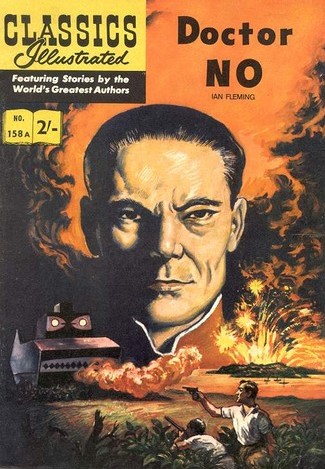
Doctor NoI remember reading Dr. No and there's a sequence where Bond is lying in bed and a poisonous centipede is crawling up his body. Fleming has thought every detail out. I remember actually stopping reading and saying to myself, "Wait, wait, wait, stop. Go back to the beginning of this scene," because I felt I was seldom going to read a sequence with such attention to detail. It described this intense, suspenseful situation, and I wanted to savor it.
The centipede comes crawling through Bond's pubic hairs and he feels his scrotum tightening up. Then it's questing up his belly and his belly flesh is kind of rippling. When it comes to Bond's throat, it stops. Bond realizes it's listening or feeling the blood pulsating in his jugular vein. Next, the poisonous centipede is coming up over Bond's chin, and he has to close his lips and then his eyes because it's crawling up his face. The centipede comes to his brow and suddenly Bond's hair starts to stand up on end and he hears this noise and he doesn't know what it is. Then he realizes the centipede's drinking the sweat off his forehead.
Aggh! Wow!

September 6, 2013

The Great Sabre Interview Part Five: The Future Depends on Where You Are as a Creator

Continuing our monster interview with Don McGregor, Don talks about disappointments, the future, stories about children, and the way that death and injury actually affects characters.
Read the introduction to the Great Sabre Interview
Read Part One of the Great Sabre Interview
Read Part Two of the Great Sabre Interview
Read Part Three of the Great Sabre Interview
Read Part Four of the Great Sabre Interview
If you enjoy reading this interview, please consider supporting the Sabre: the Early Future Years Kickstarter project!
Support Sabre: the Early Future Years on Kickstarter!

Don McGregor: What had seemed so positive -- the sale of Ragamuffins overseas - brought Sabre to where the series did not recover, and, in the end, was one of the key elements that led to Sabre: The Decadence Indoctrinationnever reaching completion.
Jason Sacks for Comics Bulletin: I think that's the really sad part of it. There's this kind of tragedy about if the book had just been distributed better, if you had just been able to coordinate the stories better somehow, we would have possibly had the chance to read that full incredible "Decadence Indoctrination" storyline. Instead it got mangled or bungled or whatever word you want to apply to it.
McGregor: Yeah, it's one of those things that's still a painful wound.
I don't blame anybody for it. It would be different if somebody was acting maliciously, but that wasn't the case. Everybody had something to lose. That said, I still have the emotional scars remaining. It doesn't make it any easier to deal with the fact that the book is gone and I never had the chance to show people where I was going and what I intended to do.
Still, I'm glad I had the chance to do the books I did.
 Ragamuffins is still one of my favorite books out of anything I have ever done. I wish I had been able to continue it. The series was going to grow from story to story, and it was unlike any of the other series I had done or created. I always said it was a book about childhood for adults. That was one of the things the series was. The stories that did see print all had flash-forwards from the 1950s to the '60s, '70s and beyond. So there is also a cause and effect aspect to the series. Oftentimes, the series would look at what adults think they are teaching kids, and what the child really takes from what has happened.
Eventually, there would have been stories that occurred when the mothers and fathers were five years old, and we would see what shaped them to become the adults and parents they were.
But more. In the long run, we would look at America from the early 1900's, the teens, the 20's and 30's, etc. We would see what had changed in America and the world, and what hadn't.

September 5, 2013

The Great Sabre Interview Part Four: there wasn't another book like Sabre. It was its own thing.

Continuing out monster interview with Don McGregor, Don talks about families, stealing ideas, the perils of bimonthly publishing and much more!
Read the introduction to the Great Sabre Interview
Read Part One of the Great Sabre Interview
Read Part Two of the Great Sabre Interview
Read Part Three of the Great Sabre Interview
If you do love reading this interview, please consider supporting the Sabre: the Early Future Years Kickstarter project!
Support Sabre: the Early Future Years on Kickstarter!

Daniel Elkin for Comics Bulletin: Don, you've mentioned a lot about family and how that's the center of Sabre. I was thinking that it's interesting that you had Sabre and Melissa come together and create a family, yet Melissa had no parents and Sabre's relationship with his family was kind of, well, not what we call wholesome.
Don McGregor: I love that idea. I love the idea because so many people have contentious relationships with their families and often with their parents. I liked the idea of examining that impact for someone who has parents, like Sabre, and contrasting it with Melissa, who has no parents. She has a glass tube for a family and she yearns for the very thing that Sabre has so many conflicting emotions about. Melissa's reactions are equally complex and profound, but I was intrigued with the idea of someone who only had transparent glass to reflect her search for heritage, for love or hate or a combination thereof.
So this allowed me to explore family from two radically separate angles. As we all do, the characters have to try to reconcile themselves to their divergent pasts, but their unity gives them a chance to keep the wounds from crippling them. And we have it facing us. These are questions we will probably really have to confront. It gets closer all the time.
So while I was creating the series, I was looking for things I wanted to write about and thought would resonate on a human level with many of the readers. In this aspect of the series, I wanted to do something where you have a human being who has always yearned for an emotional connection, but she only has this glass tube to go back to. For me there was a poignancy here that lent a great deal of emotional consequence to her character. It also gives strength and purpose to her, too. I love it when she stares at Midnight, when they have a stand-off together, because they each have chosen what is important in their lives, and sometimes that brings them into striking confrontation with each other.
Sabre by Don McGregor
But see, now, here's another thing that affects your books, you're not even aware that are going to affect the books; you guys are talking about whether the medium could handle a series of this sort at the time I was creating it. First, I had no idea it would take over two years before Sabre would become the book that people eventually had a chance to hold in their hands. You're absolutely right Daniel, for better or worse, there wasn't another book like Sabre. It was its own thing.

September 4, 2013

The Great Sabre Interview Part Three: The Beach that Came Alive

Continuing our monster interview with Don McGregor, Don talks about why he did a science fiction graphic novel, why he showed love between black and white characters, and between gay characters, and the frightening story of the day a beach that came alive.
Read the introduction to the Great Sabre Interview
Read Part One of the Great Sabre Interview
Read Part Two of the Great Sabre Interview
If you do love reading this interview, please consider supporting the Sabre: the Early Future Years Kickstarter project!
Support Sabre: the Early Future Years on Kickstarter!

Don McGregor: Daniel, I want to say again I found it interesting how you were talking about your experience of when you first saw those books and how it stayed with you with memories of the time period that you saw them. I guess I was struck by how many people have expressed different life-stories about how they encountered those books and how they affected them. I suspect that it has something to do with when the person experiences the book, where they were at at that point in their lives.
Daniel Elkin for Comics Bulletin: Yeah and it was because it was like nothing else that I was reading at the time, it really stuck in my brain.
Jason Sacks for Comics Bulletin: Why do you think it stuck in your brain so much, Daniel?
Elkin: Why did it stick in my brain? Well I think part of it was telling the stories about people and not about heroes. There was nudity in it, which was completely new for me, at least in comic books, and there's this interracial relationship, and the hero looked like Jimi Hendrix, and all that sort of worked together to be unique. It was unlike anything that I had seen before and, like I wrote, unfortunately, it came at a time where I was sort of moving away from comics and I didn't stick with the series. In retrospect, I apologize.
McGregor: Nothing to apologize for, Daniel. When people first began writing to my stories, or when I started doing conventions as a writer, it was a surprise how intense and emotional people were about the Panther, "Killraven", Sabre,Detectives Inc.
Sometimes it felt as if I were in a Confessional, hearing things of such inner pain or joy, that it took me aback that people I did not know would reveal so much of themselves in such a candid manner to someone who was virtually a stranger to them. I don't believe I was ever looking ahead or could have predicted such personal revelation from the readers when I wrote the stories.
You don't think about any of that when you're in the midst of creating. You're just trying to write the story and I've think I've said this before to you guys, I'm just trying to hear the voices in my head, of the characters.
Certainly the voices of Sabre are completely different than in series like Detectives Inc. or Ragamuffins. Each series needs a separate narrative voice. A distinct approach to the writing. But that's not including the voices of the characters. And in a series like Ragamuffins it has to be voices from the 1950s, and on top of that mostly the way young kids of five or six years old speak.
Ragamuffins by Don McGregor and Gene Colan
To be honest with you I wanted to do Ragamuffins before Sabre. But even I knew it would be foolhardy to test a market place most industry people did not feel existed in such a capacity to support a title, going with little kids growing up in the 1950s would have given me less of a chance to prove that it did. It's also the reason I didn't start with Detectives Inc. This medium was then in the throes of superheroes and costumed characters. I also knew that at that time I was known as a superhero, fantasy epic writer, that already that was the common perception. Yes, there were people who remembered I'd started published writing at Warren Magazines doing mostly horror stories, but we're now three years down the line and doing a regular series that acquires an ardent following changes everything.

September 3, 2013

The Great Sabre Interview Part Two: Birth, Violence and Gay Kisses

This interview originally ran on Comics Bulletin
Continuing out monster interview with Don McGregor, Don talks about creating some of the first gay characters in comics, the bullshit of politics, strong female characters, the importance of good comic coloring, the strange way America deals with violence and sex, and much more.
Read the introduction to the Great Sabre Interview
Read Part One of the Great Sabre Interview

If you do love reading this interview, please consider supporting the Sabre: the Early Future Years Kickstarter project!
Support Sabre: the Early Future Years on Kickstarter!

Don McGregor: When I was working on "Exploitation" as a mini-series, Deuces Wild and Summer Ice were definitely characters that were going to be in the storyline. I had been trying to write gay characters since Taku and Venomm in Panther's Rage. But, as naïve as I might have been, I wasn't totally ignorant of what I could do, and what I had to bide my time, and see if I could find a way to do it. But Deuces and Summer were a done deal, and I was doing a lot of work creating their characters. Dean Mullaney would not care, would not tell me I could not have homosexual characters in the series; I'd already written lesbian characters in the earlier Detectives Inc: A Remembrance of Threatening Green.
Certainly, early on, I was developing Sabre's opposition in "Exploitation". I love Joyful Slaughter.
Sabre by Don McGregor
For me, Joyful was so unique and colourful and idiosyncratic. Joyful's personality was so distinctly different from any of the villains I had created before, and a costumed hero series often requires an opposing force of character that instils something unsettling but also charismatic.
For some reason, for me, a little of Joyful is inspired by Tex Avery and Bob Clampett and Chuck Jones. I'm sure some people reading this interview won't get that, but I guess it's his off-the-wall, bonhomie personality that I find so fascinating. I like the sequences between Sabre and Joyful, at least partially because they are such polar opposites in their world-views, and I had a good time writing the dialogue sequences between them. All that, of course, fights for how much room you have to devote to such scenes within the constrictions of a finite number of pages.
Joyful appealed to my sense of humor, but also that sociopathic bent that he sees nothing wrong with the terrible violence he can inflict on others, just through his power alone. And I loved the idea of Joyful running for President, and that the public didn't vote, just the invested elite, that all the camouflage that anybody is giving everybody a choice or real options is now blatantly in the open as bullshit. No charades, at all.

September 2, 2013

The Great Sabre Interview Part One: characters that are alive in an alternate universe

This interview ran originally on Comics Bulletin
As promised, today we start a massive interview with Don McGregor about his unparalleled series Sabre. The interview will run at least a week and will be the definitive word on a massively influential and powerful book. You'll find as you read this interview that Don is an incredibly honest, incredibly passionate man whose work means an incredible amount to him. You can hear and see the passion in every word that Don shares about hiw work. That passion makes this a wonderful interview that I'm sure you'll love reading. Before you read this interview, read our article about Sabre that sets context and style, then come back here to hear the juicy behind the scenes details!
Jason Sacks for Comics Bulletin: When you look back on the run you produced on Sabre, what's the story element that you most wish you could have gone back and elaborated on?
Don McGregor: In the process of creating a series, there are a lot of factors that have to be considered before I even begin writing any finished copy.
Even if you have introduced a concept, an idea, for yourself and to a publisher, it's often not determined exactly what format that book is going to appear in, especially when it's a comic. During the time-frame that I had written the originalSabre, long before I had chosen an artist, in approaching that graphic album or novel, whatever you want to call it, it was awhile before it was determined it would be 38 pages in length. That was the only determination that was in cement, in place and there's no way around it. Whatever was going to be in that book or not be in that book, I had 38 pages to do it in and I really worked hard at trying to figure out how much I could work into a solitary book, in a story that would hopefully satisfy readers that had been following "The Black Panther" and "Killraven" and the other material I have been writing.
But, it wasn't lost on me that I was competing now with two and a half years' worth of books in 38 pages.
And there's no way you can even come close to doing a novel in 38 pages.
At one point in your piece, Jason, you said something about being successful in some alternate universe. Realistically, in the creative world here, all things being equal, I would prefer that success happen in this one; it would be my best hope. I read what you wrote to Marsha and she just said, "Tell Jason, 'This one'." This is the universe we're trying to survive in.
That said, sometimes I have talked about Sabre, Melissa Siren and the others that it's almost as if they do live in some kind of alternate universe, because there was a time after I had finished the first story that I virtually knew what happened next in their lives, even though I wasn't thinking about Sabre, I was in the midst of making the first Detectives Inc. a reality, and was also creatively involved with developing Ragamuffins.
Sabre by Don McGregor
And then, one night it just hit me, I knew Sabre and Melissa's lives. I knew where they went. I knew what happened next, the tone and theme and overall actions of "An Exploitation of Everything Dear" was clear to me. I hand-wrote it down as fast as I could, trying not lose this glimpse into what you label an "alternate universe." For many folks, who'd only seen the graphic novel, they do think of Sabre as being a lone hero who walks off into the distance at the end and leaves the woman behind and goes on to a new adventure. That was never my intent for Sabre as a series; I always knew it would lead where Sabre #7 did, the birth of Sabre and Melissa's children. That ending was as far as I could take the characters in a 38 page book.
I always knew that the story was planned to be a love story between a man and a woman and also raising a family and having to make decisions that affect your life, and those you love. So I essentially knew the entire spread of Sabre: An Exploitation of Everything Dear that night. Part of it is a road story, which examines what has happened in various states as Sabre treks to return to Melissa before she gives birth to their children.

September 1, 2013

The Great Sabre Interview: Preview and Analysis

This originally ran on Comics Bulletin
Jason Sacks: Don McGregor was perhaps the most humanistic comics writer of the 1970s and '80s. Where other writers were obsessed with grandiosity and flash, with superhuman achievements and the triumph over evil, McGregor explored different territory.
McGregor knew that the most important battle for a real hero was the battle within. It was the battle to preserve some nature of humanity in a world that would bruise and batter, a world of people with strange names and incredibly narcissistic ambitions, who would tie you to an erupting geyser and force you to battle with your own inner doubts and pains simply in order to return to the thing that you loved most.
Don wrote a slew of great comics in that era (and wasn't able to write a slew more great comics – a true tragedy that is hopefully rectified in some parallel universe where Don is the bestselling writer in comics), but perhaps none reflects his view of the world more than Sabre.
Sabre, the most explosive hero in comics
When we first meet Sabre, on the first page of the original Sabre graphic novel, he looks like a cross between Eastwood's Man Without a Name and Jimi Hendrix. Sabre is a lone her, a single man on a mission of anger and vengeance. As we find out several pages later, there is more to this man than first meets the eye: "There still some survivors who will not abandon their romantic ideals. One of these survivors has been labeled a romantic realist. He calls himself Sabre. He is a roguish anachronism, or so he'd like to think."
What in the world does it mean to be a romantic realist? It's a compelling turn of phrase, but one that I hadn't encountered before I read the term from McGregor. That phrase gives the reader an odd sort of mystery to uncover, but as the 14 issues of Sabre play out, we see that the phrase is perfectly well-suited to this action hero.
Sabre is romantic in nearly every sense of the world. He dearly loves his life-partner Melissa with all his heart and soul. The pair have as realistic a romance as you can find in a book that takes place in a kind of post-apocalyptic society. Sabre and Melissa clearly love each other deeply, and McGregor presents the relationship between the two as some of the most realistic depictions of marriage ever shown on the comics page. Sabre and Melissa flirt and make love, bandage each others' metaphorical and literal wounds, balance prosaic tasks like changing diapers while also working hard to defend each other from giant marauding crabs (not nearly as corny a scene as it sounds).

August 24, 2013

Hard is the Journey by Li Po

HARD IS THE JOURNEY

Gold vessels of fine wines,
thousands a gallon,
Jade dishes of rare meats
costing more thousands,

I lay my chopsticks down
no more can banquet,
And draw my sword and stare
wildly about me:

Ice bars my way to cross
the Yellow River,
Snows from dark skies to climb
the T'ai-hang Mountains!

At peace I drop a hook
into a brooklet,
At once I'm in a boat
but sailing sunward …

(Hard is the Journey,
Hard is the Journey,
So many turnings,
And now where am I?)

So when a breeze breaks waves,
bringing fair weather,
I set a cloud for sails,
cross the blue oceans!


- Li Po