Showing posts with label Patrick Kyle. Show all posts

October 30, 2018

A Garden More Cyclical Than Linear: John James Dudek reviews ROAMING FOLIAGE by Patrick Kyle

Profound and silly, abstract yet story-driven, Roaming Foliage encompasses all of the nuances of the wildly talented Canadian comics artist Patrick Kyle. His newest book is a marriage of the different types of abstract, fine art, and narrative-led comics work he’s done over the last several years. Following in the footsteps of 2016’s Don’t Come In Here, this book also delves into untamable and ever-shifting landscapes and individual change. While it certainly maintains a lot of the experimentation that Kyle is so well known for, this book is a return to a more recognizable narrative form. The story isn’t linear, nor is it particularly easy to follow. Nonetheless, this is Kyle at his finest, using abstract imagery alongside goofball character antics to tell a larger story about friendship and the importance of community.

Roaming Foliage follows a handful of characters as they traverse a wild and magical garden, each trying to find something they’re missing: acceptance, the ability to better oneself, a new suit, a battery-like fungus… the narratives shift, cross paths, and split up, making it feel like a cohesive world. While set in the garden, the location is also a functional character in relation to its seeming autonomy. As its “maze-like and chaotic” nature is affected directly by the emotional state of Rotodraw, a humanoid robot who has lived for hundreds of years, its shifting and changing affect the paths of other characters, who cannot control it. Kyle’s penchant for crafting physical spaces shines here. The world itself is as important to the story as any other aspect and the experimental layout of the book is right at home because of it.

Within this world, there are two main groups making the journey. The first group consists of two boys in search of a fungus that powers Rotodraw. They help one another push their way through the garden as it becomes increasingly unstable, facing unexpected adversaries like a gigantic elf and a conscious fungus. It’s classic Patrick Kyle, a romp seemingly unbound by time and space; the kind of rambling, fun adventure he excels at in his short stories, expertly woven into this larger narrative.
    
The other main arc of the book, in which a girl and a small head without a body traverse the garden together, is profoundly beautiful and rife with the pro-community and friendship themes that Kyle sneaks into much of his work. The two work together for most of the book as one body is stacked two heads high and the narration and dialogue don’t hold back from exploring their newfound partnership. “Look at us, unification of two friends into one perfect person,” the girl says. “Power and influence through team-work.” Their conversation is almost heavy-handed at times, but it’s beautiful and soft in a year that really needs more friendliness in the comics space. 

Even more poignantly is when the bodiless head is given limbs, and, thus, independence from being carried everywhere. Without batting an eye, the girl states, “I’m so proud of you! You were so brave!” The head’s independence only strengthens their friendship bond as they move forward on their journey. In a book somewhat cluttered with multiple storylines and unrelenting visuals, one can almost gloss over the sweetness the characters exhibit toward one another. There is almost no malice or cruel action in the entire book, and the characters openly praise and encourage characteristics they find admirable in one another. Community is praised and characters who help one another are rewarded.

Kyle’s writing style is enviable here in that he effortlessly shows off his ability to create dense blocks of narration and over-simplified dialogue which is captivating, serious, and funny all at the same time while still allowing the story to progress. Exposition and dialogue are interwoven with narrative seamlessly in a way that in a weaker writer’s hands might feel clunky and forced. The writing often tells what’s happening instead of letting the visuals simply show the reader, but in the end, words service the art, which is able to constantly shift and change to craft a unique tone.

If it suffers from anything, Roaming Foliage can be hard to follow as Kyle seamlessly shifts point of view around in a physically inconsistent world. This doesn’t necessarily drag the story, it just requires more of the reader’s attention. The density of more cluttered pages requires the book to be read carefully and one cannot simply skim the dialogue boxes and understand the plot of the book. There is more to it than an illustrated conversation and the book challenges you to find out what it’s all about.
    
In fact, where Roaming Foliage really excels is in its experimental use of the comics medium itself. It’s the kind of comic that can only really exist as a comic, yet, even with this, it eschews classical page layouts and paneling schemes allowing each page to become a piece of art in its own right. Kyle is as much a cartoonist as he is a fine artist and illustrator and it’s here he uses those skills to masterfully construct each page. Panels are only used when necessary, full bleed backgrounds run elements off the edges to emphasize the wild and endless state of the environment, and often a page is used to set a tone as much as it is used to advance the story. As an example, Kyle includes a page purely focused on a handful of items that the characters do not have. The page doesn’t need to be there as it doesn’t change the relationships between the characters and their space, but it sets an undeniably unique tone.

Further experimentation can be found in almost every page element. Sometimes hand-drawn, but more often set in type, the lettering is integral to the collage-like tone of the comic. Words litter the page, handwritten dialogue overlaps with typed dialogue, some words are even hidden within blocks of ink, only visible when the light catches the page just right. It’s ambitiously hectic and gives the book an improvisational feeling that lends to the ever-changing nature of the magical garden setting.

The heavily-experimental page layouts and intermittently drawn-out pacing require more from the reader than a casual afternoon read… and yet it somehow all works. Despite being visually cluttered, the characters still move through the pages in a way that unconsciously guides the eye and is marvelous to look at. It’s a delightful adventure comic rife with detail that plays with readers expectations in a way that most other artists aren’t quite doing.

Through it all, friends work together and grow closer, a community is strengthened, the world proves itself to be a cyclical more than linear, and, when it’s all over, the reader finds themselves back where they started, and eager to read through a second time.
----------------------------------------------------------------------------
John James Dudek is a comics artist and a graduate of the IPRC Comics & Publishing Program. He cares a lot about worldbuilding and how people develop stories. If you like these things too, please talk to him about it! He can be found around the internet @funwithjohnjames. He makes art in Portland, Oregon with the Soft Skills Comics Collective. He is friendly.

January 19, 2018

Cities As Symbols: Philippe LeBlanc on STRUCTURES from Uncivilized Books

(Editor's Note: I've been following Philippe LeBlanc's writing over at The Beat for quite some time now, and I've always been impressed with his ability to write reviews about small press comics that come from a clear critical eye and a certain fearlessness in taking on difficult work. When Philippe said he'd like to write about the Structures series from Uncivilized Books for this site, I gave him carte blanche, as I knew he'd write something spectacular. As you can read below, I wasn't wrong.)


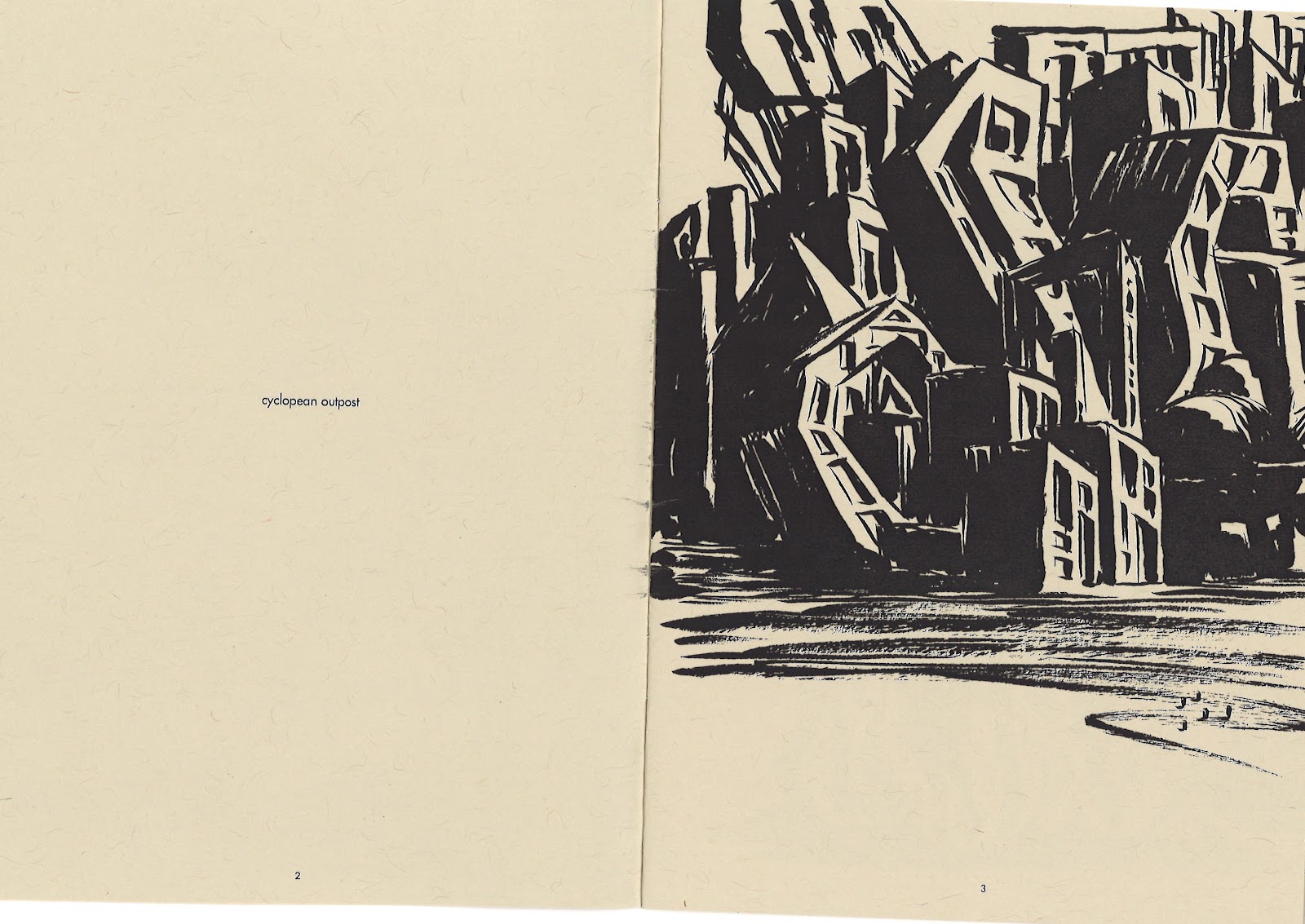
The first illustration comes next to the ominous words Cyclopean outpost. We see minuscule human shapes walking towards a massive metropolis, humongous in size. The figures are featureless, they barely register. How can a person matter when facing such an enormous city? We are minuscule, meaningless. These first pages marks the start of a multiyear, multi-artist project called Structures published via Uncivilized Books.

I remember meeting Tom Kazcynski, the publisher of Uncivilized books and cartoonist, at TCAF in 2014 and talking about the Structures project was going to materialize and now, four years later, I am reading Structures 1-11, the building block of this series.The book takes place in an immaterial void reflecting only a sliver of reality and not bound to a specific time of publishing. It is timeless. It’s about the structures we built and how we see them once they’re built. They become symbols. 


Art by Tom Kaczynski, Structures 1-11

I remember visiting Toronto for the first time and how being in the city felt. I’m from Quebec City, a much smaller city in comparison to Toronto’s enormous size. It was massive, tall and expanding into infinity. I remember the overwhelming feeling of invisibility, of worthlessness amongst a sea of human beings walking through the core of downtown in the winter, surrounded by towers hovering so far above me, I could barely register where they ended. I had been to major cities before, Montreal or New York are close relatives after all, but Toronto was something else. Perhaps it was this heterogeneous architecture, one that seems empty of planning or logic, skyscrapers surrounding townhouses, a lake with very little waterfront access on the ground (at least downtown directly), and other varied odd bits of patchwork creating the city. I remember when I first saw Denis Villeneuve’s film Enemy, it captured similar feelings as he depicted Toronto as a cage, a massive city with streetcars electrical grids constantly overhead, claustrophobia abounds. I wondered how a Metropolis such as this could have expanded this way, and how the modern wonders of architecture felt so dehumanizing and oppressive. 

Structures 1-11 stands as the foundation of this exploration of objects, space, and big ideas and it comes in deceptively small packages. It is not interested in depicting reality, but rather, it explores concepts on the outskirt of reality. What do our modern cities look like? What would the end of days look like? What is reality? All of those are contained within this series through abstraction and cryptic notes. The juxtaposition of words on a blank page and drawings on another is an interesting way to explore these concepts and a reminder of how comic books work. Comics are really just words over drawings, but what you can do with that is endless. 

Another example of these cryptic explorations of structures as symbol echoes across the two pages depicting The Tomb of Jack Kirby. It's a beautiful reminder of the massive legacy Kirby has left the comic book world. I remember reading about Kirby for the first-time in the pre-internet era of my childhood (in a copy of Wizard #33. I think). I believe it was a sort of a tribute issue, complete with a massive array of praise from a number of comics artists, editors, etc. Without having even seen his art, I knew how important his legacy was and how much comics owed to him. His creations fuel the big publishers to this day and his concepts are still the object of admiration. Depicting his legacy as a towering edifice of grief and wonder is bold and spot-on. Kaczynski creates a futuristic metropolis just on the edge of reality filled with tall concepts and ideas. Exploring our relationship with our landscapes and urban environment in our modern ages in 11 images is incredible. That four other cartoonists explored similar concepts is remarkable. 


Art by Vincent Stall, Structures 12-23

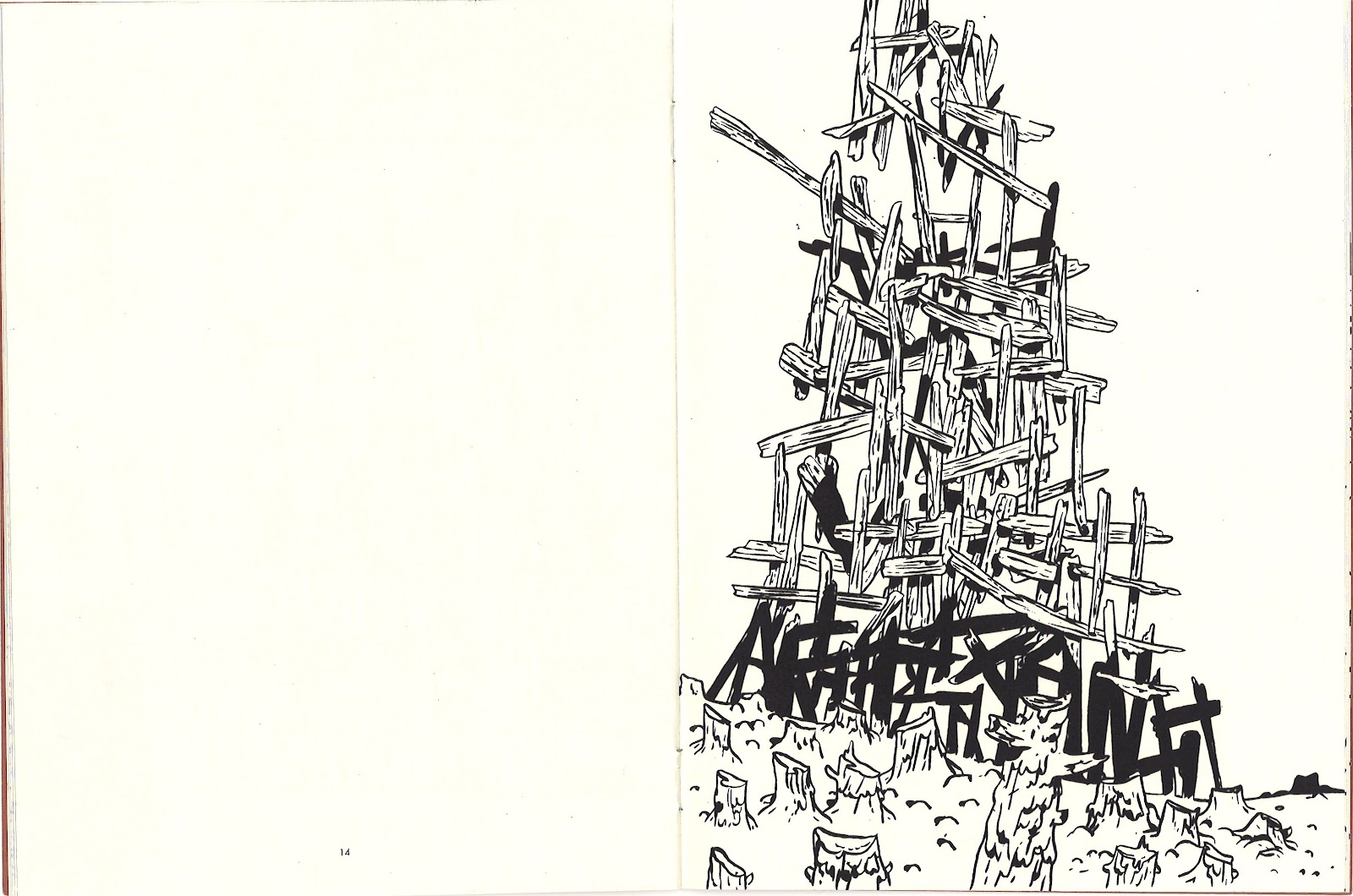
The following issues follow in the footsteps cleared by Kaczynski. Each artist tackles big, bold ideas about our modern world, and explores them in their own way. The recurring element of each comic is the structure of the comic itself, a blank page with text followed by a page with an illustration. Vincent Stall’s Structures 12-23 begins with a seeming collapse of civilization, leaving the world in ruins. From these ruins, a new type of architecture rises to impose its grotesque will on nature. We only see the structures built by the survivors as they cannibalized the past, the landscape, and nature itself to create a series of temporary habitats. Stall focuses on the way we accommodate ourselves by repurposing our surroundings. 


Art by Michael Deforge, Structures 24-34

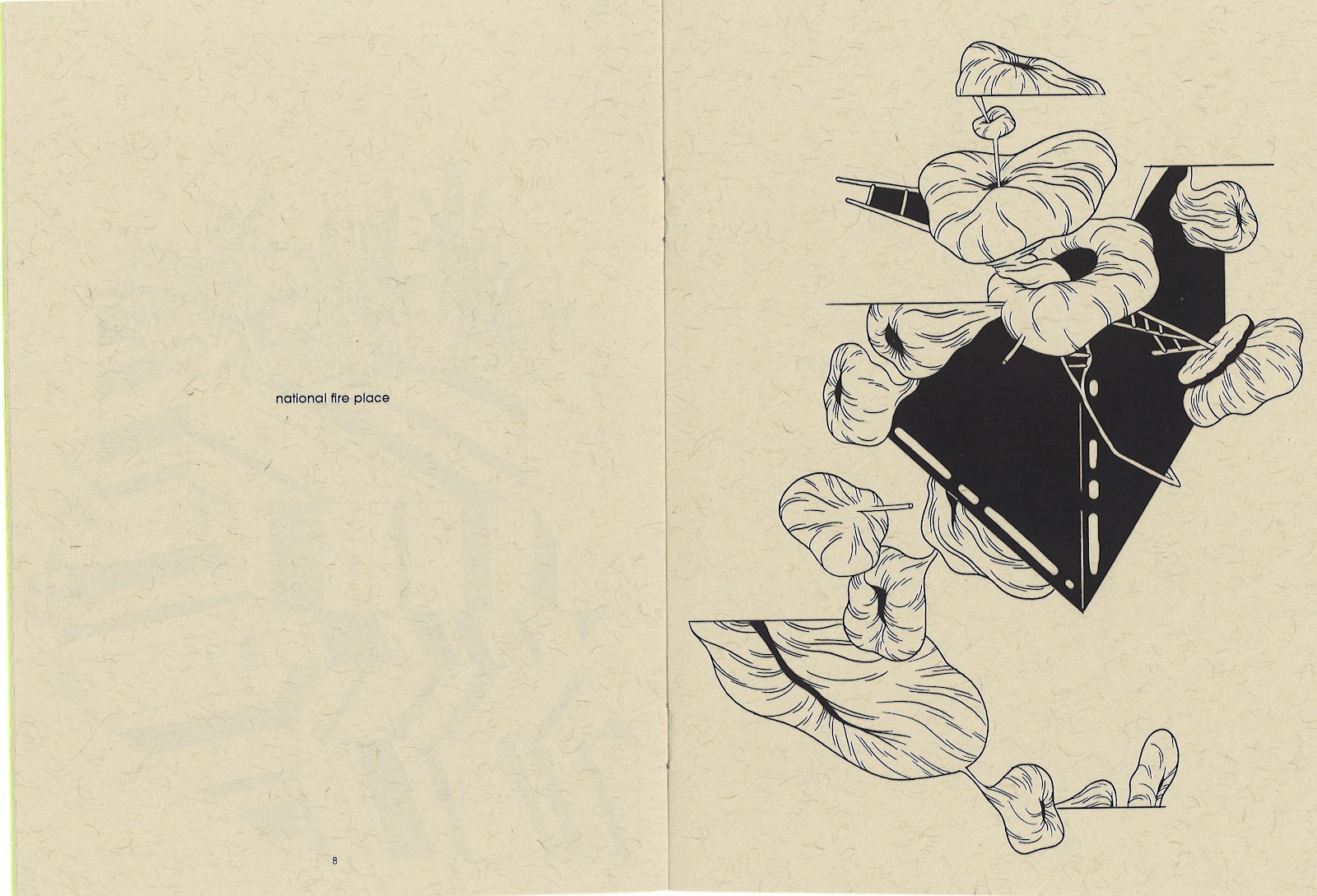
Michael Deforge pushes these ideas forward in Structures 24-34 by moving away from physical structures and on to ideological ones. Deforge is looking at how nonsensical national myths can be. We take certain things for granted, but what we build as part of our national myth is often arbitrary. Some things are easier to understand, but others seem haphazard. Deforge shows various shapes and forms that are supposed to be items of national significance, whether it’s national ladders or national living rooms, and each image is twisted and unrecognizable. It forces the reader to consider how we build myths and why we take some things for granted when they can be, in fact, just irrational and subjective. Our inspiring stories and symbols are not always self-explanatory, if we’re thinking about some of our Canadian myths and how they take on a significance of national importance, one can understand how Maple syrup or the resilience of the beavers but some other elements are more nebulous than others. Canadian niceness, for example, is one of those that are harder to wrap your head around. Are people nice, or passive-aggressive, and how did this become part of our myths? 


Art by Patrick Kyle, Structures 35-45

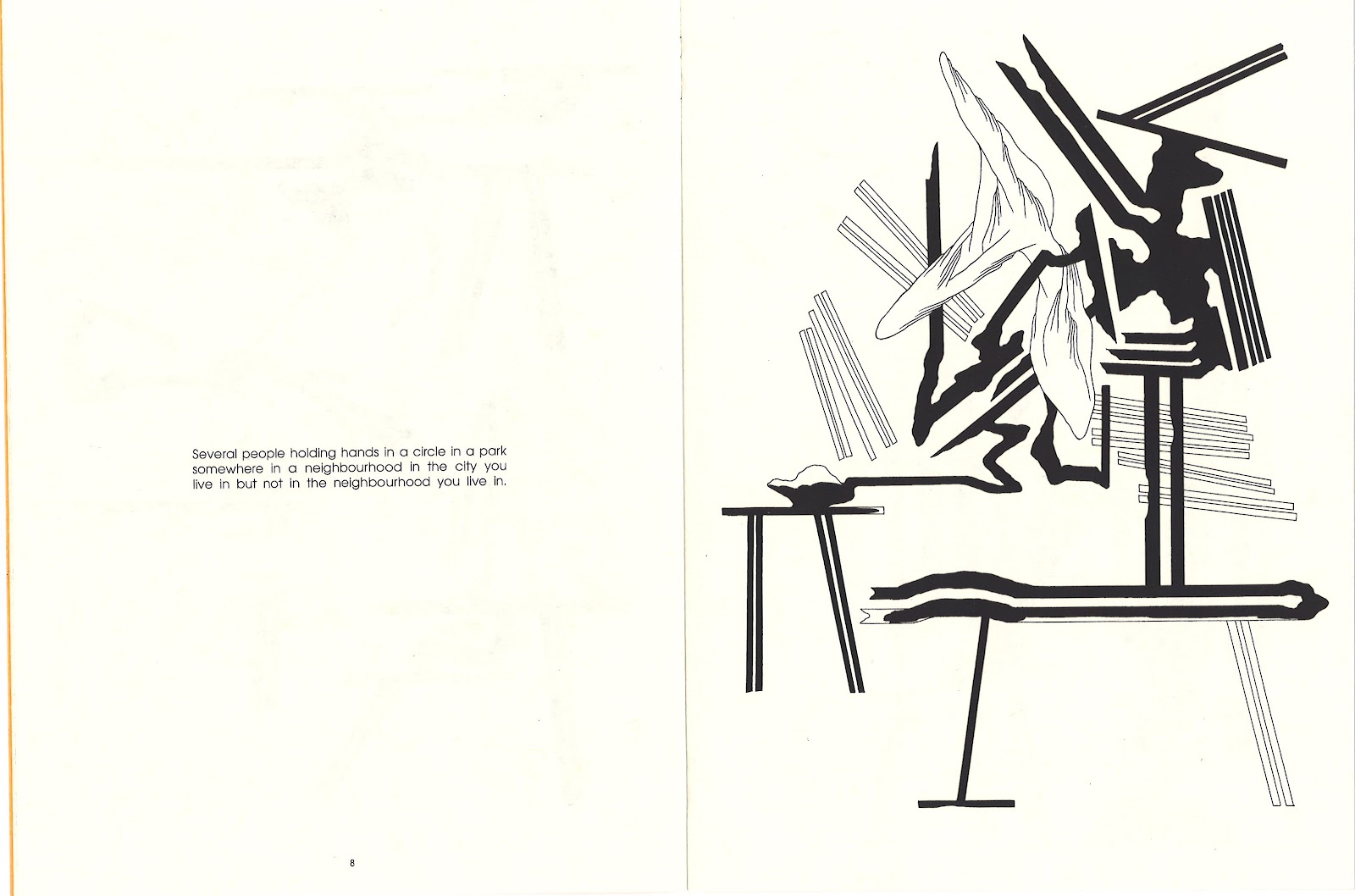
In Structures 35-45 Patrick Kyle looks at the twisted structures of our mind. Kyle creates a world where everything is twisted into abstraction. It’s almost like navigating a dream, or a nightmare. You can almost recognize the structures he’s depicting, they are just twisted enough that you see the foundation of a table, or a chair, but the rest is barely decipherable. The text doesn’t talk about a structure, but of a construct of the mind, just bizarre enough to feel familiar, but strange enough to be horrific. My favourite example might be “Several people holding hands in a circle in a park somewhere in a neighbourhood in the city you live in but not in the neighbourhood you live in”. Kyle builds a nightmare for us to consider. How does our mind organize information and what happens if those structures are twisted? Kyle forces us to consider that, much like the construction of myths, habitats and cities, our psyche may not be as structured as we think. 

Structures is a series that has been exploring interesting topics throughout its short publication history. From the creation of modern society, to how we destroy nature for our own purpose, to how we construct myths and how our mind behaves, Structures show that comics can achieve thoughtful explorations of philosophical topics and existential questions even in small formats. The medium is made better by work like these, each piece builds onto the previous one to create something bigger than the sum of its part. Uncivilized Books can be very proud to publish such a strong and experimental comic series.


-----------------------------------------------------

Philippe Leblanc is a Canadian comics journalist. In his regular life, he improve Canadian medical education, and is the co-host of the Ottawa Comic Book Club. He reads alternative, indie, and art comics at night and writes about them for The Comics Beat and Your Chicken Enemy