KEITH SILVA: [Lead] I am a
forty-one-years-old, by all accounts, a grown-ass man. When it comes
to superheroes, my sell-by date has long passed, in other words, I’m
not buying (much).
[Penitent lead] Elkin, I’m sorry. I
fucked up. I don’t know what else to say. I thought I was ordering
spaghetti with marinara. Instead, I got egg noodles and ketchup.
[Apostolic lead] Forgive me, Elkin, for
I have sinned, it’s been … too long since my last confession.
Let’s start at the start: a month ago
I said
Divinity
#1 is the best book of 2015 , so far (
editor's note -- Keith waxes rhapsodic about Divinity on the Panel Culture podcast at the 17:30 mark). And then, as the
kids say, this (the ‘this’ being
Divinity #2) happened:
Pro tip: hyperbole is a bitch, kids,
especially when it comes time to collect.
Apply whatever ‘trusty’ metaphor
fits: the
football
gag from Peanuts, the folktale about scorpion and the
frog/turtle or the thing about how resentment is, you know, like
drinking poison and expecting the other person to die.
Divinity
#1 gave no indication it tied into the Valiant Universe except, I
guess, that that’s a given nowadays. I don’t know why I thought
Divinity was going to be … different, a standalone story,
untethered to universality, un-shared with the rest of the Valiant
Universe. Obviously, I was a fool. I’m clapping on the one and
three (again) while everyone else is pounding their feet to the
backbeat of shared universes and king continuity. Why couldn’t
Divinity have been different?
I’ve sampled a couple of the Valiant
Comics relaunch titles --
Shadowman (twice),
X-O Manowar
– and quickly gauged these were garden variety superhero fare with
varying degrees of success. Why is Valiant doing what Marvel and DC
already do so well and with
names brands we’ve all
known since we were whelps suckling at the teat of Stan Lee and that
degenerate Bob Kane. Coincidentally, it’s like the
Seinfeld
episode titled
“Bizarro
Jerry,” when Elaine tells George, “
I'm, I'm
sorry … We've already got a George.” Nothing succeeds like
success so why wouldn’t Valiant want to follow Marvel (Disney) and
DC (Warner Bros.) into mainstream middle-brow multiplex mediocrity?
Get while the getting’s good, I suppose.
I remember your
end of the year essay for
Loser
City, Elkin, about your waning enthusiasm for Valiant.
You wrote:
“I
know the fault lies with me, not them. Perhaps it’s a
hypersensitivity to whatever smacks of crass consumerism bred from
having grown up in the suburbs of Dallas, Texas where everything is
plastic and everyone is trying to sell you something. Maybe I should
lighten up and be more accepting? Oh, that’s right, John Lydon also
said, “Turn the other cheek too often and
you get a razor through it.”
Your use of the
Lydon quote, genius on all counts. So why are we here … Again?
Divinity #1 has the two things I
need in a mainstream comic: an original premise and a crackerjack
creative team. With comics like MIND MGMT and Red Handed:
The Fine Art of Small Crimes, Matt Kindt dazzles readers with
original and many-layered stories no other writer or cartoonist is
telling. Divinity makes for a worthy addition. Kindt imagines
a communist cosmonaut, Abram Adams, who returns to Earth after being
sent to the farthest shores of outer space where he encounters (the
solicit says with grave import) “something unknown. Something
that … changed him.”
Kindt’s script is brought to life by
Trevor Hairsine (penciler), Ryan Winn (inks) and David Baron
(colors). Together these three artists bring warmth to the far frigid
reaches of space. Hairsine is a realistic stylist (is that a thing?)
a cartoonist who’s figures are artistically classical in the style
of Frank Quietly. Winn and Baron act as twin sparks bringing
Hairsine’s pencils to life with depth and humanity.
One more thing, Valiant has released
Divinity in what they’re calling a ‘prestige format,’
basically the look and feel of how Dark Knight Returns read,
in singles. Nostalgia achievement unlocked!
When Valiant’s “Avengers” showed
up, my heart sank. I immediately became Hannibal Lecter chiding that
young upstart Clarice Starling through the glass. (with apologies to
Ted Tally) I thought, “No, no, no you were doing fine [Kindt et
al.] you had been courteous and receptive to courtesy. You had
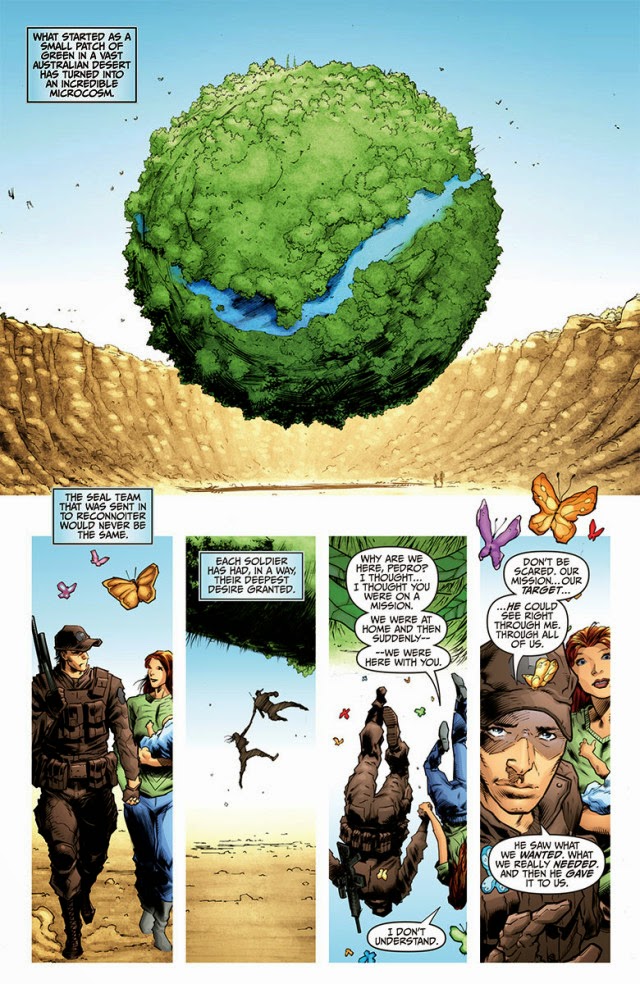
established trust with the black soviet cosmonaut who turns people
into butterflies and birds, and now this ham-handed segue into your
‘shared universe.’ Tut-tut-tut. It won’t do.”
This is so much pissing into the wind,
but why does Valiant, a publisher without the yoke of a corporate
overseer around its neck, have to copy what Marvel and DC are doing
with (almost) every property? Why can’t they be different … with
even one comic? You know, this shared universe thing … it’s
gonna’ get old, it already is old. People will tire of it
eventually, right? Why not create something new?

For me,
Divinity went from
high-concept Dickian sci-fi to (slightly) above average superhero
saga with that one panel. Look, I know I’m coming off as the dick
and, yeah, I know, if mainstream superhero comics
aren’t for me
then why’d I buy a mainstream superhero comic? Maybe because I
thought this time it was different and this was the Valiant book for
me, for the guy who doesn’t need a cohesive comic book universe (is
that a thing?). Oh, and to seem even more out of step and old,
watch
The
Nairobi Trio, it’s an old Ernie Kovacs skit (who?)
about what conformity gets you (if only Valiant could ever be as
creative). I bet someone like say … Matt Kindt could come up with
something as creative, inventive and smart.
I like to style myself an optimist. I
want to spend my time writing about comics I care about. Maybe,
Elkin, it’s best for me to remember the actions and sentiment of a
young Hopey Glass and be done.
DANIEL ELKIN: Preach, brother,
preach.
“…I
hated myself. I had created nothing, I belonged to nothingness, to
the néant, and it seemed to me that my own death was the only thing
left that I could create.”
―
John
Fowles,The
Magus
Oh Silva, I hear you. Perhaps the lines
around our eyes are not so much a product of our getting older, but
rather from our endless proclivity for grimacing. Disappointment,
apparently, ain’t just a young man’s game.
See, yeah, you sold me, my friend. I
eagerly bought in, too. When you waved Divinity in my face, I
perked up like a puppy catching a whiff of somebody cooking a Monte
Cristo sandwich. Here it was, something slick and something … well
… not quite new, really … but something laying a clean, fresh
shag carpet over what is, for all extents and purposes, a well-worn
path through the living room of comics. It was something beautiful
to behold. Thick. Full of the possible. I, too, followed your lead
and got excited about this book.

Issue #1 was like a glitter bomb of
promise. Kindt was racing around the house opening windows, letting
all the smells of potential rush in; he compelled his reader to slow
down and to detach from plot in order to revel in potentiality.
Hairsine’s pencil work pulled me in at all angles and perspectives
and emotional heft carved into faces. Winn’s inks accentuated and
deepened Hairsine’s dynamism and both the grandeur and the solitude
of moments. And don’t get me started on the subtlety of Baron’s
coloring work; here is an artist who understands what color is in
terms of narrative intent and whose deft palette brings cascades as
much as it brings quiet.
It was exciting.
And then, yeah, issue #2, that thing
that happened….
What started with such promise became
stained and matted in a matter of moments when the green ink of the
money chase spilled from its pages.
The whole experience smacks of getting
back together with an ex and, after only twenty-four hours,
remembering all the things that drove you apart. You can’t blame
the other for whom they are, you can only rip into yourself for your
infinite capacity for hope.
Which calls for a moment of
self-reflection, doesn’t it? What is our relationship with our
expectations? Who are we to demand a certain type of art from our
artists? By constantly being teased back by hype, by hope, by
Aaron
Meyers to sample some corporate property only to be
reminded over and over again of that Yeatsian admonition that “
the
falcon cannot hear the falconer,” what pathology does this
indicate within us?
What need are we trying to fulfill?
Before moving forward, though, I have
to wade tight through the past. See, I came back to comics after
over a decade of abstinence. On the surface, the impetus of my return
was the birth of my son. I was going to become somebody’s “Dad”
and, like so many others, the enormity of that
triggered all sorts of chemical reactions in my amygdalae.
Why did this synaptic explosion lead me
back to the likes of Spider-Man, Thor, Wolverine, and their ilk
though?
Was this return to Marvel properties a
result of my desire to bring to my child something I knew gave me
comfort and pleasure and dreams when I was young once too? Or was it
like
Lou
Reed sang, “
A little me or he or she to fill up
with my dreams, a way of saying life is not a loss”? Or was it
a desperate attempt to reclaim some selfish innocent moment or
passion in the direct face of the fact that time had, yes, moved on,
youth was gone, I had officially become a “man”?
You know as well as I do that there’s
always someone out there who is happy to point a giggling finger at a
middle-aged reader of superhero comic books and declare him or her as
someone stunted in their development, a weak-kneed Peter Pan afraid
of death or hiding from the onslaught of responsibility foisted upon
us.
But that’s not it, really, is it?
That doesn’t shove its thumb into the heart of the matter. At least
I don’t think so…
Because ultimately, Silva, these sorts
of books full of super-heroic shenanigans leave guys like you and me
feeling hollow or bored or cheated out of something. It’s like we
are flailing in a leaky rowboat, desperately scanning the horizon for
some sight of land only to be tossed further and soaked through by an
indifferent sea.
But is the onus of this on Valiant or
Kindt et al?
No. The fault, dear Silva, is not in
our stars, but in ourselves.
Which then begs the larger questions:
What are we doing with these sorts of books and why do we keep doing
it?
SILVA: “but in ourselves …”
indeed, indeed. The irony that Divinity is about a character
with the power to grant someone their deepest wishes and desire is
not lost on me.
There’s no need for explanations,
navel-gazing, or hand-wringing. It’s time to be a grown-ass man: I
got duped. How I came up with the notion Divinity was going to
be the Ronin of Valiant I don’t know, but I did and 1861
words later, here we are. I got suckered in by marketing and a pretty
face, not the first time and sadly it won’t be the last.
Cassius was right, again.
I’m not bent-out-of-shape that
Divinity became a superhero story, not really. What bothers me
is it’s another example of the homogeneousness of mainstream
comics. Abram is Valiant’s Galactus, right? As far as Valiant is
concerned it’s still March 1966 (!).You can’t repeat the past,
right Elkin? Has diversity in mainstream comics gone to ground ... is it all at Image Comics now?
I can’t come up with the right
metaphor to convey my frustration with what I see as new lamps for
old and add to my frustration why most of my peers are okay with this
sameness. I embarrass myself with how much I sound like Annie Wilkes
from
Misery when she recalls the ‘chapter plays’ or
‘cliffhangers’ (I know that, MR. MAN!) from her days in
Bakersfield; and that one time she stood up to excoriate her fellow
fans of ‘Rocket Man’ for having amnesia, shouting, “he didn’t
get out of the
cock-a-doodie-car!”
I don’t want to be Annie Wilkes. First I think I'm Hannibal Lecter and now Annie Wilkes, wow.
While I higgledy-piggledy borrow one
phrase and one You Tube link after another from pop culture I might
as well not break precedent: “
follow
the money.” Valiant is doing what they need to do to
rally their tiger teams as they leverage this best practice to align
with their corporate values and marketing strategies to make hay in
this very scalable marketplace. I look forward to when these
paradigms shift and we see a sea change away from this model of
shared fictional universes. But that’s me.
It’s time to quit the Nairobi Trio,
Elkin, for good this time, I hope. I’m tired of getting knocked in
the head. But absolutes are like hyperbole, you feel it the
next morning. Superhero comics aren’t Comics and that’s the
difference. Divinity serves as only the latest reminder the
art form of Comics is more powerful, deeper and richer, than its puny
superhero origin stories.
Elkin: Oh, Silva. I see you
there high up on the mountain-top with your long, white beard dancing
in the wind, your arms akimbo, your feet planted firmly in a
shoulder-width wide stance, shouting down at the people populating
the valley below, “No shepherd and one herd! Everybody wants the
same, everybody is the same; whoever feels different goes voluntarily
into a madhouse!” And yeah, I know there is a certain irony to
quoting Zarathustra given the context of this “review,”
but I guess I just wanted people to know that there is still one type
of Übermensch
I can get behind.
My worry, of course, is that people
will read all our words here and think the two of us sound either
like petulant, slick-bearded hipsters or wrinkled, drool-spattered
curmudgeons. But that's the risk you have to take to be true to your
craft.
Still...
I'm with you 100%, my friend. Let us
follow the words of 1 Corinthians 13:11 and “put away
childish things.” Instead of questioning the whys of our
disappointment or the wherefores of our apperceptions, instead let us
use our tools to celebrate that which we enjoy.
Because there is so much out there that
isn't disappointing.
Have your read
Generous Bosom by
Conor Stechschulte? Or
Ann by the Bed by Emily Carroll (in
Youth in Decline's
Frontier #6)? Did you know that Elijah
Brubaker recently put out issue #12 of his series
Reich? Or
that Sean Ford is working on issue #6 of his
Shadow Hills
series?
These are the type of comics we can get
excited about because these are the kind of books for us. These are
the capital-”C” Comics that you are talking about, the ones that
use the tools of trade to tell a story, not massage a brand.
Let's not worry about the men we've
become. Rather, let's celebrate the men that we are.
Let's smile and grin at the change all
around and, hopefully, we won't get fooled again.
And of course there is certainly a
place for comics like Divinity – ones that are trying their
best to be interesting and original and beautiful and true, caged as
they are in the confines of corporate dictums and IP shepherding.
There's nothing inherently wrong with what Kindt and Hairsine are
doing with this book. A matter of fact, given what it is (or, I guess
in our sense, what it turned out to be), it's a gorgeous thing to
behold. Top-notch. Top-shelf. Top-dog. Top-of-the-world, ma.
It's just not what we want.
So yeah, nearly 2,700 words later, here
we are stepping off our soap box or dismounting from our high horse
or climbing down the stairs of our ivory tower or whatever it is that
we are doing here and coming back to the thought that we keep
reiterating in so many different formats: Comics are an enormous
Luby's
Cafeteria where everyone can come and find something
delicious to eat, from a slab of Chicken Fried Steak to a plate of
Carrot and Raisin Salad to a slice of Chocolate Ice Box Pie. You can
pick and choose what you like, then sit down and enjoy your meal.
Just don't put a plate of Blackened
Tilapia in front of me and tell me it's Blackened Chicken. I'm not
going to be happy when I put it in my mouth.
P.S. And yeah, full disclosure: Just
so you know, I signed up over on Comics Bulletin to participate in
this huge all-staff undertaking of examining DC's 1985
crossover/event money shot Crisis
on Infinite Earths (Nothing Will Ever Be The Same Again!)
which represents pretty much everything we've been bemoaning here.
And I know this makes me seem like every type of hypocrite there is
and for which I have no explanation other then having a propensity to
agree to things in the evening after drinking gin all afternoon....
It'll be great, though...
Right????
- - - - - - - - - - - - -
Keith Silva is a writer, photographer, and producer for a long-running locally produced Vermont television extravaganza. Follow him on Twitter @keithpmsilva