October 27, 2017

TURNING FAMILY DYSFUNCTION INTO PURE ART: Nick Hanover reviews GORO by Sarah Horrocks

(Editor's Note: The following is the second of what I hope to be many contributions to this site from other writers writing about off-the-radar small press books being published today. If you're interested in contributing to this endeavor -- and getting paid to do so -- please pitch me at YCEReviews@Gmail.com or hit me up on Twitter @DanielElkin and let's see if we can work together.)
 

A closeted gay muscle man avoids responsibility while hiding out in a squalid Colombian hotel room, becoming literally entangled while speaking to his ex-wife on the phone. Elsewhere, a trans woman sits in a sterile nursing home, informing a nurse that she visits her father so often not because she loves him, but because she hates him and likes watching him be humiliated. A lean deputy visits a sex worker who despises him, demanding she call him by his dead brother’s name. These are the opening images of Sarah Horrocks’ new series Goro, immediately setting a tone of raw family hate against a backdrop of inky spaces and figures that frequently break out of the boundaries of their panels, rebellion and bile and vengeance screeching from every frame.

Horrocks herself describes Goro as “an exploration of my love of people saying shitty things to each other...and also my love of screaming and crying in comics,” stating “the focus on the book is mostly just family yelling at each other.” As playful as this framing of the book is, it’s also more accurate than a serious dissection of the book’s convoluted plot -- stuffed to the brim with twisting betrayals and secrets involving a wealthy but exceptionally dysfunctional family -- could ever hope to be.

It’s not that Goro is merely a story about “family yelling at each other;” it’s an artistic rendering of the form of hatred and anger that is unique to families, positioning Goro as a 21st century update of Munch’s The Scream, where instead of a lone figure yelling into the abyss, it’s a group of people forced together by blood and all the more bitter for it. And with 2017 functioning in many ways as an endless battle between family members over hateful views, Goro couldn’t possibly be more potent, even as it’s set in the 1980’s.

Because of its ensemble approach, in its first two issues Goro doesn’t have a central character, though it does seem to filter everything through the perspective of Sandra, a trans woman whose ostracization from and abuse at the hands of her family makes her the most righteously angry figure in the comic. Before coming out, Sandra was seen as a likely heir to her family’s company, Rubio, and her “betrayal” prompted the company to instead be handed over to Sandra’s brother-in-law Andrew, the now ex-husband of her more neutral sister Beth. This situation has left Sandra’s sister Francis -- perhaps her only ally -- bitter and resentful, fluctuating between half-assed sympathy for Sandra’s experience and outright rage at Sandra for having what she feels is an undeserved claim to Rubio leadership.

Part of why Sandra’s perspective is easy to latch on to is because her anger and hate is immediately understandable. Sandra is vocally and proudly angry in conversation, as are most of Goro’s characters, but her reasons are clearer, more sympathetic. Sandra comes from what Horrocks’ calls “a prominent family of motherfuckers”, yet she’s the only one whose vengeance you really root for. She is also the one whose victimization is most apparent. Her prickly nature and ferociousness never feels as off-putting as, say, her terrifying mother; it’s rawer, less discriminating, but also more authentic and intense.
This aspect of Sandra’s personality extends to her aesthetics, as well. When we glimpse Sandra’s apartment in the second issue, it’s like a trip inside her head, with erratic art sprawling across the walls. Horrocks fills the background with text art connecting to the larger identity themes in Goro, like “Be a F*ggot or a Tr*nny But Not Both” and “Mirror Mirror You Sack of Shit.” The style here is equal parts Francis Bacon, Basquiat, and Sienkiewicz (whose Elektra: Assassin is referenced by Horrocks as an influence on the series), punctuated by the largest amounts of white space in the comic.

This juxtaposition of the kudzu crawl of Sandra’s art and the scene’s expansive white space adds further meta-commentary on Goro’s running duality motif, with many of the characters straddling two conflicting identities, like Andrew’s closeted status and Sandra’s brother Alan’s use of his dead brother’s name. There’s also the two-faced nature of the characters, from the family matriarch’s sinister plotting to Francis’ early betrayal of Andrew, letting his ex-wife know that he isn’t at a company meeting despite what he claims. Everyone is at war with themselves and each other and Horrocks’ art is equally confrontational and divisive.
What does unify Sandra and her siblings, though, is an immense distrust and revulsion towards their mother, the chief motherfucker in this family full of them. Mrs. Motherfucker serves as the clearest connection to the melodrama icons Horrocks notes as inspiration for the series, a cocktail of the unapologetic ambition of a Douglas Sirk lead and the ball stomping fury feared by so many post-James Dean wildmen. In some panels she looks like a vampiric husk of a woman, all shoulder pads and knife sharp cheekbones, while in others there’s still a trace of glam to her, a hint at the magnetism that allowed her to get to the top in the first place. But in every scene she demonstrates immense contempt for everyone around her, caring only for what they can offer and what she feels they owe her.

Though Goro’s larger plot still in its infancy, Horrocks’ ability to make the throbbing vitriol of this family bleed out from every moment on the page provides ample stimulation. By focusing on the toxicity of the relationships before giving more than a glimpse of the larger plot, Horrocks preemptively raises the stakes, making whatever shit is about to go down all the more impactful. It also allows Horrocks’ vividly rough art to hit harder, forcing you to view it through the emotion it provokes rather than plot or storytelling beats, a welcome change of pace from the all too frequently sterile and stoic vibe of most family drama works.
Horrocks’ work has always packed a visual punch, but Goro is a major leap forward; it stands out as the best fusion of her vicious dialogue skills, trash art aesthetic, and keen insight on the way people interact. And while the family in Goro is by no means normal, I suspect more than a few readers will recognize some familiar impulses and frustrations in their interactions. Because ultimately Goro is a work that is at its most potent when it’s simply making you think of every horrible thing you’ve ever wanted to shout at a family member who has wronged you, forcing you to wonder how much separation there really is from you and the monsters on display here.

**************
Nick Hanover got his degree from Disneyland, but he’s the last of the secret agents and he’s your man. Which is to say you can find his particular style of espionage at his site Loser City as well as Ovrld, where he contributes music reviews and writes a column on undiscovered Austin bands. You can also flip through his archives at  Comics Bulletin, which he is formerly the Co-Managing Editor of, and Spectrum Culture, where he contributed literally hundreds of pieces for a few years. Or if you feel particularly adventurous, you can follow him on Twitter, where he mostly likes to yell at the family that is comics: @Nick_Hanover

October 23, 2017

ICYMI -- Small Press Comics Criticism and Whatnot for 10/16/17 to 10/22/17

Highlighting some great small press comics criticism being published, as well as other random things that have caught my eye over the past week.

COMICS CRITICISM 

* RJ Casey writes this excellent review of ANTI-GONE by Connor Willumsen, a book "about positioning privilege and diversion as sacred pastimes."

* Andy Oliver on KO by Shanti Rai, a comic that "mixes an uncomplicated but appealing artistic style with flowing, often tightly packed panel-to-panel storytelling to give us a painful meditation on love and loss with a mythological slant."

* Ryan C. goes through Fantagraphics' new anthology NOW, which made him "realize just how much (he'd) missed having a top-quality anthology available on a consistent basis at a price that didn't break the bank."

* Rob Clough on Laura Knetzger's BUG BOYS 15, "a story about finding out what you really want and finding out where and how to do it."

* Alex Hoffman reviews SUKIBITO DIARY by Chu Nap.

* Ryan C.'s THIS WEEK'S READING ROUND-UP features looks at Berserker #1 from Breakdown Press, Sex Fantasy by Sophia Foster-Dimino, Steam Clean by Laura Kenins, and Sugar Town by Hazel Newlevant.

* Robert Kirby highlights REQUIEM FOR A HOT COMB by Ajuan Mance.

WHATNOT

* Paul Lai interviews Avery Hill's KATRIONA CHAPMAN "about the UK publisher's intriguing comics lineup, its history as a comics press, and its upcoming releases." 

* Greg Hunter interviews ANNIE MOK about "Carta Monir, Emily Carroll, Satyajit Ray, and more."

* Priya Sridhar interviews KAT LEYH.

* Alex Dueben interviews ELIZABETH LAPENSEE about Deer Woman: An Anthology, which LaPensee co-edited, "featuring the work of a number of creators who use the story of the deer woman to tell stories of resistance, healing, empowerment, and hope."

* COMIC ARTS BROOKLYN, on November 11th, looks like a pretty damn impressive show this year.

* Ann-Marie Cahill's A STRAW-MAN FOR FALSE FEMINISTS: A RESPONSE TO MAYIM BIALIK.

* Clara Mae's ALIEN: COVENANT DECENTERS ITS FEMALE PROTAGONIST IN FAVOR OF A MAN.

* Michael Burgin's SCIENCE IS A SUPERPOWER ... IF YOU'RE A BOY. 

* Dara Horn's WHY YIDDISH IS FUNNY.

October 16, 2017

ICYMI -- Small Press Comics Criticism and Whatnot for 10/9/17 to 10/15/17

Highlighting some great small press comics criticism being published, as well as other random things that have caught my eye over the past week.

COMICS CRITICISM

* Kawai Shen writes about the Koyama Press book launch and then digs deep into GG's new book I'M NOT HERE, writing "Perhaps you will find a new perspective on how identity is constructed and what happens when the environment you live in forces you to adopt identities you never wanted nor imagined for yourself."

* Alex Hoffman also unpacks I'M NOT HERE by GG, which "reminds readers that we exist disjointedly, disappointedly, on the planes of what is, and what could be."

* John Seven writes this review of MIS(H)ADRA by Iasmin Omar Ata, a book about epilepsy that Seven says is "an overpowering manual that brings you into the sufferer's experience in order to not only build sympathy, but practicality."

* Annie Mok doesn't like Tom Gauld's BAKING WITH KAFKA.

* Rob Clough reviews TAKING UP SPACE by Adam Meuse, a book that provides "another way of coping with grief".

* Elizabeth Brei has this mixed review of SUGAR TOWN by Hazel Newlevant, "a frank, sweet look at a pair of queer girls getting to know each other ... that makes the story feel incomplete".

* Brian Salvatore reviews FREDDIE AND ME by Mike Dawson and writes, "the book presents a really fascinating look at family, music, memory, and the places that all three intersect."

* Jacob Shapiro writes about THE LEOPARD by Sarah Horrocks, saying "Her comics are intensely violent and sexual, and often deal with the trans experience in a bare, heavy, unsentimental way that drives in the knife and never lets up."

* Sam Thielman on Chris Ware's new book, MONOGRAPH.

* Robyn Chapman on THE EARLY WORKS OF ELEANOR DAVIS.

* After a bit of a grimace-inducing second paragraph, Edward Haynes writes a gentle review of SPINNING by Tillie Walden.

* Nathan Evans has this opinion-laced (For example: "How refreshing to see a cartoonist eschew the shallow narcissism and sharp crassness that so often sullies autobiographical comics.") review of Leslie Stein's new book, PRESENT.

WHATNOT

* Rebecca Fulleylove interviews TARA BOOTH about her art as a form healing and building a community.

* Alex Dueben interviews MICHEL FIFFE about his book, Zegas.

* There's a whole slew of panels from SPX 2017 up on their YouTube channel. A great place to start is ARCHITECTURE OF A PAGE moderated by J.A. Micheline, where she talks with Tillie Walden, Sloane Keong, Iasmin Omar Ata, and Chris Kindred about page layouts and "how structure can contribute to emotional content".

* Julia Gfrörer is making amazing designs for T-SHIRTS (and totes) -- one a day -- for all of October.

* Weirdly, Jordan Shiveley is also making some beautifully bizarre T-SHIRTS for you to buy (have we entered The Golden Age of T-Shirts???).

* Jenny Brewer tells us about the Liverpool-based initiative COMICS YOUTH who are doing good work in the area of mental health and young people.

* Charles Paul Hoffman's excellent and heart-felt HOW COMICS HELPED ME COME OUT AS NON-BINARY.

* MariNaomi and Myriam Gurba's new advice podcast ASK BI GRLZ is live.

* Rob Clough examines what made this year's CXC a success.

* Nick Hanover writes a thoughtful and powerful piece over on Loser City called WHY SO ANGRY: REFUSING TO FORGET STORIES OF ABUSE.

* The Culture Of Comics Can Be Utterly Fucking Disgusting, Y'all:
-- Nola Pfau does a great job of breaking down the shit-show of a week in the wonderful world of comics in their piece PREVIOUSLY ON COMICS: LIVING IN A HELLSCAPE. If you're a person who is not privy to how terrible the world of comics can be at times, this is a good(?) start to become acquainted with the dark side.

-- Pfau's piece should then be followed up by reading SHINE A LIGHT by Katie Skelly about the harassment she experienced at a comics event.

-- Also, Zainab Akhtar of Comics and Cola has been chased off of Twitter because of sickeningly unfettered racial and misogynous harassment. Kim O'Connor's THREAD here does a good job of breaking down what happened.

* Lawrence Burney's LET'S ALL SETTLE DOWN ABOUT EMINEM'S HIP HOP AWARDS CYPHER.

* And finally, if you grew up in Dallas in the 80s, this one is for you. Yes, that's right, some weirdo is making a documentary about The Church of The SubGenius and they are looking for funding on KICKSTARTER. You'll pay to know what you really think.

October 13, 2017

For This Very Reason We Exchanged Our Shoes: Austin Lanari Reviews š! #26 dADa

Title: š! #26 'dADa'

Publisher: kuš! Komiksi

Contributors: A. Burkholder , Brie Moreno, Cátia Serrão, Daniel Lima, Dāvis Ozols, Dunja Janković, Dylan Jones, Ernests Kļaviņš, Jaakko Pallasvuo, José Ja Ja Ja, König Lü.Q., Līva Kandevica, Maija Kurševa, Marc Bell, Mārtiņš Zutis, Olaf Ladousse, Roman Muradov, Saehan Park, Sammy Stein, Vincent Fritz, and Zane Zlemeša

Available: HERE

(Editor's Note: The following is the first of what I hope to be many contributions to this site from other writers writing about off-the-radar small press books being published today. If you're interested in contributing to this endeavor -- and getting paid to do so -- please pitch me at YCEReviews@Gmail.com or hit me up on Twitter @DanielElkin and let's see if we can work together. For now, please enjoy Austin Lanari's review. It's a good one, and I'm proud to use it to debut this new idea. It sets the perfect bar for what I am looking to feature on this site.)
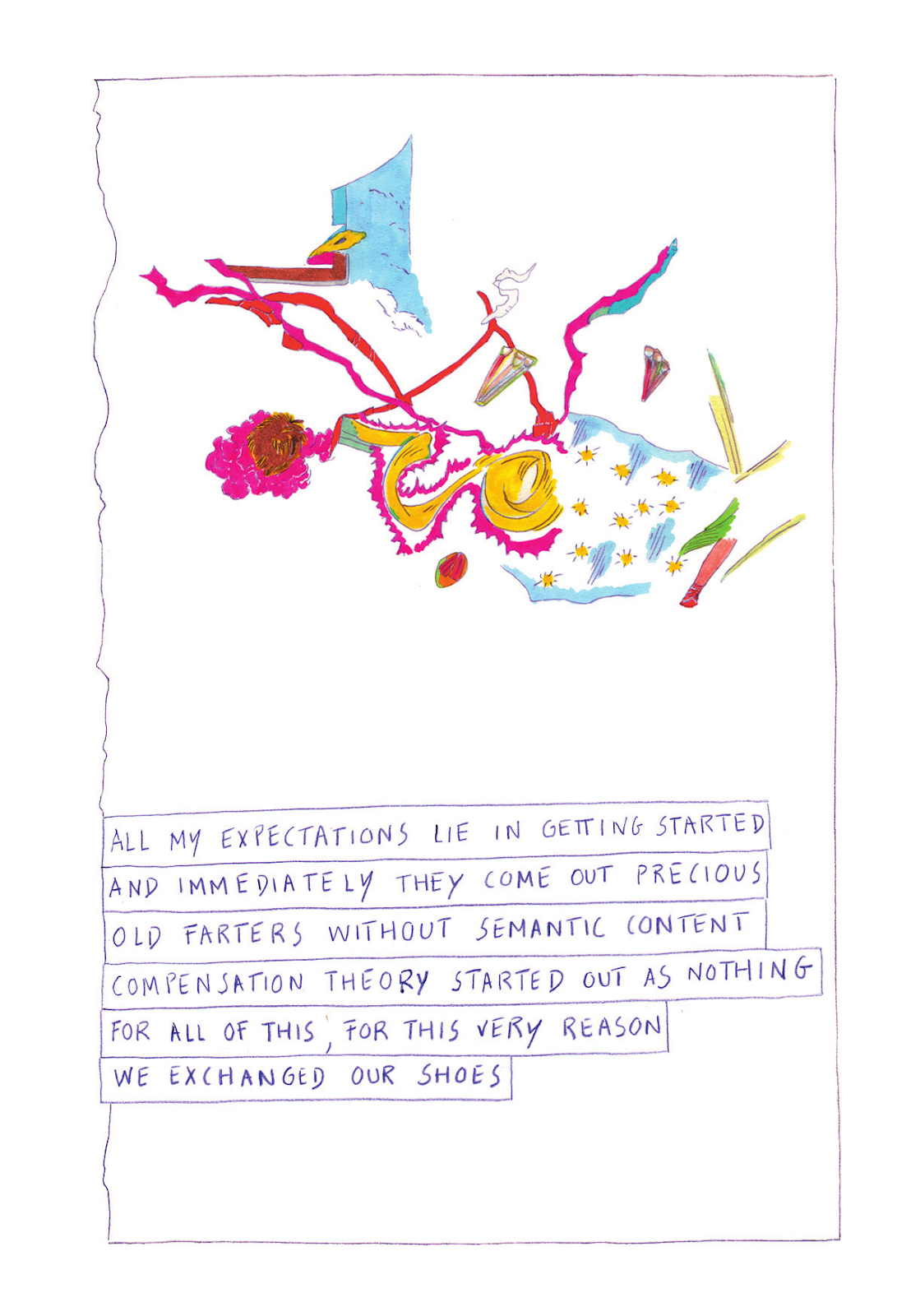
Definitions of art abound and yet, ultimately, most of us bottom out on the same Hustler-esque take: “I know it when I see it.” Yet there is some set of similarly-oriented intuitions clustered together in our respective psychologies and social spheres that dispose us to ascent easily to particular works as art, while simultaneously writing off a good chunk of the contemporary work being done. Ironically, a lot of modern art exists to challenge the autopilot that comprises our typical aesthetic experience, which is very often defined by an experience of beauty that requires very little from the viewer. Dada is anti-art for this very reason: just because we are disposed one way does not mean fine work cannot exist outside of a given aesthetic area. If our conceptions about art exist essentially unchallenged, then what better way to stoke introspection about art than with art itself.

And then what about our conception of comics?

Scott McCloud thinks they’re narrative pictures, with or without text to help. R.C. Harvey thinks the interplay between text and picture is essential. Kurt Busiek... tweets stuff.  

I don’t think focusing on a definition necessarily begets prescriptivism. Understanding the things essential to any given medium allows for a fuller understanding of one’s work within that medium. Additionally, it doesn’t seem all that misleading to talk about comics as if they are sequences of images that hang together in order to evoke a specific sort of emergent meaning.  Deconstructing comics, then, means not just taking apart our conceptions of beauty or of the order internal to a given work; it means dismantling the links between many individual pieces. Dada comics thus make the images tenuous representers of things in the world while simultaneously being tenuously connected to each other.

When comics and dada collide, the semantic and conceptual distance between the individual emotional need to grasp things and the broader societal habit of over-taxonomizing ways of thinking is shrunk to the width of a grain of rice and thrown under a microscope. A confrontation with the narrative autopilot that most sequential images force us into on a subconscious level immediately yields heavy scrutiny.

Like any good anthology, š! #26 gets off to a strong start with the first page of Maija Kurseva’s aptly-titled “Manifest” reading “THERE IS NO ULTIMATE TRUTH” as its header. Dadaists don’t have a monopoly on this, of course (American Pragmatists are fond of saying that there’s no capital ’T’ truth; one Pragmatist even makes an appearance in this book), but it’s a shot across the bow in terms of tone and stated aim.  Kurseva sets off representational sparks in the reader, allows them to fizzle before they spin into a narrative, and repeats. There is a unity of purpose and tone, and the reader is left wondering… “how?”
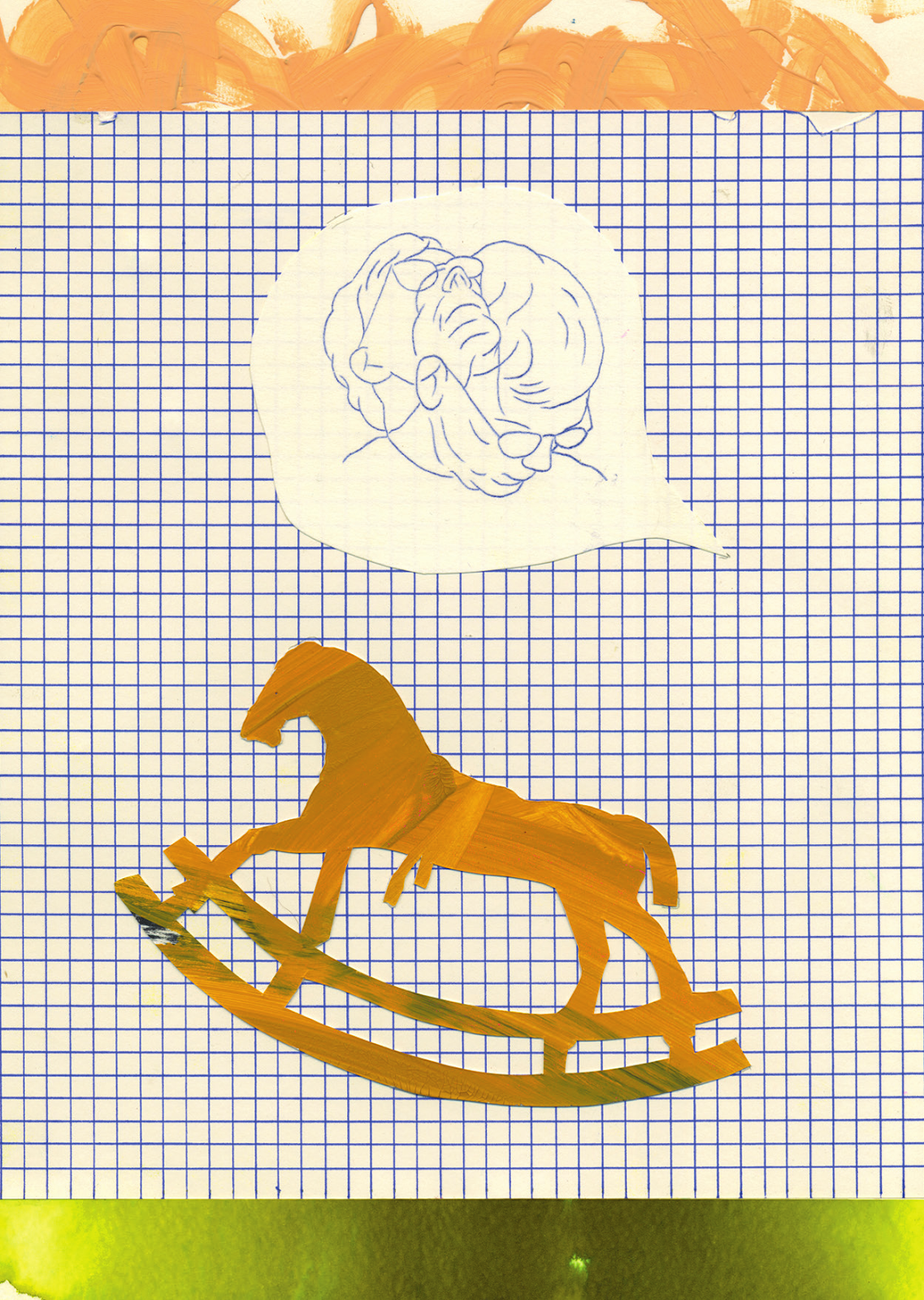
Kurseva’s comic is a beautiful, sometimes wordless ode to the best of what you can achieve with abstract juxtaposition in the comics form. A man nods in a speech bubble above the image of a rocking horse. A figure uses calipers to precisely measure one of several amorphous blobs. These not-narrative elements are hammered home because they are collaged. The fact that the elements on the page each have their own visible feel--that they each have prominent, raised, physical presence on the page--makes the juxtaposition of the elements feel tangible. These pages have subjects, and yet we as readers watch Kurseva’s pages diverge conceptually, failing to elicit meanings in the juxtapositions, even as those juxtapositions weigh heavier on each page.

Despite dada’s protest, Kurseva’s work is consistent with how I think we can understand the most challenging work being done today: it boils down to ambience. The best stuff coming out of small press publishers to the latest work of Jillian Tamaki takes our sense of a narrative woven from images and stretches out our semiotic faculty. We are forced to try and embrace--literally, hug together--a syntax hanging sporadically, leagues apart, between the images and words. In this space, via this space, meaning is augmented, warped, and thus composed in a way only comics can manage. Movies come close with their superior ability to stretch out the juxtaposition of images, but only comics let you go at your own pace and put it all on simmer, while somehow still feeling pulled to that next page turn.
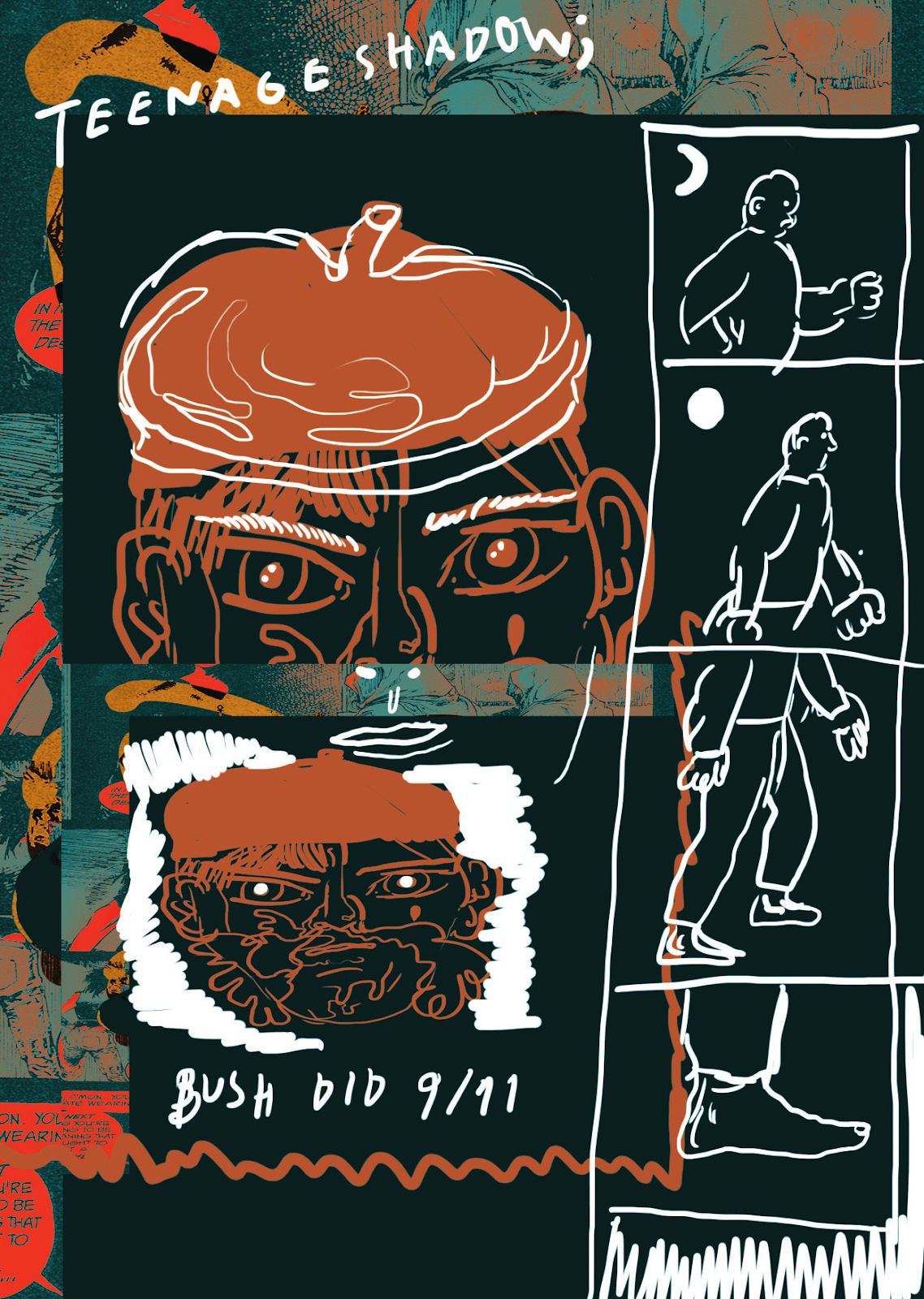


Jaakko Pallasvuo’s contribution to š! #26 inspires much more alarming, visceral reactions than his peers. As you navigate the pages of “Fables and Reflections”, it is immediately apparent how the goal of each page is to make you comfortable or uncomfortable in a distinct way, only to wrest that feeling from your mind’s grasp one page later. He starts by inverting the colors of an existing comic that he did not draw, and then stripping out everything but the black and white tones. Over this he mixes freehand drawing and uncomfortable flower collaging that varies in opacity. Other than when the borrowed comic later returns, the story is a mess of random prose and panels strewn about. Any time he deploys any of these features, he immediately switches gears, not allowing even comfort in modes of discomfort.

Pallasvuo's work here is a good approximation of the anthology itself: at its best, it confounds in ways inherent to the medium, turning juxtaposition in on itself and adding layers where it seems like there should not be any; at its worst, it throws shit at a wall to see what sticks... and not much does. While it makes sense for a dada comic not to run too far with any given structure, each page of this comic feels like it’s from a different planet, and after a few pages, I don’t know why I’m making the trip anymore.

How can we find value in the medium if not through narrative? I can think of several ways, and so can this anthology, which fluctuates wildly in its response to the question. Sometimes, the answer is straight-up eyeballing the medium itself.
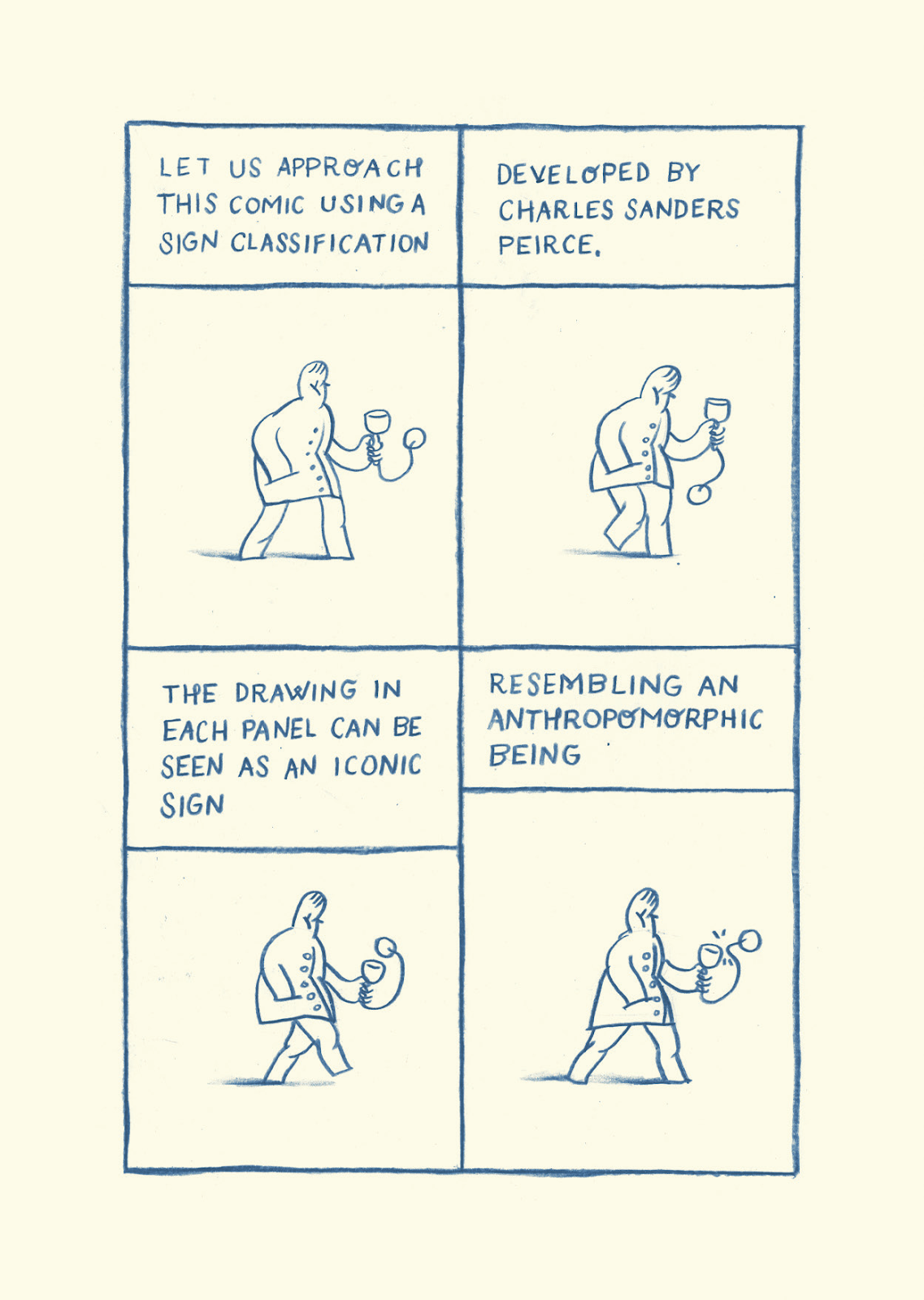
Martins Zutis does this in "Cup and Ball" when he more-or-less carries out a comic in which he describes the comic itself as the comic goes. Zutis leans into a slightly more technical impression of Scott McCloud as he explains the way in which each individual comic panel evinces meaning as an iconic sign.  The more this one sat with me, the more impressed I was: Zutis drives a narrative with a description of the narrative itself. After talking about things that do not resemble that which they represent (like words), he explains how he sees a few of his drawings as embodying a particular metaphor, which is itself the abstract embodiment of meaning through resemblance. None of his observations about the form are novel or earth-shattering, but, like his line, his execution is delicate, making for a subtle meditation on the form composed with the form itself.
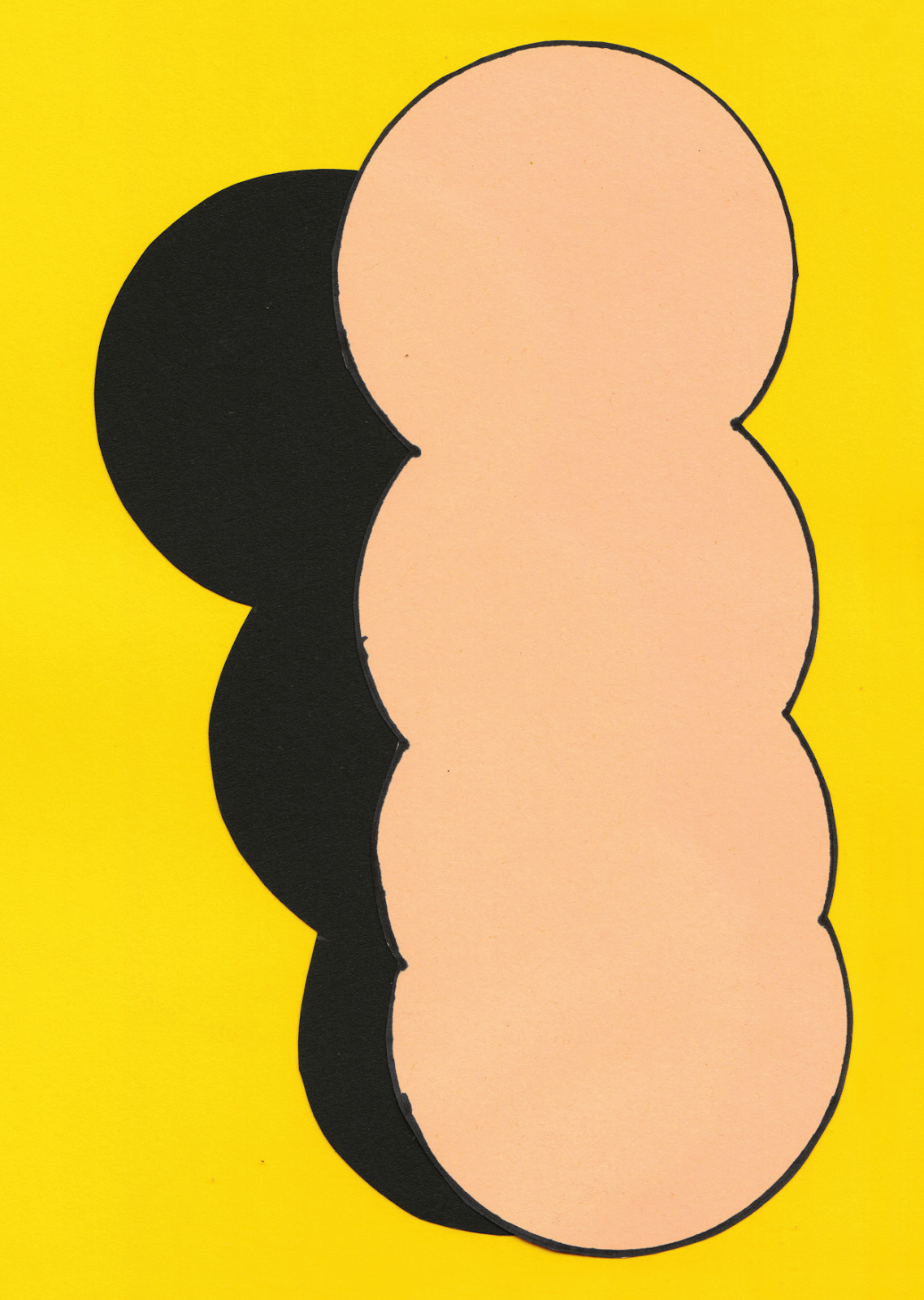
Other times, š! #26 answers the challenge of building substantial comics without narrative by scaffolding pages with colors and lines, but not together: each page alternates meat and bones.  Dunja Jankovic's "A Conversation Between Black and White" is an infuriating distillation of all of the basic visual elements of comics. Here contrast is literal: one page has color, another has black and white, and only black and white. Lines come together to form shapes on one page, and then run exclusively against each other in specific directions on the next. As a reader, it's worth trying to figure out what's being asked of me when I'm faced with this kind of work. I am more likely to believe that this is a series of consecutive illustrations than a comic. While that says almost as much about me as it does about the work, if you ask someone in enough ways "what is the point of this?" eventually you will hear, "I don't know."

Imagine stringing a series of Rothkos together and being told it was a comic. Surely it isn't true just because somebody says so, but think about what the experience would be like if you knew very little about Rothko's work. That which can be impactful standing on its own is asked to carry a different semiotic burden when placed next to other images intentionally, as part of a whole greater than itself. What, then, are we as readers to make of a work that exists to undercut itself? How can it extend or inform our experience of the world if all of its energy is focused inward, with its syntax collapsing like a dying star?
Still yet other times, š! #26's answer to value is to embrace narrative, albeit it in ways that acknowledge that the narrative itself is not inherently useful. The very idea that "good" comics stand opposed to the more confounding ones by virtue of having tidy narratives is directly challenged by work's like Burkholder's "Meet Da Blee" which hinges on one single gag and beats both the reader and Blee himself to death with it. Fritz's "An Alert and Knowledgeable Citizenry" has a rhythm to it and a singularity to its imagery that is hard not to enjoy. Sammy Stein’s “End of Dada” presents its narrative objects in such a sterile fashion as to appear like it belongs in an inflight instruction manual, synthesizing elements of nature and artifice, yet making both feel foreign.
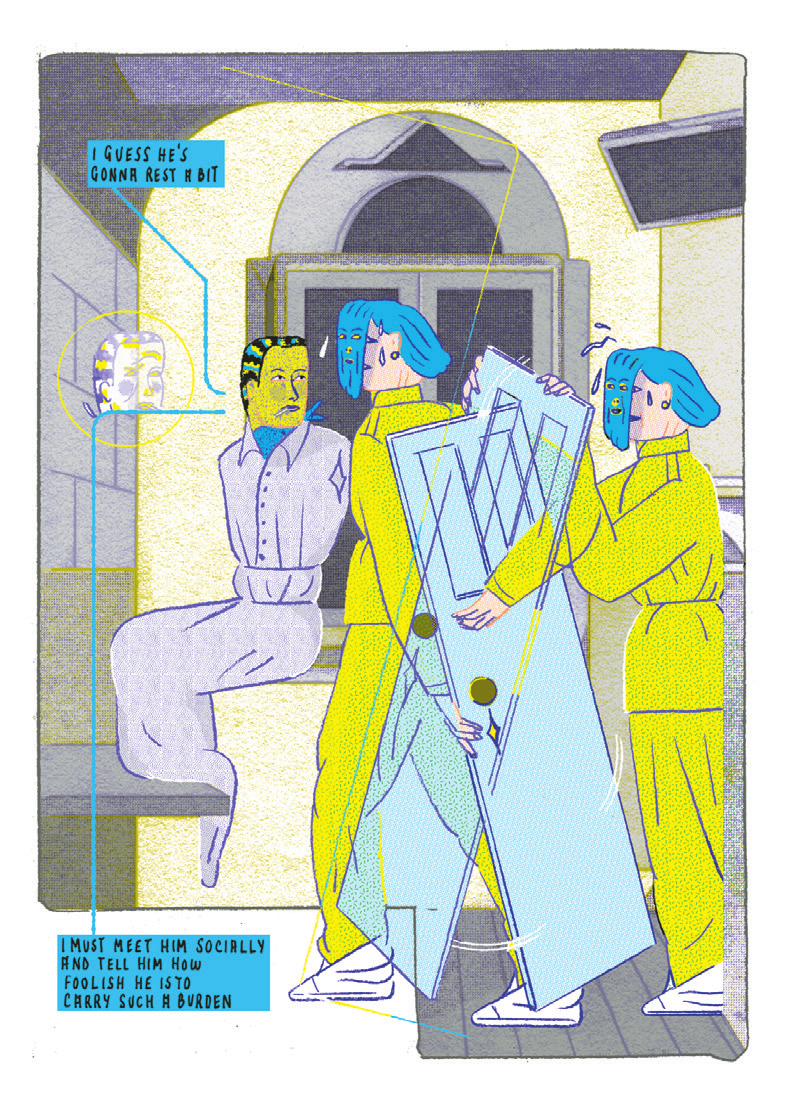
Daniel Lima scratches our itch for narrative by experimenting with time by using space, all driven heavily by a strong color identity and striking design. What’s notable about “What is a Door, Properly Speaking?” is that, in terms of dialogue, it is a word-for-word remake of this Krazy Kat strip. Lima took this already surrealistic scene in which Krazy ponders why door mouse carries a door around and injected surrealism into the very fiber of a comic’s structure.  In the original strip, backgrounds constantly change, and yet Lima heightens the visual surrealism by carrying out this cubist waltz in a single confined space in which only objects in the foreground move, and almost always in unexpected ways.

It is hard to capture the breadth of ways in which this particular edition of š! chose to challenge readers. While individual comics shine, the nature of all of this work qua Dada is meant to be oil to the water that is a cohesive reading experience. The emulsification of the work largely depends on the reader’s patience and willingness to come at the anthology from an angle that works for them. Initially, I felt like I was fighting pretty hard just to get some semblance of a holistic take on the book. It was only on my third or fourth time through that I started to appreciate a scattering of choices made by specific artists, and those choices helped illuminate more obtuse work throughout the book.

Eventually, I realized that this is actually how I read all anthologies, and not just the ones where a stack of milk cartons in a giant tube sock is getting laid. Where I originally took the question at the core of this book to be, “how can we find value in comics without narrative?” a more true-to-dada question that readers will arrive at, allowing for some patience, is “how can we talk more organically about the space between what’s on the page and how we make it work in our heads?” Narrative, where it emerges in most comics, is just one way that sequences of images can connect with people. It is linguistic in a rigorous sense, which also means that it tends to be one of the least interesting ways a comic can connect with us, since it requires no effort on the reader’s part.

Of course, even when a work is driven by narrative, there is still much more going on between the work and the reader than meets the eye, if only they allow themselves the time to marinate in that space between the them and the work. Challenging work makes it easier to enter that space, but it is also quicker to frustrate readers. Pushing through that frustration doesn’t mean assenting to the excellence of all abstract art. Instead, it means the difference between merely pointing at artwork and having an intellectual and emotional dialogue with it, even if the only fucking thing it says back is “dada.”


Austin Lanari is a programmer by day and a writer by day also. He likes to sleep at night. He’s got a master’s in Philosophy and he’s gainfully employed, so shut up. You can find his writing on Comics Bulletin, Loser City, Comic Bastards, and mostly these days on his own site at . Follow him on Twitter .


October 8, 2017

ICYMI -- Small Press Comics Criticism and Whatnot for 10/2/17 to 10/8/17

Highlighting some great small press comics criticism being published, as well as other random things that have caught my eye over the past week.

COMICS CRITICISM

* Dominic Umile on TENEMENTS, TOWERS, AND TRASH by Julia Wertz the pages of which are "an almost painful exercise in their portrayal of how rapidly our beloved buildings are altered irrevocably, bulldozed, or just left to fall into disrepair."

* John Seven reviews JOHNNY APPLESEED by Paul Buhle and Noah Van Sciver, a book that "becomes less a standard biography of a man -- though it most certainly is in parts -- and more a poem on the nature of America and the relationship between landscape and philosophy, with Johnny Appleseed as the manifested point of union between the intangible and the manifest." (Nice bit of writing there, Seven)

* Alex Hoffman has been struggling with the concept of the graphic memoir lately (I've been having the same experience, though for different reasons -- more on that later this week, hopefully), and that struggle informs his reviews of both Tillie Walden's SPINNING and POPPIES OF IRAQ by Brigitte Findakly and Lewis Trondheim.

* Henry Chamberlain on the Ben Katchor edited THE BEST AMERICAN COMICS 2017 and celebrates and takes to task all that it implies. Chamberlain also interviews BEN KATCHOR (which, I know, should be in the "WHATNOT" section according to the totally arbitrary rules I've set up for myself, but sometimes my OCD won't allow me to do anything but make little "packages" like this).

* Lucy Bourton introduces me (and, perhaps, you) to the comics of MARIA MEDEM, and I, for one, am so glad for the introduction. The images that Bourton puts in this piece are amazing.

* Ryan Sands writes a few quick takes on some of the books he picked up at SPX 2017.

* Phillipe LeBlanc proves once again that Canadians have more patience and wherewithal than most other people by posting his extensive list of nice art, plugs, news, congratulations, releases, and reviews in his SMALL PRESS AND INDIE COMICS GALORE post over on The Beat.

* Finally, because he was kind enough to reach out to me last week when I was in the midst of all that I was buried under, I'd like to draw your attention to Ryan C.'s Four Color Apocolypse site, especially his READING ROUND-UP because he looks at some great books and writes well about them.


WHATNOT

* If the ability to conduct great interviews were a currency, then Jason Sacks would be a millionaire. Check out his interviews with TILLE WALDEN and ALEX ALICE to see what I mean.

* Phillipe LeBlanc talks to NATALIE ANDREWSON about Risography and Fairy Tales.

* Kat Overland and a group of WWAC writers talk about their experience at and share their thoughts about DRAGON CON 2017.

* Alex Mansfield's WHAT MAKES A GOOD COMIC BOOK COVER?

* Elkin Obsession Tickled Alert: Paul Berman's WHITMAN AND THE AMERICAN REVELATION. 

* Nick Ripatrazone's has this list of eight "notable" books in his MUST READ POETRY: OCTOBER 2017 column (I like to think they are "notable" insofar as there are places that still publish poetry). 

* Jamelle Bouie's WE MADE TA-NEHISI COATES INTO A SYMBOL.

* And, finally, go read THIS.

September 24, 2017

ICYMI -- Small Press Comics Criticism and Whatnot for 9/18/17 to 9/24/17

Highlighting some great small press comics criticism being published, as well as other random things that have caught my eye over the past week.

COMICS CRITICISM

* JA Micheline uses her interview with Tillie Walden as a springboard into a review of Walden's new book, SPINNING, as well as a discussion of her work rituals and her interest in structure. It's a short piece, but it stands as a testament to why JAM is one of the best critics in the business. 

* Andy Oliver reviews Katie Skelly's MY PRETTY VAMPIRE which "can be interpreted as both a story representing individual freedom and release and one with a far broader allegorical meaning in terms of social commentary."

* Kim O'Connor explores PORTRAIT by Simon Hanselmann and writes, "The thing is, in a  culture where everything is both universally known and impossibly obscure -- as it is on the Internet, as it is in indie comics -- a lot of stuff becomes plausibly deniable when your preferred mode of talking shit is encrypted." 

* Robert Kirby reviews Hannah K. Lee's LANGUAGE BARRIER, writing "With her decoded, beautifully visualized language, Lee communicates a memorably funny, insightful and humane statement about the times in which we live and our often flailing efforts at connection." Sounds like the perfect book for me.

* Henry Chamberlain takes a casual and breezy look at DARK SIDE OF THE MOON by Blutch, eventually calling it "an utterly mesmerizing work."

* John Seven reviews Ulli Lust's VOICES IN THE DARK, a book that is "Just straightforward with enough delicacy that it takes pity on the reader for having to endure what it is showing us."

* Over on Comicon.com, I wrote two new reviews of books I picked up at SPX this year. First is STAGES OF ROT by Linnea Sterte. Next is BODY MAGIK by Scott Roberts.

WHATNOT

* Paul Lai interviews comics poet and editor of InkBrick, PAUL K. TUNIS about comics poetry. This is a pretty great conversation.

* Alex Dueben interviews ELI VALLEY about his book Diaspora Boy.

* Kat Overland writes about celebrating diversity and community in her look back at the 2017 IGNATZ AWARDS.

* Alex Hoffman takes a look back at his SPX 2017 experience with THE FAMILY YOU CHOOSE.

* Rob Clough shares his REFLECTIONS ON SPX 2017.

* Kyle Pinion shares his haul in his piece ALL THE WONDERFUL THINGS I BOUGHT AT SPX THIS YEAR.

* Heidi MacDonald shares her particular thoughts on SPX 2017 as well, calling it THE YEAR OF GETTING WOKE.

* Nick Hanover's DEVIN FARACI AND THE COST OF UNEARNED SECOND CHANCES is one of those incredibly well-written articles about a complex situation that boils it down in a way that leaves you with your blood boiling.

* The new SHORTBOX is available for order!

* Giles Scott's HIGH SCHOOL READING AS AN ACT OF MEANINGFUL AGGRESSION.

September 22, 2017

Review: BODY MAGIK by Scott Roberts

I review 
BODY MAGIK
by Scott Roberts


Roberts trusts his readers to let the experience happen. As his art causes you to disjoint and disconnect from all that you know, it also forces you to examine that which is left behind. In that way, body magik once again demonstrates the importance of art and the inviolability of the dynamic between the artist and their audience.

September 21, 2017

Review: Linnea Sterte’s STAGES OF ROT

Starting to go through the books I came home with from SPX.
Starting with 
STAGES OF ROT
by Linnea Sterte
published by Peow Studios


And yet all the life that teems in the context of death, the symbiosis between rot and growth, saturates still. Sterte adds peace to violence, understanding that all things rise and fall only to keep the process intact. What strikes us as a sudden departure is only the beginning of yet another interwoven circle. Perhaps this provides some small comfort. Perhaps it doesn’t matter. After all, even amongst all the discord there is the complexity of beauty. On every page of this stunning book, we find the orbicular drama of life, death, rot, life sublimely rendered.