Showing posts with label Francesca Lyn. Show all posts

December 13, 2018

BOOKS WE LIKED 2018: Francesca Lyn, David Fairbanks, Kawai Shen, and Josh Hicks

It’s the most wonderful time of the year. That’s right -- it’s BEST OF season when comic sites large and small churn out their lists, anointing subjective BESTS and, thereby, relegating thousands upon thousands of unlisted comics to the long box of Misfit Toys.

We here at Your Chicken Enemy are uncomfortable with these implications of creating BEST OF lists. Instead, we focus on celebrating ALL that is good in small press/self-published comics. Our site is built on an appreciation for diversity, admiration of artists, respect for the craft, and, of course, sandwiches.  

So, in lieu of the traditional BEST OF list, Publisher and EiC of YCE, Daniel Elkin, has gathered his flock of (Chicken) Enemies and asked them for their contributions to Your Chicken Enemy’s inaugural
Today’s BOOKS WE LIKED 2018 features books liked by Francesca Lyn, David Fairbanks, Kawai Shen, and Josh Hicks

Make sure to check out Wednesday's Favorites from Nick Hanover, Sara L. Jewell, Jason Sacks, and Mark Stack

Tuesday's Favorites from Ryan Carey, Philippe LeBlanc, Steve Morris, and Austin Lanari.

And Monday's Favorites from Rob Clough, Kim Jooha, Alex Hoffman, and Keith Silva.

Francesca Lyn:
Where Do You Go At Night?
by Miranda Harmon
Self-Published
More Information HERE

Where Do You Go At Night? is a charming, self-published 28-page collection of short autobiographical comics that center on Harmon’s move to Southern California. This is a humorous and sensitive comic from a cartoonist that radiates talent. Harmon, a graduate of the Sequential Arts Workshop (SAW), is a gifted storyteller who perfectly captures the daunting and exhilarating feeling of moving to a new place. In the comic, Harmon explores her new home, going on bad dates, making new friends, and pondering what it means to grow and change. Her strong drawing skills are revealed in her thoughtful character design and the care in which she renders her environments. In addition to a dose of whimsy, Harmon’s comics have a touch of the surreal. Whether she depicts herself as a human woman or as a busy cat going grocery shopping, her ability to communicate a nuanced mood shines through. I purchased this minicomic directly from Harmon at the Small Press Expo. At the time of this review Where Do You Go At Night? is out of print but will be reprinted next year. Several of Harmon’s other comics are available through Radiator Comics.

Battle Arc 2088
by Danny Djeljosevic (writer and letters) and Brett Marcus Cook (art)
Self-Published
Available HERE

Battle Arc 2088 is a tightly plotted comic set in a Day-Glo cyberpunk future. In this 40-page comic, Djeljosevic and Cook present a cautionary tale of what we may encounter when our biology becomes inextricably linked to proprietary technology. The story follows scientist turned crusader Zell as she navigates wearing a stolen experimental super suit called the Battle Arc. The suit allows Zell to fight people who have augmented her bodies through sophisticated biohacking. While Djeljosevic and Cook have created a fascinating future world where chaos rules, their biggest strength lies in creating a compelling protagonist with genuine pathos. Zell is a refreshingly heroic character with a strong moral compass. Her sincere desire to do what is right for all of humanity drives the story and this strong characterization adds heart and poignancy to what could have been a visually appealing but more general sci-fi story. I purchased Battle Arc 2088 by supporting the comic’s Kickstarter campaign, but it's now available on Gumroad for download.

David Fairbanks:
Did You See Me?
by Sophia Foster-Dimino
Published by ShortBox
Available HERE

The idea of a definitive, whole self has always been fantasy, but in 2018 we seem more capable than ever of fracturing, of presenting only select facets to select groups of people. Who are you on Twitter? On Facebook? At work? With your partner? When you dream? Where and in what ways do our collections of personae overlap, what does it mean to know someone, and what does it mean to be honest? These are heavy, complicated ideas that Foster-Dimino seems perfectly at home with. By using different styles for the waking world and the dream world, by presenting the spaces of Twitter and television via different layouts, she establishes firm boundaries between these areas, boundaries which are perfectly subverted by the narrative. 

On its surface, Did You See Me? is just a story about a person moving from one relationship to another, but the continued juxtaposition of uniform narrative and distinct artistic style begs the reader to question their own reality. What is a real relationship? Is a person being unfaithful if they dream about (or share dreams with) someone else? What if it feels like infidelity to the dreamer? How different is that dream space from the ether between two people's computer screens? Foster-Dimino encourages this kind of questioning in the reader while being brave enough to avoid offering a clear answer, which has left me thinking about Did You See Me? since it arrived in my mailbox earlier this year.

On a Sunbeam
by Tillie Walden
Published by Avery Hill Publishing
Available HERE

Yes, I am using the print publication of On a Sunbeam to justify mentioning it the year after it was finished. No, I do not feel guilty about finding a loophole to praise one of the best cartoonists working today. Tillie Walden has a knack for distilling emotion and expression into essential, smooth lines. Her faces are simple without sacrificing any human complexity. It may sound cold to describe it as "efficient," but I think it's apt. The style of Walden's characters allows the reader to quickly and easily read the human dynamics of a scene to then absorb her narrative, her worldbuilding, or even just her backgrounds.

While The End of Summer had its Little Nemo connection, On a Sunbeam more closely walks in the steps of Winsor McCay, with Walden giving herself permission to create and explore fantastical worlds unburdened by the small chunk of history we have carved out on Earth. Her limited color palettes somehow allow the comic to pop in a way that would be impossible with a full range, and they help clearly establish tone and time. It would be a joy simply to come along for the ride as Walden draws whatever world she sees fit, but the characters she gives us feel both familiar and wholly new. The relationships of a crew of scavengers/restorationists and a cadre of boarding school students would each be enough to carry a 500-page tome like On a Sunbeam, but here we get both as Walden weaves their timelines for a story of love and humanity that is epic in scope.

Kawai Shen:
Koreangry 3
By Eunsoo Jeong
Self-Published
More Information HERE

Koreangry 3 is the third issue of the Koreangry series, a self-published comic by Eunsoo Jeong. It features a series of photographs of a plasticine-like version of the author, bug-eyed with cartoonish foam hair, a crooked tooth, and a pair of irate, bushy brows furrowed into an acute “v”. Jeong then poses her model in miniature dioramas full of the most fantastic, tiny props: beer bottles on her bedside table, a basket full of Korean spa toiletries, a pot of a dead plant in her office, its leaves scattered on the floor.

True to its title, in a mere 24 pages, Jeong delivers a torrent of expletive-laden rants on weighty topics such as sexism, racism, work precarity, and anti-immigration in the US. Jeong's depictions of herself as outlandish and unfeminine are refreshing because she is never self-deprecating and has a great sense of comedic timing. The entire series is recommended.

YOU DON'T HAVE TO BE AFRAID OF ME
By Victor Martins
Self-Published
Available HERE

Victor Martins' You Don't Have to Be Afraid of Me is a self-published, two-color riso, autobio comic. It employs a disarmingly cute cartooning style to Trojan-Horse you right into Martins' personal experiences in overcoming gender dysphoria, gendered violence, and self-harm.

Despite the comic's brevity, it manages to pack in a powerful mix of cultural critique, vulnerability, and a touch of humor. Do not be fooled by the simplicity of Martins' drawings. His economical linework is precise and his figures expressive. His use of text is also disarmingly casual, only to be deployed on one page in a memorably graphic manner to devastating effect.

All in all, it's a very personal story that reminds me how the autobio genre in comics can convey an immediacy, intimacy, and vibrancy that cannot be found in other mediums. It also shows us that there are still vibrant, fresh narratives to be found in autobio work.

Josh Hicks:
Dark Angels of Darkness
by Al Gofa
Published by Peow Studio
Available HERE
Sweden’s Peow Studio always put out beautiful comics (I reviewed their Ripples here last year) and Dark Angels of Darkness is no different. Al Gofa’s macho wasteland punching epic follows military mastermind Megan, superspy Garo and killing expert Symba in their quest to overthrow the dictatorial Imperius Rhâââ, an all-powerful being who has imposed a law making the act of fusion -- two beings combining and becoming one -- punishable by instant death. Gofa’s writing is self-aware and knowingly goofy, stopping just short of full-on parody, and the fusion-based conceit gives ample opportunity for him to bombard us with new characters (each with their own full-page pin-ups) and excuses for fight scenes. Despite the homage-heavy premise (Gofa’s admitted touchstones of video games, 90s action figures, and 80s manga are all well served) Darkness’ sense of humour, expressive brush lines and lush colouring -- all yellows, oranges, and purples -- make for a dynamic and fresh book that sits perfectly within Peow’s catalogue. The most metal comic I read this year!

Summer Break

by Lottie Pencheon
Published by ShortBox
Available HERE


Lottie Pencheon is making some of my favorite minicomics in the UK at the moment. A shift in tone from her shorter joke-driven work, Summer Break is a foray into heavier stuff, being explicitly autobiographical and dealing directly with depression, disassociation and a general, undiagnosable feeling of malaise. The book finds Lottie in the middle of a mental health crisis that she can’t begin to fathom or understand. Unsure as to whether her symptoms are indicative of larger issues or simply a vitamin B12 deficiency, she opts to continue with a planned family outing to the country -- where things only continue to get worse. The longer format allows Pencheon’s art pencils and colors really shine, and as Lottie’s mental state worsens, Pencheon’s world deteriorates with her: environments begin to fall apart, objects begin to trail, and interior discourses between two interior Lottie’s -- Summer Break’s equivalent of the classic angel and demon on the shoulder -- begin to erupt into chaos. Pencheon’s sense of humor and pure cartooning skill allow her to navigate the subject matter without veering into the self-exploitative or the twee, and it quickly becomes clear that Summer Break is a highly personal and cathartic work -- not to mention a compelling and affecting one.

Soft X-Ray/Mindhunters

by A. Degen

Published by Koyama Press
Available HERE


A. Degen is a weirdly formative figure in my comics reading and practice. His story in Snake Bomb Comix #2 was one of the first small press comics I ever read, and as a result, I feel almost genetically predisposed to like anything he puts out. Like much of his previous work, Soft X-Ray/Mindhunters is wordless, telling two stories — Mindhunters, about a pair of masked brain-based vigilantes, and Soft X-Ray, about a group of abstract god-beings — in tandem, using images alone. Degen tends to maintain an obscure bedrock of esoteric philosophical, religious and literary thought underneath what are essentially poppy and colorful sci-fi stories, and that continues here. He made his first work while living in Japan, and pop-art flavours of Tadanori Yokoo illustration, Sasaki Maki comics, and children’s live-action tokusatsu programming run throughout the book -- belying many of his more academic influences (i.e: the ones I am too stupid to ‘get’ without using google) -- while his clear line, detailed environments, and emphasis on purely visual storytelling work together to provide a lush, dense and satisfying read. In turns funny, dramatic, mysterious and incomprehensible, Soft X-Ray/Mindhunters is Degen’s most ambitious book to date and a comic that I fully recommend.

July 16, 2018

A Pattern Language: Francesca Lyn on Identity, Ephemera, and Nostalgia in Whit Taylor’s WALLPAPER

In 2015 it was announced that actor Lupita Nyong’o would play a character in Star Wars: The Force Awakens. Nyong’o, best known for her Academy Award-winning role as an enslaved woman named Patsey in 12 Years a Slave (2013), would portray Maz Kanata, a CGI character, through voice and motion capture. Some fans of Nyong’o were upset that she would not actually be visible onscreen, citing the pervasive lack of representation of black women in film, particularly in fantasy or science fiction. However, Nyong’o’s reasoning for taking the role was outlined in an interview done by Buzzfeed News, claiming that there was  “a liberation in being able to play in a medium where my body was not the thing in question.” Though Nyong’o may have been simply tired of being scrutinized, her reasons for taking the role of Maz Kanata to resonate with a hopeful possibility and suggest a desire to take a more expansive view of how black women can be depicted. In 12 Years a Slave,  Nyong’o’s role is one of significant physicality - Patsey is continually abused, raped, and brutally beaten. By playing Maz Kanata, Nyong’o was trying to escape the hypervisibility of Black womanhood. Nyong’o’s reasoning is one of creative resistance that strategically stresses the possibilities of black women on the screen.

Similarly, themes of liberation and possibility are prevalent in the work of cartoonist Whit Taylor. Taylor, a black cartoonist and health educator, frequently engages with issues of race and identity. In “Finding Your Roots,” a webcomic published by The Nib, Taylor explores race and identity through the hairstyle choices of black women. Taylor centers her comic on her experience transitioning from chemically straightened hair to learning how to embrace her hair’s natural texture. She has also collaborated with fellow cartoonist Chris Kindred on the nonfiction comic “African-Americans Are More Likely to Distrust the Medical System. Blame the Tuskegee Experiment.” Published by The Nib on February 26, 2018, this comic presents the history of the Tuskegee Experiment, a clinical study conducted between 1932 and 1972 by the U.S. Public Health Service where black men were infected with syphilis without their knowledge. Kindred and Taylor outline the study and its aftermath, emphasizing it’s unethical nature and lasting impact on the black community. 

Taylor is very aware of how race and representation factor into her life and art. In a 2015 interview with Artworks Blog, she stated, “In my work, I explore issues of identity frequently. Being a black woman, issues of race and gender are things that I find myself coming back to because they have and continue to shape who I am and how I perceive the world.” 

Using varying degrees of representation, Taylor strategically makes blackness absent and present, engaging with what scholar Deborah Whaley refers to as an “affective progression of blackness” - embedding and layering images to create meaning. This is significant because mainstream media culture still predominantly presents whiteness as the default. Characters are usually thought of as white unless described otherwise. 
In her 2016 book Wallpaper, Taylor does not directly code the protagonist as black. Though told in a confessional, almost diary-like style, Wallpaper is not an explicitly autobiographical work. However, the unnamed protagonist does share some similarities with her creator. For example, Taylor is also from New Jersey and has a brother. However, this omission should not be dismissed as an oversight. Taylor’s past work indicates that she is obviously well-versed in racial politics.  Watermelon...And Other Things That Make Me Uncomfortable As a Black Person (2011) is an autobiographical work that directly addresses and challenges stereotypes Taylor and other black people have experienced. Wallpaper, though, might seem like a departure in both format and content. 

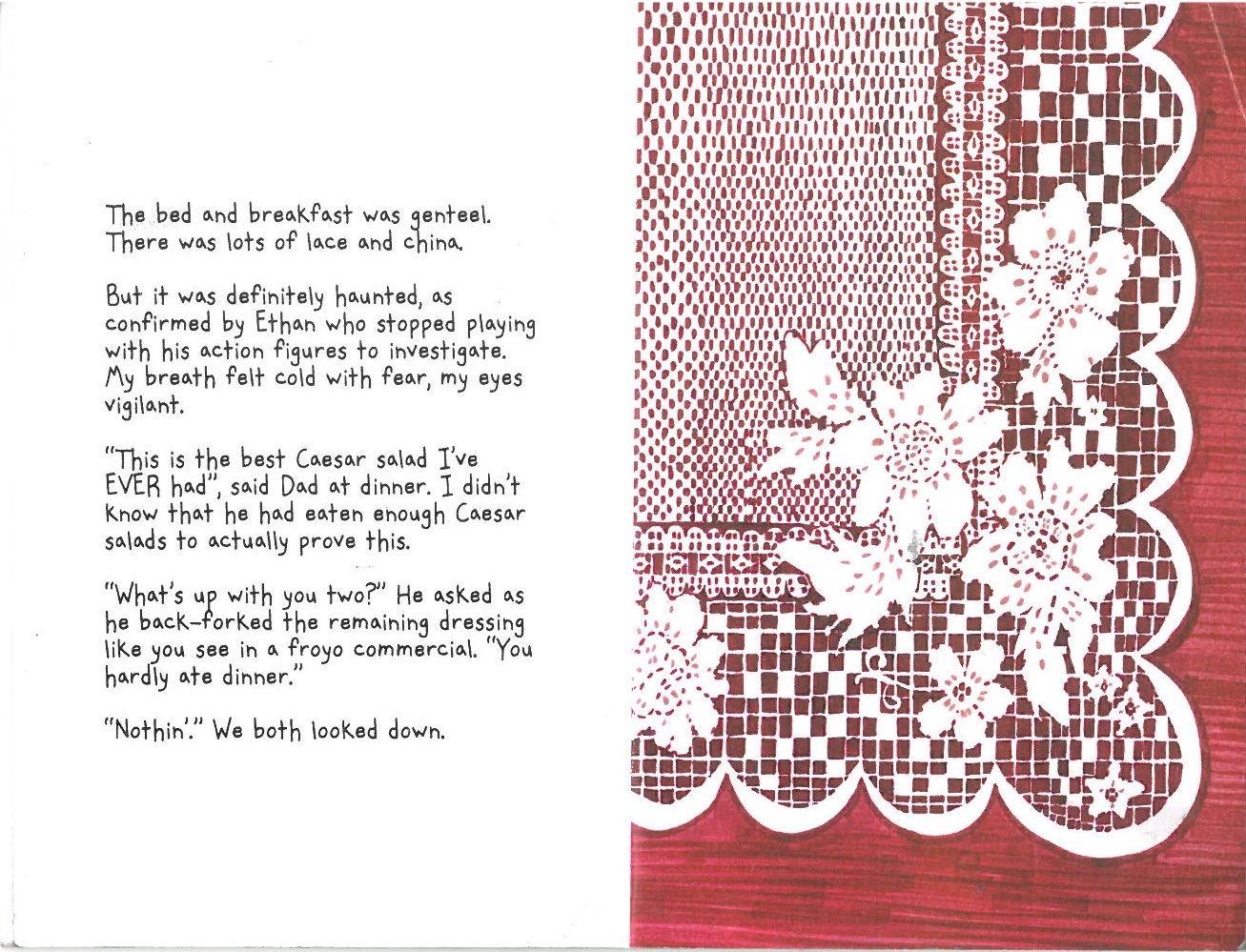
Taylor’s Wallpaper is a meditative, conceptual comic that uses patterns and abstraction for narrative starting points. Wallpaper is notable for its particularly intimate presentation; it is small even by the standards of a minicomic. The cover of the comic depicts a pink and green pattern that is bordered by a striped, repeated delicate floral motif. This unapologetically decorative, feminine cover combined with the small format of the comic makes you feel like you have stumbled upon something secret and precious. 

Beyond its small, intimate format, Wallpaper breaks a lot of rules and common expectations of cartooning. It has no panels. Words and images are never presented on the same page. Rather, the left spread contains the narrative text and the right contains a full-bleed drawing of a significant pattern or texture. In Wallpaper, these everyday patterns are used as starting points for the protagonist’s musings. This narrative has the effect of contemplative remembrances, evoking a strong sense of nostalgia in the reader. 
Taylor has used unconventional compositional strategies in other comics. For instance, Taylor’s comic “Alternatives to Avocado Toast for 2018” offers wry commentary on how we receive information from the news media. A creative interpretation on trends and the major events of 2017, this comic is arranged vertically with pieces of toast functioning as panels. By putting all of these ideas on toast, Taylor employs an absurdist sense of humor that emphasizes the strangeness of living in contemporary times. In this comic, reports on the use of fidget spinners, handheld devices meant to help people focus, are juxtaposed with stories on climate change. By putting all of these events and trends on toast, it appears to flatten them out and effectively starts to equalize them. Taylor also titles one toast “Escapism Toast.” This toast has a unicorn horn and a mermaid tail, linking these trends to nostalgia and the idea that millennials are turning to imagery from their childhood to provide comfort in an increasingly uncertain, chaotic world. 

Wallpaper, on the other hand, focuses on personal rather than collective nostalgia. The first pattern that the comic displays depicts white flowers with greenery against a brown background, representing the wallpaper in the kitchen. The narration on the facing page explains that the protagonist’s mother removed much of the house’s patterns, which were decorative choices by the previous owner. Subsequent patterns are derived from other pieces of the house - tile floors, examples of linoleum, and carpet. However, not every drawing is something that the protagonist physically encountered. One pattern depicts the lickable wallpaper from the film Willy Wonka and the Chocolate Factory. Taylor’s presentation results in flattening them out. By presenting them side by side, Taylor suggests that these fragments all seem to run together for the protagonist, with something remembered from a movie given equal weight to a “real” experience. 

Wallpaper progresses with the protagonist continuing to examine the patterns that surround her. We learn more about her family, including a visit to her grandmother’s house and a family vacation to Cape May. As Wallpaper progresses, it becomes apparent that the protagonist is documenting patterns that are disappearing from the house. There is a pervasive sense of loss throughout the piece; it is apparent that things are changing beyond home renovations. Her grandmother moves to an assisted living facility and is later hospitalized. 
    
First published in 1977, A Pattern Language: Towns, Buildings, Construction delineates structural patterns which are viewed as timeless entities. Written by Christopher Alexander, Sara Ishikawa, and Murray Silverstein of the Center for Environmental Structure of Berkeley, California, A Pattern Language attempts to put forth elegant solutions to problems regarding architecture, building, and community livability. It argues that, when considered together, these patterns form a sort of language for building and planning structures. The book itself is organized in a consistent format with a picture illustrating the pattern followed by a paragraph description.  While operating on a much smaller scale, Taylor also begins to create her own structural patterns that become language, organizing her comic in a way that more closely resembles fragmented memories. Like A Pattern Language, Taylor uses a consistent format throughout the comic. With the rigidity of this, Wallpaper becomes a microcosm that encapsulates the elliptical nature of difficult memories. Particularly traumatic memories may be virtually impossible to articulate. 

Wallpaper uses significant sensory memory, particularly descriptions of taste, to great effect. For instance, when the protagonist recalls dreaming about the edible wallpaper, she also mentions eating a Fruit Roll-Up for breakfast. Later, she describes the walls of the newly repainted den as being the color of Hershey’s chocolate bars and describes accidentally smearing some on a copy of Pride and Prejudice. In Wallpaper, the sweetness of these junk food treats contrast with the more somber mood of the narrative, giving them a cloying rather than indulgent connotation. When the family later goes out for pizza after seeing the grandmother in the hospital, it’s not an entirely unexpected that the protagonist is sick on the car ride back. 
Wallpaper concludes with the floral wallpaper in the kitchen getting replaced with beige paint. The protagonist has a strong reaction to this, getting upset with her mother and storming out. The last pattern in the comic is a scrap of wallpaper. The narration reveals that this scrap is actually from a dollhouse. The protagonist explains that she found the dollhouse and fixes it with help from her mom. This dollhouse wallpaper fragment is a fitting ending to a comic done on such a small scale. 

Just as A Pattern Language illustrates how simple structures can become components of complex networks, Wallpaper demonstrates how small moments and unanswered questions can have a powerful emotional resonance. Reading the protagonist as a black woman makes sense not only because of Taylor’s own racial identity, it also provides greater resonance as to why the comic is structured the way it is. Taylor does not depict any bodies, letting patterns and the words of the protagonist tell the entire story, creating a rhythm for the dissonance of trauma to reverberate against. Additionally, the black female body is not the focus here. We cannot scrutinize how she chose to depict the protagonist or if she resembles Taylor. Instead, we are given a story which subtly suggests that whiteness is not the default as it delicately limns the struggles of adolescence. 

---------------------------------------------------------------------------

Francesca Lyn is currently a doctoral candidate in Media, Art, and Text at Virginia Commonwealth University in Richmond, Virginia. Her dissertation “Graphic Intimacies: Identity, Humor, and Trauma in Autobiographical Comics by Women of Color” examines five texts by women of color written in the new millennium. She is interested in how autobiographical comics offer a new framework for exploring transgenerational trauma through the complex and intersecting themes of race and gender. She created and teaches the interdisciplinary courses  “Gender, Race, and Comics” and “Gender in Comics”. In these courses, students learn how to do comics research with special emphasis on utilizing VCU’s Comic Arts Collection. In her free time, she enjoys performing standup comedy and creating her own comics.